
The Problem Nobody Talks About
You Google your brand name and your website shows up. Great. But when someone asks Chat GPT “which digital marketing agency should I hire in Hyderabad,” your brand is nowhere. Gemini recommends your competitor. Perplexity pulls up a random directory listing. And you are sitting there wondering what went wrong.
This is the new visibility gap. And it is growing fast.
Most businesses are still playing the old SEO game, chasing page one rankings, building backlinks, tweaking meta tags. That stuff still matters. But the game has quietly shifted underneath everyone’s feet.
AI tools like ChatGPT, Gemini, and Perplexity are now the first stop for millions of people looking for recommendations, answers, and decisions. If your brand is not showing up in those conversations, you are losing business to brands that figured this out before you did AI Search Optimization
This guide will show you exactly how to fix that.
Table of Contents
ToggleQuick Answer AI Search Optimization
To get your brand mentioned by ChatGPT, Gemini, and Perplexity, you need to build what these AI systems trust: authoritative content, consistent brand mentions across the web, structured data, and a strong presence on platforms these tools actively crawl and reference. The brands AI recommends are not the most popular ones. They are the most well-documented, consistently cited, and clearly explained ones.
What Does It Mean to Get Mentioned by AI?
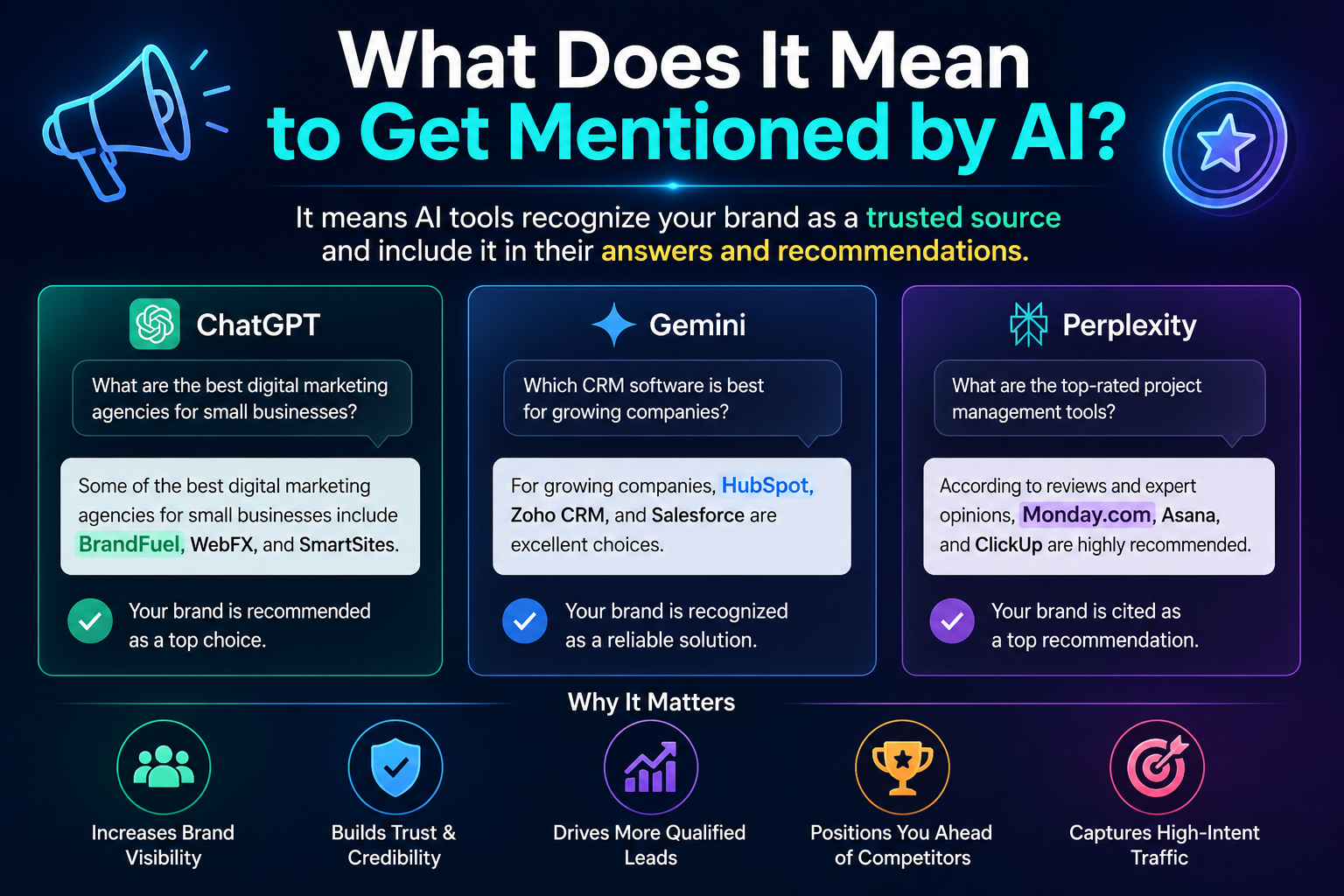
When someone asks an AI tool a question like “best hair restoration clinic in Hyderabad” or “top digital marketing agencies in India,” the AI pulls from its training data and live web sources to recommend specific brands, tools, or services.
Getting mentioned means your brand name, your services, and your expertise are part of the information these systems draw from when they generate answers.
It is not paid advertising. It is not a ranking algorithm you can hack. It is essentially earned authority, built over time through consistent, structured, and credible content that AI systems find easy to understand and trust.
Think of it this way. AI tools are reading the internet and summarizing what they find. If your brand shows up clearly and consistently in the right places, they will include you. If you barely exist beyond your own website, they will skip you entirely.
Why This Matters More Than You Think
Search behavior is changing. A lot of people, especially younger audiences and professionals, are skipping Google altogether for certain types of questions. They go straight to ChatGPT or Perplexity to get a recommendation. They want a direct answer, not a list of ten blue links to scroll through.
If your brand is not part of that answer, it simply does not exist in that moment.
Here is what makes this particularly important. AI tool mentions carry a level of implied trust. When Perplexity recommends a brand, the reader does not question it the way they might question an ad. It feels like a neutral, researched recommendation. That kind of credibility is hard to buy and very valuable when you have it.
Brands that invest in this now will have a serious advantage over the next two to three years as AI-assisted discovery becomes the dominant way people find businesses and make decisions.
The Complete Strategy: How to Get Your Brand Into AI Answers
Step 1: Build Content That Directly Answers Questions
What It Means
AI tools are fundamentally answer machines. They look for content that clearly and directly answers specific questions. The more your content matches the way people ask questions, the more likely it is to be pulled into AI responses.
Why It Matters
Chat GPT, Gemini, and Perplexity are trained on and actively crawl web content. They favor content that is structured, authoritative, and answers questions without making people dig. If your blog or website is full of vague brand storytelling and no concrete answers, AI systems have nothing useful to pull from it.
How To Do It
Write content in a question and answer format. Use FAQ sections on every major page. Create dedicated blog posts that target the exact questions your audience types into AI tools. Think “which is better for hair loss, PRP or hair transplant” or “how much does a hair patch cost in Hyderabad.”
Use clear headings, short paragraphs, and direct language. Write the answer first, then explain it. Do not bury the answer three paragraphs in.
Example
A hair restoration studio in Hyderabad that publishes a detailed blog titled “Hair Weaving vs Hair Bonding: Which One Lasts Longer and Costs Less” is giving AI tools exactly what they need. A clinic with only a homepage that says “we provide hair solutions” gives them nothing.
Pro Tip
Structure your FAQ sections using actual question formatting in your headings. “What is the cost of hair bonding in Hyderabad?” is more likely to get pulled by AI than “Hair Bonding Pricing.”
Step 2: Get Your Brand Cited Across Authoritative Platforms
What It Means
AI systems trust brands that show up consistently across multiple credible sources. A mention on your own website counts for very little in isolation. But when industry directories, news sites, review platforms, and other websites also mention your brand, that creates a pattern of credibility.
Why It Matters
Perplexity and Gemini actively crawl the live web. Chat GPT references content from its training data and increasingly from Bing search. If your brand only exists on your own website, these systems have little reason to surface you as a trusted recommendation.
How To Do It
Get listed on Google Business Profile, Justdial, Sulekha, IndiaMART, and any relevant industry directories. Reach out to local publications for features or mentions. Ask satisfied clients to write detailed reviews on Google and other platforms. Collaborate with other businesses or bloggers who can naturally mention your brand.
Publish guest articles on industry sites where you can be cited as an expert. The goal is a web of consistent, credible mentions that all point back to your brand as a real, trusted, operating business.
Example
A digital marketing agency that has been featured in a local business magazine article, listed across five directories, mentioned in three client case studies on LinkedIn, and cited in two guest blog posts on marketing websites is far more likely to be recommended by AI than an agency with only a website and a dormant social page.
Pro Tip
After every media mention or directory listing, create a short blog post or social post referencing it. This reinforces the signal and helps AI systems connect the dots across multiple sources.
Step 3: Use Structured Data and Schema Markup
What It Means
Schema markup is a piece of code you add to your website that helps search engines and AI tools understand what your business does, who it serves, and what makes it credible.
Why It Matters
AI systems are increasingly using structured data to quickly extract factual information about businesses. Schema helps your brand appear in knowledge panels, AI summaries, and structured search results. Without it, AI tools have to guess what your business does by reading your page copy. With it, you are telling them directly.
How To Do It
Add LocalBusiness schema if you are a local business. Add FAQPage schema to pages with FAQ sections. Use Organization schema on your homepage. Add Review schema where you display testimonials. If you have a specific service like hair replacement or digital marketing, use Service schema to clearly define what you offer.
Your developer or a decent WordPress plugin can handle this. It is not optional if you want AI visibility.
Example
A hair clinic that adds Local Business schema with their name, address, phone number, services offered, and operating hours is giving Gemini and Perplexity the exact structured information they need to mention the clinic confidently in local recommendation queries.
Pro Tip
Use Google’s Rich Results Test tool to check if your schema is implemented correctly. A schema error is worse than no schema because it can confuse the system entirely.
Step 4: Build a Strong Wikipedia and Wikidata Presence (Where Relevant)
What It Means
Wikipedia and Wikidata are two of the most trusted sources that AI systems reference heavily. A Wikipedia article or a Wikidata entity for your brand, founder, or business category signals real-world credibility at a very high level.
Why It Matters
ChatGPT was trained heavily on Wikipedia data. Gemini and other Google AI products use Google’s knowledge graph, which pulls significantly from Wikidata. A presence here is a direct signal of legitimacy.
if your business is large enough or notable enough, create or contribute to a Wikipedia article about your industry niche, your city’s business ecosystem, or your services. For most small businesses, getting mentioned within existing Wikipedia articles is more realistic than having a standalone page.
For Wikidata, you can create an entity for your business with verified information. This is more accessible than Wikipedia and has a direct impact on Google’s knowledge panel.
Example
A mid-sized hair restoration chain that gets mentioned in a Wikipedia article about hair replacement procedures in India, with a linked Wikidata entity confirming their operating details, is significantly more likely to appear in AI-generated recommendations than a comparable clinic with no presence there.
Pro Tip
Focus on being mentioned within existing Wikipedia articles first. Editors are less likely to delete a mention in an existing article than to remove a new article about a business they have not heard of.
Step 5: Publish Consistent, Experience-Driven Content
What It Means
Google’s EEAT principles, which stand for Experience, Expertise, Authoritativeness, and Trustworthiness, are the framework that both Google and AI systems use to evaluate how much a source should be trusted. AI tools are trained to favor content that demonstrates real-world experience.
Why It Matters
Generic content does not get recommended. Content that sounds like it comes from someone who has actually done the work, seen real results, and understands the nuances of a topic is far more valuable to AI systems and readers alike.
How To Do It
Write content from a first-person or experiential perspective where possible. Include real numbers, timelines, outcomes, and observations. Share case studies, before and after scenarios, client results, and practical insights that only someone in the industry would know.
Publish consistently. A brand with 80 well-written, experience-driven blog posts is more likely to be cited by AI than a brand with 5 polished but generic pages.
Example
A digital marketing agency that publishes a case study showing how they grew a hair clinic’s WhatsApp leads from 12 per month to 85 per month in 90 days using Meta Ads, complete with the actual strategy, the creative approach, and the results, is creating content that AI systems treat as high-authority reference material.
Pro Tip
Include specific names, locations, time periods, and numbers in your content. Vague content loses to specific content every time when it comes to AI trust signals.
Step 6: Optimize for Conversational and Long-Tail Queries
What It Means
People talk to AI tools the way they talk to a person. They use long, specific, conversational questions rather than short search queries. Your content needs to match this behavior.
Why It Matters
A page optimized for the keyword “hair transplant Hyderabad” will not perform as well in AI recommendations as a page that directly answers “is hair transplant safe for someone in their 20s in Hyderabad.” The conversational match is what AI systems look for.
How To Do It
Research the actual questions your audience asks. Use tools like AnswerThePublic, Google’s People Also Ask, or just pay attention to what your clients and prospects ask you in real conversations. Build your content around those exact questions.
Use natural language in your headings and subheadings. Write answers that are specific, direct, and useful within the first two to three sentences.
Example
Instead of writing a generic blog on “hair bonding services,” write a post titled “Is Hair Bonding a Good Option for Men with Thinning Hair in Their 30s?” and answer that question in detail. That is the kind of content Perplexity and ChatGPT pull from.
Pro Tip
Think about what someone would say to their friend before googling. That conversational phrasing is your content brief.
Common Mistakes Brands Make With AI Visibility
Only focusing on Google SEO. Traditional SEO and AI optimization overlap but they are not the same thing. A page that ranks on Google does not automatically get recommended by ChatGPT. You need to optimize for both, separately.
Having thin or vague content. AI systems avoid recommending sources that are unclear, promotional, or lacking in specific detail. If your website reads like a brochure, it will not get cited.
Ignoring third-party mentions. Your own website alone is not enough. You need consistent mentions across directories, review sites, and editorial content.
Publishing without structure. Content that lacks clear headings, direct answers, and logical flow is hard for AI to parse and use. Structure matters a lot more than most people realize.
Being inconsistent with brand information. If your business name, address, phone number, and service descriptions vary across platforms, AI systems get confused. Consistency is a trust signal.
Best Practices for Getting AI Mentions
Keep your brand information consistent across every platform. Same name, same address, same phone number everywhere.
Publish content regularly. Monthly at minimum. Weekly if you can manage it.
Focus on depth over frequency. One detailed, well-researched 2500-word post beats five thin 500-word posts every time.
Build relationships with journalists, bloggers, and industry publications that can mention your brand in credible editorial contexts.
Add FAQ sections to every service page and blog post.
Use schema markup across your entire website, not just the homepage.
Keep your Google Business Profile updated with fresh posts, photos, and responses to reviews.
Respond to every review, positive or negative. Active engagement is a trust signal.
Tools Worth Knowing
| Tool | What It Does | Best For |
|---|---|---|
| AnswerThePublic | Finds question-based search queries | Content ideation for conversational queries |
| Google Search Console | Shows how your content performs in search | Tracking impressions and click-through rates |
| Semrush or Ahrefs | Keyword and backlink research | Finding gaps in your content strategy |
| Schema Markup Validator | Tests your structured data | Ensuring schema is correctly implemented |
| Perplexity AI | AI search with cited sources | Testing whether your content gets cited |
| ChatGPT with Browsing | Live web-connected AI responses | Checking if your brand appears in AI answers |
| Mention.com | Brand mention tracking | Monitoring where your brand is being cited |
Real-Life Example: How One Marketing Agency Got AI Visibility
A digital marketing agency in Hyderabad had been running client campaigns for three years. Solid results, good reputation, but almost zero visibility in AI-generated recommendations. The challenge was that their website had five pages, minimal blog content, and almost no third-party mentions. When someone asked Chat GPT to recommend a digital marketing agency in Hyderabad, the agency was never mentioned.
They started publishing two detailed blog posts per month covering specific local business marketing challenges. They got listed on 12 directories. They published three case studies with real client results. They added schema markup to their website. One of their posts got referenced in a regional business publication.
Four months later, when tested on Perplexity and Bing AI, the agency started appearing in answers to queries about digital marketing services in Hyderabad. Not every time. But consistently enough that new prospects started saying they found them through an AI recommendation.
The traffic from AI-assisted discovery is still growing. They are ahead of 90 percent of their local competitors simply because they started early.
Expert Tips
Start by searching for your own brand and your competitors in Chat GPT, Gemini, and Perplexity right now. See what comes up. That gap between what you see and what you want to see is your roadmap.
Do not write for AI systems. Write for your actual audience first. AI systems trust content that humans find genuinely useful. When you serve the reader, the AI follows.
Treat your FAQ sections as seriously as your main page copy. That is often the most-cited section in AI responses.
Long-form content consistently outperforms short content for AI mentions. Depth signals expertise. Brevity signals a surface-level understanding.
Entity building is underrated. Every time your brand name is mentioned alongside your location, your service, and your industry in credible content, you are building an entity that AI systems can recognize and reference.
What does it mean to be mentioned by ChatGPT or Gemini?
It means when someone asks an AI tool a relevant question, your brand name or content appears as part of the AI’s answer or recommendation. This happens when AI systems identify your brand as a credible, well-documented, frequently referenced source in a specific topic area.
How long does it take to get mentioned by AI tools?
There is no fixed timeline. Most businesses that focus seriously on this strategy start seeing results within three to six months. The key factors are content quality, consistency, and how many credible external sources mention your brand.
Does traditional SEO help with AI visibility?
Yes, but it is not enough on its own. Good SEO improves your content quality and backlink profile, both of which contribute to AI visibility. But you also need conversational content optimization, schema markup, and third-party brand mentions that traditional SEO does not always prioritize.
Do I need to be on Wikipedia to get mentioned by AI?
Not necessarily. Wikipedia helps, especially for ChatGPT which was trained heavily on it. But for Perplexity and Gemini, which actively crawl the live web, strong content across authoritative third-party sites can be equally effective.
Does having more reviews help with AI mentions?
Yes. Review signals, especially on Google, contribute to your brand’s overall authority and trustworthiness. More detailed, genuine reviews give AI systems more language to associate with your brand and services.
Can small businesses get mentioned by AI tools?
Absolutely. AI tools do not exclusively recommend large brands. A small business in Vizag or Hyderabad with detailed, helpful, well-structured content and consistent third-party mentions can absolutely get recommended alongside or instead of larger competitors.
How do I check if my brand is being mentioned by AI?
Search for relevant queries in ChatGPT, Gemini, and Perplexity directly. Include your city, your service, and variations of how people might look for your business. Track this monthly to see progress.
Is Perplexity more likely to mention my brand than ChatGPT?
Perplexity cites live web sources in real time and is generally more likely to surface newer, well-optimized content. ChatGPT depends more on training data, though browsing-enabled versions also access live content. Both matter and require slightly different approaches.
Does social media presence affect AI visibility?
Indirectly yes. Active social media creates more brand mentions, drives traffic to your content, and contributes to your overall online footprint. Platforms like LinkedIn, Reddit, and Quora are particularly relevant because AI tools often crawl these for authoritative answers.
Key Takeaways
- AI tools recommend brands they have seen consistently referenced in credible, authoritative sources across the web
- Content that directly answers specific questions in conversational language is far more likely to be cited by AI
- Schema markup helps AI systems understand and trust your brand information quickly
- Third-party mentions on directories, review platforms, and editorial publications matter as much as your own website content
- Long-form, experience-driven content with real examples and specific details outperforms thin or generic content
- Consistency across all platforms in how your brand is described and represented is a critical trust signal
- Traditional SEO and AI visibility overlap but require separate, intentional optimization strategies
- Brands that start building AI visibility now will have a significant advantage in the next few years
Conclusion
This is not a future problem. It is happening right now. Every day someone in your city is asking an AI tool what business to hire, which clinic to visit, or which service to use. If your brand is not showing up in those answers, a competitor is.
The good news is most businesses have not figured this out yet. The window to get ahead is still open. But it will not stay open forever.
What works here is not complicated. It is consistent, well-structured, experience-driven content, paired with a deliberate effort to get your brand mentioned across authoritative platforms. Do that long enough and AI tools will have no choice but to include you.
Start with what you can do this week. Write one detailed FAQ-rich post. Update your schema markup. Get listed on two directories you have been ignoring. Small steps, done consistently, compound into serious visibility.
Ready to Get Your Brand Mentioned by AI?
If you are a business in Hyderabad or Visakhapatnam looking to show up where your customers are searching, including on ChatGPT, Gemini, and Perplexity, NexasAI can help you build a content and visibility strategy that actually works.
We do not just write blogs. We build authority. Reach out to us and let us talk about what this looks like for your business specifically.