

Most businesses don’t fail because of a bad product. They fail because the right people never hear about it in the right way Why Your Marketing Isn’t Working .
You’ve probably been there. You ran ads. You posted on Instagram. Maybe you even hired someone to “do the SEO.” And yet the leads are thin, the sales feel slow, and you’re left wondering what everyone else knows that you don’t.
Here’s the thing it’s usually not a budget problem. It’s not a platform problem either. It’s something deeper. Something most marketers won’t say out loud because fixing it requires admitting the strategy was wrong from the start.
This post breaks down exactly what that hidden problem is, why it keeps tripping up otherwise smart businesses, and what you can actually do about it.
Table of Contents
ToggleQuick Answer Why Your Marketing Isn't Working
The hidden reason most marketing doesn’t work is a lack of message-market fit. Businesses focus on channels and tactics before they understand who they’re talking to, what that person actually wants, and why they should care. When your message doesn’t connect with the right people at the right moment, no amount of ad spend or content will fix it.
What Is Message-Market Fit?
You’ve probably heard of product-market fit — the idea that your product needs to solve a real problem for a real group of people. Message-market fit works the same way, but for your marketing.
It’s when what you say, how you say it, and who you say it to all line up perfectly.
Think of it like this. Imagine a hair clinic running ads that say “Book a consultation today.” That’s not a message. That’s a call to action floating in the air with nothing holding it up. Now compare that to an ad that says “Losing hair in your 30s? Here’s what actually works without surgery.” Same business, completely different pull.
The second one doesn’t just reach people. It reaches the right people at the exact moment they’re thinking about this problem. That’s message-market fit. And most brands are nowhere close to it.
Why This Matters More Than Any Tactic
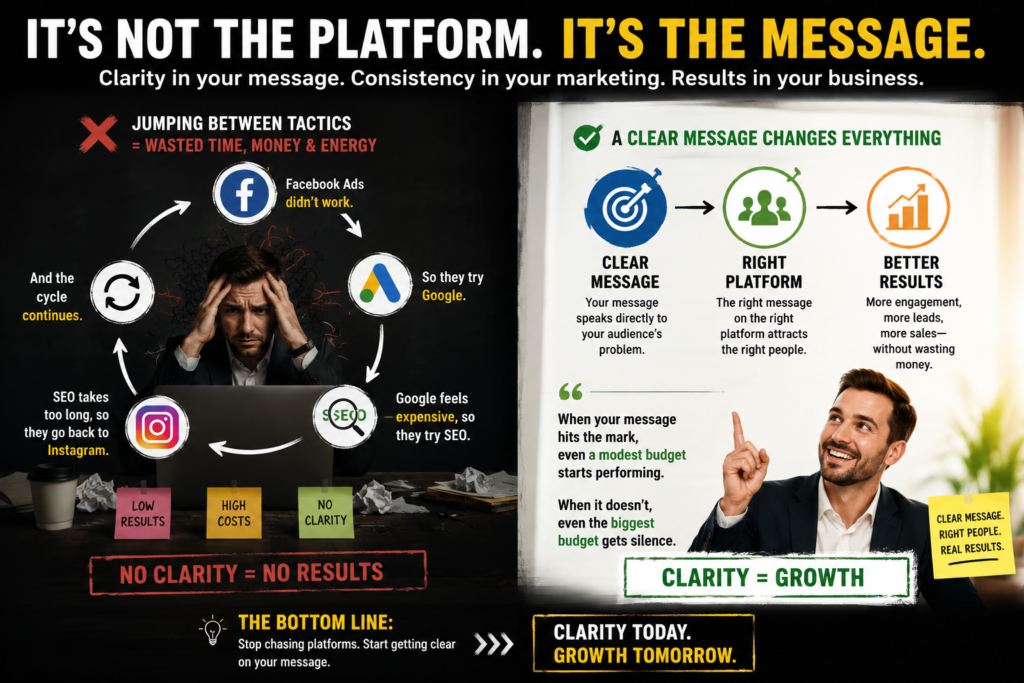
There’s a reason businesses keep jumping from one tactic to another. Facebook ads didn’t work, so they try Google. Google feels expensive, so they try SEO. SEO takes too long, so they go back to Instagram. And the cycle continues.
None of those platforms are broken. The message is.
When your message hits the mark, even a modest budget starts performing. When it doesn’t, you can pour money into the best-optimized campaign in the world and still get silence.
This is why some brands seem to grow effortlessly while others with bigger budgets struggle. It’s not luck. It’s clarity.
The Complete Fix: How to Find and Fix Your Marketing Message
Step 1: Understand Who You’re Actually Talking To
What It Means Most businesses have a general idea of their target audience. But “general idea” isn’t enough. You need to know the specific person, their specific situation, and the specific words they use to describe their problem.
Why It Matters If you’re guessing at your audience, your message will feel generic. Generic messages get ignored. People can feel when something wasn’t written for them.
How To Do It Go where your audience already talks. Read reviews on competitor pages, browse Reddit threads, scan comments on YouTube videos related to your industry. Note the exact language people use when they describe their problem. Not your version of their problem. Their version.
Then build what marketers call a customer avatar, but go beyond demographics. What’s keeping them up at night? What have they already tried that didn’t work? What would their life look like if this problem was solved?
Example A digital marketing agency targeting local salons shouldn’t position itself as “a full-service digital marketing partner.” The salon owner doesn’t think in those terms. She’s worried about empty appointment slots and competitors stealing her regulars. The right message speaks to that directly — not to the service.
Pro Tip The best source of messaging research is your existing customers. Call three of them. Ask what made them choose you, what almost stopped them, and what they’d tell a friend who needed what you offer. The words they use are gold.
Step 2: Find the Real Problem Behind the Surface Problem
What It Means People rarely buy solutions to the problem they say they have. They buy solutions to the problem beneath that problem.
Why It Matters If you only address the surface, your marketing stays surface-level. Addressing the deeper motivation is what makes someone feel genuinely understood, and that’s what drives action.
How To Do It Ask “why” five times for every problem your customer mentions.
They want more leads. Why? Because revenue is down. Why? Because they lost a few big clients. Why? Because those clients found someone who seemed more credible online. Why? Because their competitor has reviews, a better website, and shows up on Google. Why does that matter? Because they’ve been in business for 10 years and feel invisible.
That’s the real problem. And that’s what your marketing should speak to.
Example A gym doesn’t just sell fitness. It sells the feeling of being the kind of person who follows through. An accounting firm doesn’t just sell tax filing. It sells peace of mind during the most stressful time of year. Lead with that.
Pro Tip Emotional resonance converts better than logical arguments almost every time. That doesn’t mean being manipulative. It means being honest about what’s really at stake for your customer.
Step 3: Audit Your Current Messaging
What It Means Before fixing anything, you need to see what’s actually broken. Most businesses have never looked at their own marketing the way a stranger would.
Why It Matters You’re too close to your own brand to see it clearly. What feels obvious to you is completely invisible to someone who just discovered you.
How To Do It Go through your website, your ad copy, your social media captions, your email subject lines. For each piece of content, ask three questions.
Who is this for? What problem does this solve? Why would someone care?
If you can’t answer all three in five seconds, the message isn’t clear enough.
Example If your homepage headline says “Your Trusted Marketing Partner Since 2018,” that tells the visitor nothing useful. It’s about you, not them. Replace it with something that speaks directly to what they want. “Get More Customers Without Wasting Budget” is generic, but it’s already better.
Pro Tip Read your content out loud. If it sounds stiff, formal, or like you’re trying to impress someone, rewrite it the way you’d explain it to a friend over coffee.
Step 4: Build One Core Message and Stick to It
What It Means Most failing marketing suffers from message dilution. There are too many claims, too many offers, too many directions. When everything is highlighted, nothing is.
Why It Matters Your audience makes fast decisions. You have maybe three seconds to earn another three seconds of attention. One clear message does that. Five competing messages don’t.
How To Do It Write down everything you want your customer to know. Then ask which single thing, if they believed it completely, would make them want to buy. That’s your core message. Everything else becomes secondary.
Example A hair restoration studio in Hyderabad tried running five different ad angles at once price, technology, doctor credentials, years of experience, and before/after results. When they narrowed it down to just one angle (no surgery, natural results, visible change in 30 days), their cost per lead dropped significantly.
Pro Tip Consistency beats brilliance. A good message repeated across every touchpoint outperforms a perfect message shown once.
Step 5: Match Your Message to the Right Channel at the Right Time
What It Means Even a great message fails if it shows up in the wrong place or at the wrong stage of the buyer’s journey.
Why It Matters Someone who just discovered their hair is thinning needs different content than someone who’s already researched five clinics and is ready to book. Treating both the same way kills conversions.
How To Do It Map your customer’s journey from first awareness to final decision. Then assign content to each stage.
Awareness stage content should educate and create recognition. Consideration stage content should compare and build trust. Decision stage content should remove doubt and push to action.
Most brands do only one of these and wonder why the others aren’t converting.
Example A blog post titled “What causes hair loss in your 30s” is awareness content. A comparison page titled “Hair patch vs hair transplant: what’s better for you” is consideration content. A landing page with testimonials and a “Book a free consultation” CTA is decision content. You need all three.
Pro Tip Don’t just repurpose content. Recreate it for each stage. The format, tone, and depth should change depending on where your customer is in the journey.
Common Mistakes That Keep Marketing Broken
Talking about features, not outcomes. Nobody cares that your service includes a “dedicated account manager.” They care that they won’t have to chase someone down every time they need an answer.
Copying what competitors do. If you look and sound like everyone else in your category, you become interchangeable. And interchangeable businesses compete on price, which is a race nobody wins.
Changing strategy too fast. Most marketing needs time to work. Businesses pull the plug on campaigns that were actually building traction because they expected results too quickly.
Ignoring existing customers. The easiest source of new business is usually happy customers who haven’t been asked to refer anyone or come back for something else.
Measuring the wrong things. Likes and impressions are not business results. Track leads, conversions, cost per acquisition, and lifetime customer value.
Best Practices for Marketing That Actually Converts
Be specific in everything you say. Specific claims are more believable than vague ones. “98 clients served in Hyderabad” beats “trusted by many clients.”
Test before you scale. Before putting serious money behind an ad, test three to five message variations with a small budget. Let the data tell you what’s working.
Use social proof early and often. Reviews, testimonials, case studies, and before/after results reduce skepticism faster than anything you can write yourself.
Write for one person. Even when your message goes to thousands of people, it should feel like it was written for exactly one person in exactly one situation.
Simplify your offer. The easier it is to understand what you’re offering and what to do next, the more people will do it.
Tools and Resources
| Tool | Best For | Pricing |
|---|---|---|
| Google Search Console | Understanding what searches bring people to your site | Free |
| Meta Ads Manager | Running and testing paid ad campaigns | Ad spend based |
| Hotjar | Seeing how visitors behave on your website | Free plan available |
| Semrush | Keyword research and competitor analysis | Paid |
| Google Analytics 4 | Tracking traffic, conversions, and user behavior | Free |
| Typeform | Customer surveys and research | Free plan available |
Real-Life Example
Situation: A local digital marketing agency in Hyderabad was running campaigns for a hair studio client. Ads were getting impressions but leads were inconsistent.
Challenge: The ad copy was focused on the studio’s services and technology, but nothing spoke directly to the customer’s hesitation: fear of looking unnatural after the procedure.
Action: The agency shifted the messaging to focus entirely on the “natural look” outcome, used real customer photos instead of stock images, and added a clear FAQ section addressing common fears. The landing page was rewritten to speak to someone who was nervous, not just someone who was curious.
Result: Lead volume improved. More importantly, the quality of leads improved because the new message attracted people who were already sold on the category and just needed a reason to trust this particular studio.
Expert Tips
The best marketing doesn’t feel like marketing. When your content actually helps someone understand their problem better, they associate that feeling of clarity with your brand. That’s the most sustainable kind of trust you can build.
Stop trying to reach everyone. The more specific your message, the more powerful it is. A business that speaks directly to 30-year-old men in Hyderabad experiencing early hair loss will outperform one targeting “people with hair problems” every single time.
Revisit your messaging every six months. Markets shift, customer language evolves, and what worked last year might feel dated now. Keep listening to your customers and updating accordingly.
If your conversions are low but traffic is decent, the problem is almost always the message, not the audience. Fix what you’re saying before you spend more money amplifying it.
Frequently Asked Questions
What is the most common reason marketing campaigns fail?
Most campaigns fail because the message doesn’t match what the target audience actually cares about. Businesses focus on their services instead of the customer’s problem, which creates content that gets ignored.
How do I know if my marketing message is wrong?
If you’re getting traffic but not conversions, or running ads with decent reach but low click-through rates, your message likely isn’t connecting. Low engagement and high bounce rates are also strong signs.
What is message-market fit in marketing?
Message-market fit is when your marketing message speaks directly to the right audience about the right problem at the right time. It’s the alignment between what you say and what your audience needs to hear.
How can a small business improve its marketing without a big budget?
Focus on clarity first. A clear message with a small budget will outperform a confusing message with a large one. Talk to existing customers, understand exactly what made them choose you, and use those words in your marketing.
Why is knowing your target audience important in marketing?
Because generic messages speak to no one. The more precisely you understand who you’re talking to, the more specifically you can speak to their situation. That specificity is what builds trust and drives action.
What is the difference between awareness content and conversion content?
Awareness content introduces someone to a problem or solution they may not have considered. Conversion content speaks to someone who already understands the problem and needs a reason to choose you specifically.
How often should I update my marketing strategy?
Review your core strategy every six months. Review your active campaigns monthly. Make small tests and adjustments continuously rather than waiting for everything to break before making changes.
Does good marketing require a big advertising budget?
Not necessarily. Organic search, referrals, email marketing, and content can all drive significant results without large ad spend. What they all require is a clear message and consistent execution.
What role does emotional appeal play in marketing?
A significant one. People make decisions emotionally and justify them logically. Marketing that makes someone feel understood, seen, or hopeful performs better than marketing that only lists facts and features.
How do I measure if my marketing is actually working?
Track leads generated, cost per lead, conversion rate, and revenue attributed to marketing channels. Vanity metrics like followers and impressions are secondary. Business outcomes are the real measure.
Key Takeaways
The most common marketing problem isn’t budget or platform — it’s a message that doesn’t connect
Message-market fit means your message speaks to the right person about the right problem at the right moment
Start with deep audience research, using their words, not yours
Look for the emotional problem beneath the surface-level problem
Audit your existing content by asking: who is this for, what problem does it solve, why would someone care
Pick one core message and build consistency around it
Match your content to the customer’s stage in the buying journey
Test before scaling, and measure what actually matters for business growth
Conclusion
Marketing isn’t complicated in theory. Say the right thing to the right person at the right time, and most of the work is done. The hard part is being honest enough to admit when your message isn’t doing that, and patient enough to fix it properly.
Every business that appears to have cracked marketing figured this out at some point. They stopped guessing, started listening, and built their message around what their audience was already thinking.
That’s available to you too. It starts with one honest look at what you’re saying and who you’re saying it to.
Ready to Fix Your Marketing?
If you’re running campaigns that aren’t converting the way they should, the answer probably isn’t more spend. It’s clearer messaging.
At NexasAI, we work with businesses across Hyderabad and Vizag to identify exactly where their marketing is leaking and fix it from the ground up — ads, content, SEO, and everything in between.
Reach out today and let’s figure out what’s actually holding your growth back.