

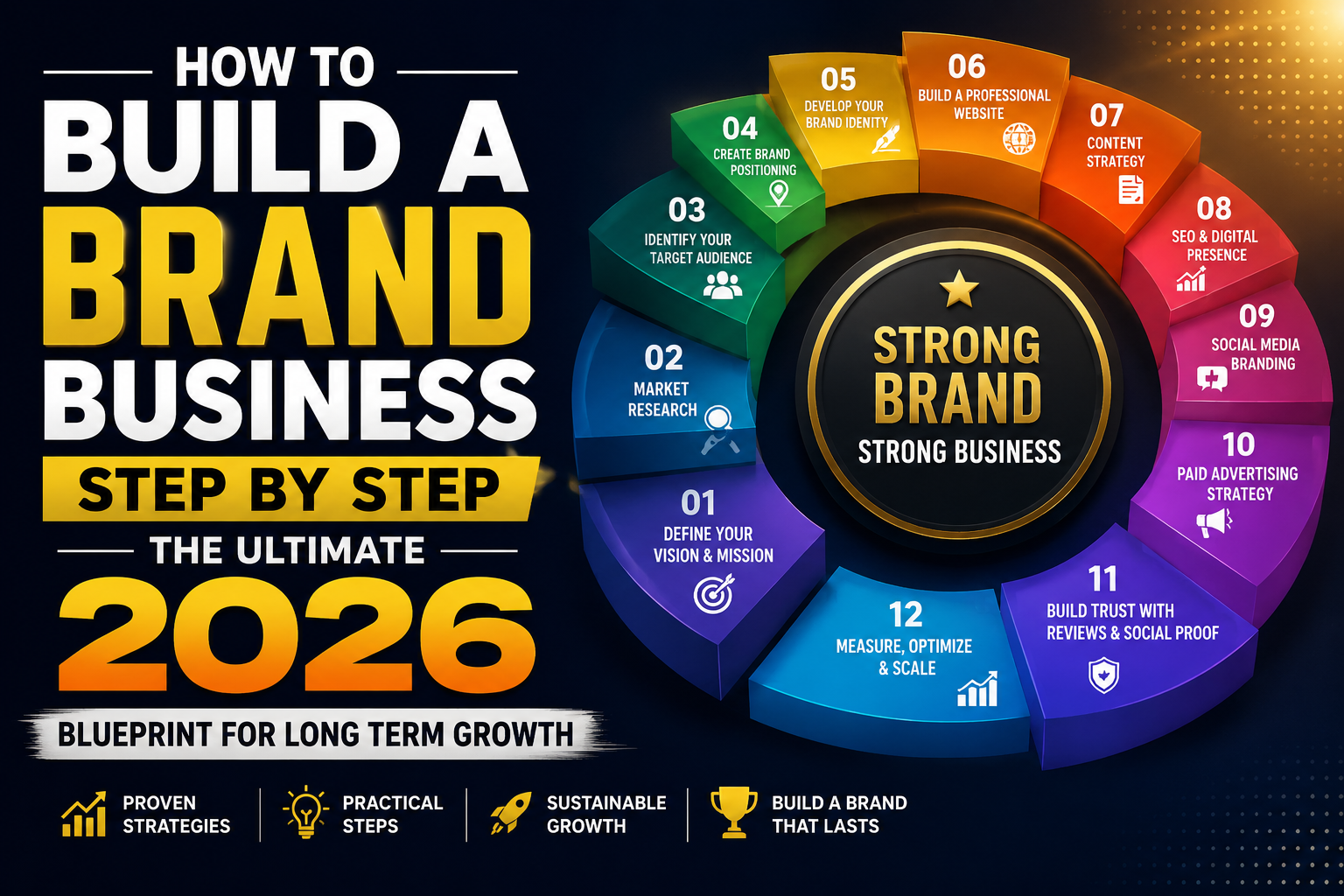
Most businesses do not fail because the product is bad. They fail because nobody remembers them Build a Brand Business
I have watched this happen so many times while working with local businesses across Hyderabad and Vizag. A salon owner spends two years perfecting her service, then loses customers to a competitor who simply posted better reels and had a name people could recall. That is not bad luck. That is the difference between running a business and building a brand.
Table of Contents
ToggleIntroduction
A brand business is not just a company with a logo. It is a business people trust enough to choose again, recommend to a friend, and pay a bit more for without blinking.
Building one is not about big budgets or fancy branding agencies. It is about doing the right things in the right order, consistently, over months and years.
In this guide, I am going to walk you through the exact process, the mistakes I see business owners make again and again, and the practical steps that actually move the needle in 2026. This comes from real client work, not theory pulled from a textbook.
Quick Answer
Building a brand business means defining a clear identity, solving a real problem for a specific audience, and showing up consistently across every touchpoint until people recognize and trust you. Start with positioning, build your visual and voice identity, create content that proves your expertise, and grow through consistent marketing and genuine customer experience rather than one time campaigns.
What Is a Brand Business?
A brand business is a company built around a recognizable identity, a clear promise, and a consistent experience, rather than one built purely around a product or a transaction.
Think of it this way. A shop that sells hair extensions is a business. A studio that people specifically seek out because they trust its results, follow its Instagram for tips, and refer their friends to it, that is a brand.
Take Looks Hair Studio as an example from my own client work. Non surgical hair replacement is a crowded category in Hyderabad, with dozens of small setups offering similar services at similar prices. What separates the ones that grow from the ones that stay stuck is whether people see them as a trusted name or just another option on Google Maps.
Why Is It Important?
A brand gives you three things a plain business rarely gets: pricing power, referrals, and forgiveness.
Pricing power means customers pay for trust, not just the service. Referrals mean your customers do your marketing for free because they are proud to recommend you. Forgiveness means when something goes wrong, people give you the benefit of the doubt instead of leaving a one star review immediately.
I have seen this play out directly. A client running Meta ads for a hair studio was paying almost 40 percent more per lead than a competitor with weaker service but stronger brand recall. The ad spend was similar. The results were not, simply because one business had built recognition and the other had not.
Complete Guide: Step by Step Process to Build a Brand Business
Step 1: Nail Your Positioning Before Anything Else
What It Means
Positioning is the specific problem you solve, for a specific person, in a way nobody else does quite the same.
Why It Matters
Without clear positioning, every other decision becomes harder. Your content sounds generic. Your ads attract the wrong audience. Your pricing feels arbitrary even to you.
How To Do It
Write one sentence that answers this: who do you serve, what do you help them achieve, and why should they pick you over the next option. Avoid vague words like best or premium. Be specific about the outcome and the audience.
Example
Instead of “we offer hair replacement services,” a sharper position is “we help working professionals in Hyderabad get natural looking hair density back within two weeks, without surgery or long recovery time.”
Pro Tip
Test your positioning statement on five people who do not know your business. If they cannot repeat back what makes you different after hearing it once, it needs work.
Step 2: Build an Identity That People Actually Remember
What It Means
This covers your name, your visual style, your tone of voice, and the small details that make your brand recognizable without a logo even showing.
Why It Matters
People forget most businesses within days of encountering them. A distinct identity is what makes yours stick.
How To Do It
Pick two or three colors and stick to them everywhere, your website, your Instagram grid, your ad creatives, your signage. Decide on a tone, are you the friendly expert, the no nonsense specialist, the premium quiet luxury option, and keep that tone consistent in every caption and every reply to a comment.
Example
For Antidot Hair Studio, we settled on a dark, premium visual palette with clean typography because the target audience wanted discretion and quality signals, not loud colors and discount language.
Pro Tip
Consistency beats creativity here. A slightly less exciting identity used everywhere will outperform a brilliant one used inconsistently.
Step 3: Create Content That Proves Your Expertise
What It Means
This is where you show, not tell, that you know what you are talking about and that you actually care about solving your customer’s problem.
Why It Matters
In 2026, people research before they buy almost everything. If your content does not show up with useful answers, a competitor’s will, and that competitor gets the customer.
How To Do It
Publish content that answers the actual questions your customers type into Google and ask ChatGPT. Blog posts, short videos, FAQs, before and after stories. Write and speak the way your real customers speak, not how a corporate brochure would.
Example
For a hair studio client, our best performing content was not polished studio photography. It was a simple Tenglish voiceover reel explaining why hair bonding fails within three months if the base is not fitted properly. That single reel brought in more inquiries than a month of generic before and after posts.
Pro Tip
Answer one specific question per piece of content. Do not try to cover everything at once. Specific content ranks better and converts better.
Step 4: Get Your Digital Presence in Order
What It Means
Your website, Google Business Profile, and social profiles need to work together and say the same thing consistently.
Why It Matters
A customer might see your ad, check your Instagram, then Google your name before deciding. If any of these feel inconsistent or unfinished, trust drops immediately.
How To Do It
Set up or clean up your Google Business Profile with accurate hours, photos, and a full description. Make sure your website loads fast and clearly states what you do within the first few seconds a visitor lands on it. Optimize for both traditional SEO and the newer reality of AI search, meaning your content should give clear, direct answers that tools like Google AI Overviews and ChatGPT can pull from.
Example
We rebuilt a service page for a Hyderabad based business targeting local searches, structuring the content so it directly answered common questions in plain language. Within a few months, organic inquiries increased noticeably without any added ad spend.
Pro Tip
Do not underestimate reviews. A steady stream of genuine reviews, even average length ones, does more for local trust than an expensive rebrand.
Step 5: Run Marketing That Builds the Brand, Not Just Sales
What It Means
Every ad, post, and campaign should do double duty, get a result today and add a small deposit to your brand’s reputation for tomorrow.
Why It Matters
Businesses that only run discount driven ads train customers to wait for the next sale instead of building loyalty.
How To Do It
Mix your marketing between direct response content, like offers and promotions, and brand building content, like education, behind the scenes, and customer stories. Keep your messaging consistent across Meta Ads, Google Ads, and organic content so people recognize you no matter where they encounter your brand.
Example
For one hair studio client, shifting Meta Ads copy from purely discount focused messaging to a mix that included short educational hooks reduced cost per lead while improving lead quality over a three month period.
Pro Tip
Track which content brings in customers who stay longer and refer others, not just which content brings in the cheapest lead. Cheap leads that churn quickly are not actually cheap.
Step 6: Deliver an Experience Worth Talking About
What It Means
The service or product experience itself needs to match, or exceed, what your marketing promised.
Why It Matters
Great marketing with a mediocre experience just gets you more people disappointed faster. Word of mouth works both ways.
How To Do It
Map out every touchpoint a customer has with you, from the first message they send to the follow up after service. Look for the moments that feel rushed, confusing, or inconsistent, and fix those first before spending more on marketing.
Example
A simple change like sending a personalized WhatsApp follow up two weeks after a hair service, checking how the client is adjusting, turned several one time customers into repeat clients who also referred friends.
Pro Tip
Ask unhappy customers what went wrong before they leave a public review. Most people will tell you privately if you ask first.
Common Mistakes
Mistake: Trying to appeal to everyone.
Impact: Your message becomes so broad it resonates with nobody in particular.
Solution: Narrow your audience on purpose. A specific promise to a specific person beats a vague promise to everyone.
Mistake: Changing your visual identity or messaging every few months.
Impact: Customers never build recognition because the brand keeps shifting under them.
Solution: Pick a direction, commit to it for at least a year, and let consistency do the work.
Mistake: Chasing every new platform and trend.
Impact: Resources get spread thin and nothing gets done well.
Solution: Master one or two channels where your actual customers spend time before expanding.
Mistake: Treating branding as a one time project.
Impact: The brand feels fresh for a launch, then fades as the business moves on to other priorities.
Solution: Treat brand building as an ongoing discipline, not a campaign with an end date.
Best Practices
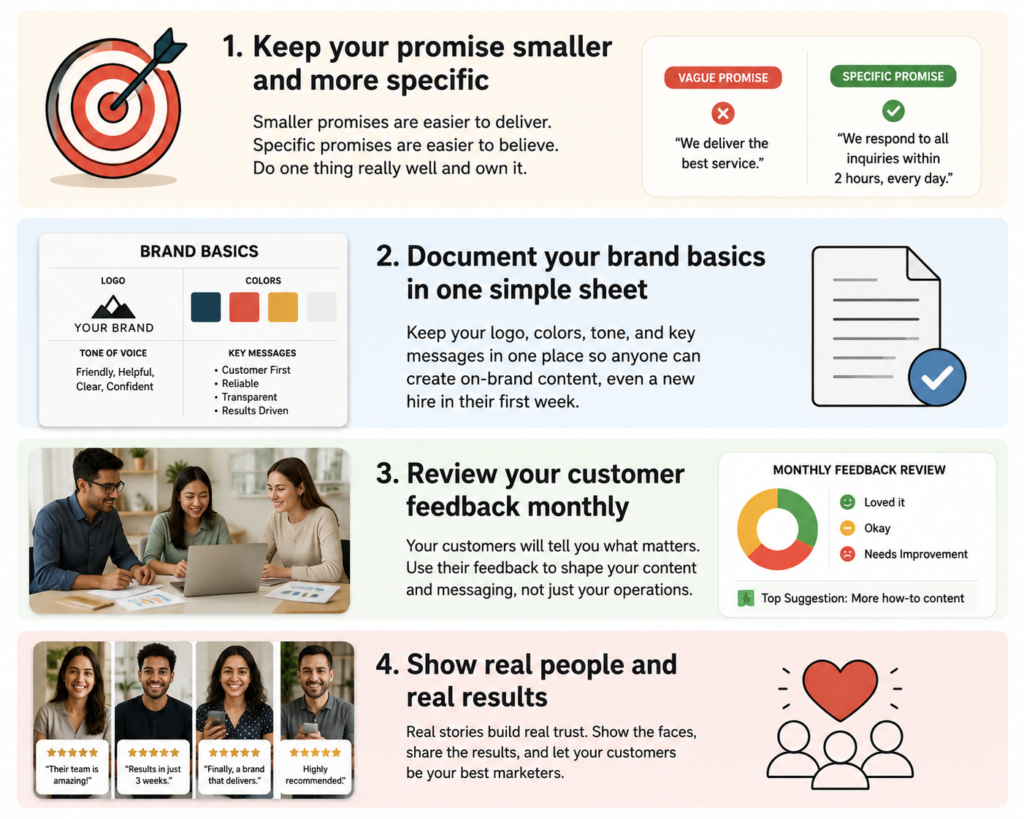
Keep your promise smaller and more specific than your competitors. Vague promises are forgettable, specific ones are believable.
Document your brand basics, colors, tone, key messages, in one simple sheet so anyone on your team can stay consistent, even a new hire on their first week.
Review your customer feedback monthly and let it shape your content, not just your operations.
Show real people and real results in your content. Stock photos and generic stock language quietly erode trust, even when nobody says so directly.
Tools and Resources
| Purpose | Free or Low Cost Option | Paid Option |
|---|---|---|
| Design and social graphics | Canva | Adobe Express |
| Website and landing pages | WordPress with a simple theme | Webflow |
| Analytics | Google Analytics 4 | Hotjar for behavior tracking |
| Content planning | Google Sheets calendar | Notion |
| Ad management | Meta Ads Manager | Google Ads with a managed agency |
Real Life Example
Situation: A hair restoration studio in Hyderabad had steady foot traffic from walk ins but almost no brand recognition beyond its immediate neighborhood.
Challenge: Competitors with lower prices were winning on paid search and social ads simply because they were more visible and more consistent online.
Action: We repositioned the studio around a clear promise for working professionals, rebuilt its Google Business Profile and website copy around real customer questions, and introduced a consistent content rhythm mixing educational reels with genuine before and after stories.
Result: Within four months, organic inquiries grew, cost per lead on paid campaigns dropped, and the studio started receiving referral clients from outside its immediate area for the first time.
Expert Tips
Do not wait until your business feels big enough to deserve a brand. Small businesses that build brand equity early grow faster because every customer interaction compounds instead of starting from zero each time.
Watch how your customers describe you in their own words, in reviews, DMs, comments. That language is often more persuasive than anything a copywriter could invent, and it tells you exactly what your brand actually stands for in the real world.
Build for AI search alongside traditional SEO. More customers now ask ChatGPT or Google’s AI Overview a question before they ever type it into a search bar. If your content answers questions clearly and directly, you show up in both places.
Frequently Asked Questions
What is the difference between a business and a brand business?
A business sells a product or service. A brand business builds recognition and trust so customers choose it repeatedly and recommend it to others, often without needing to compare prices first.
How long does it take to build a brand?
Meaningful recognition usually takes six months to a year of consistent effort, though small improvements in trust and recall can show up within weeks if positioning and content are sharp.
Do small businesses need branding or is it only for large companies?
Small businesses often need branding more, since they cannot compete purely on budget or scale. A clear identity helps them stand out locally without matching a competitor’s ad spend.
What is the first step in building a brand business?
Positioning. Before design, before content, before marketing, you need a clear answer to who you serve and why they should choose you specifically.
How much should a small business spend on branding?
There is no fixed number, but the bigger factor is consistency, not budget. A modest, well maintained identity used everywhere outperforms an expensive one used inconsistently.
Can social media alone build a brand?
Social media helps, but it works best alongside a strong website, consistent messaging, and a genuinely good customer experience. Relying on one channel alone leaves you exposed if that platform’s reach drops.
How do I know if my branding is working?
Look for repeat customers, referrals, and people recognizing your name before you introduce yourself. Rising follower counts without these signs usually mean attention without trust.
Is rebranding a good idea if growth has stalled?
Sometimes, but often the issue is inconsistent execution rather than the identity itself. Audit what is actually inconsistent before assuming a full rebrand is the fix.
How important are Google reviews for brand trust?
Very important for local businesses. A steady flow of genuine reviews often influences buying decisions more than any single piece of marketing content.
Key Takeaways
- A brand business earns pricing power, referrals, and customer forgiveness that a plain business does not get.
- Positioning comes first. Everything else, design, content, marketing, works better once positioning is clear.
- Consistency across visuals, tone, and messaging matters more than any single clever campaign.
- Content should prove expertise by answering real customer questions, not just showcase the business.
- Marketing and customer experience need to match. Great ads cannot fix a disappointing service experience.
- Building for AI search alongside traditional SEO is no longer optional in 2026.
Conclusion
Building a brand business is not a one time project you finish and move past. It is a habit of showing up the same way, solving the same specific problem, for the same specific person, again and again until people simply know who you are and trust what you do.
The businesses that pull ahead in 2026 are not always the ones with the biggest budgets. They are the ones that got their positioning right, stayed consistent, and treated every customer interaction as part of the brand, not separate from it.
CTA
If you are ready to turn your business into a brand people actually remember and recommend, start with your positioning statement this week. Write it down, test it on a few people, and let it guide your next piece of content or ad campaign.
And if you would rather have someone handle the strategy, content, and execution for you, that is exactly the kind of work we do at NexasAI for businesses across Hyderabad and Vizag. Reach out and let us build your brand story together.