

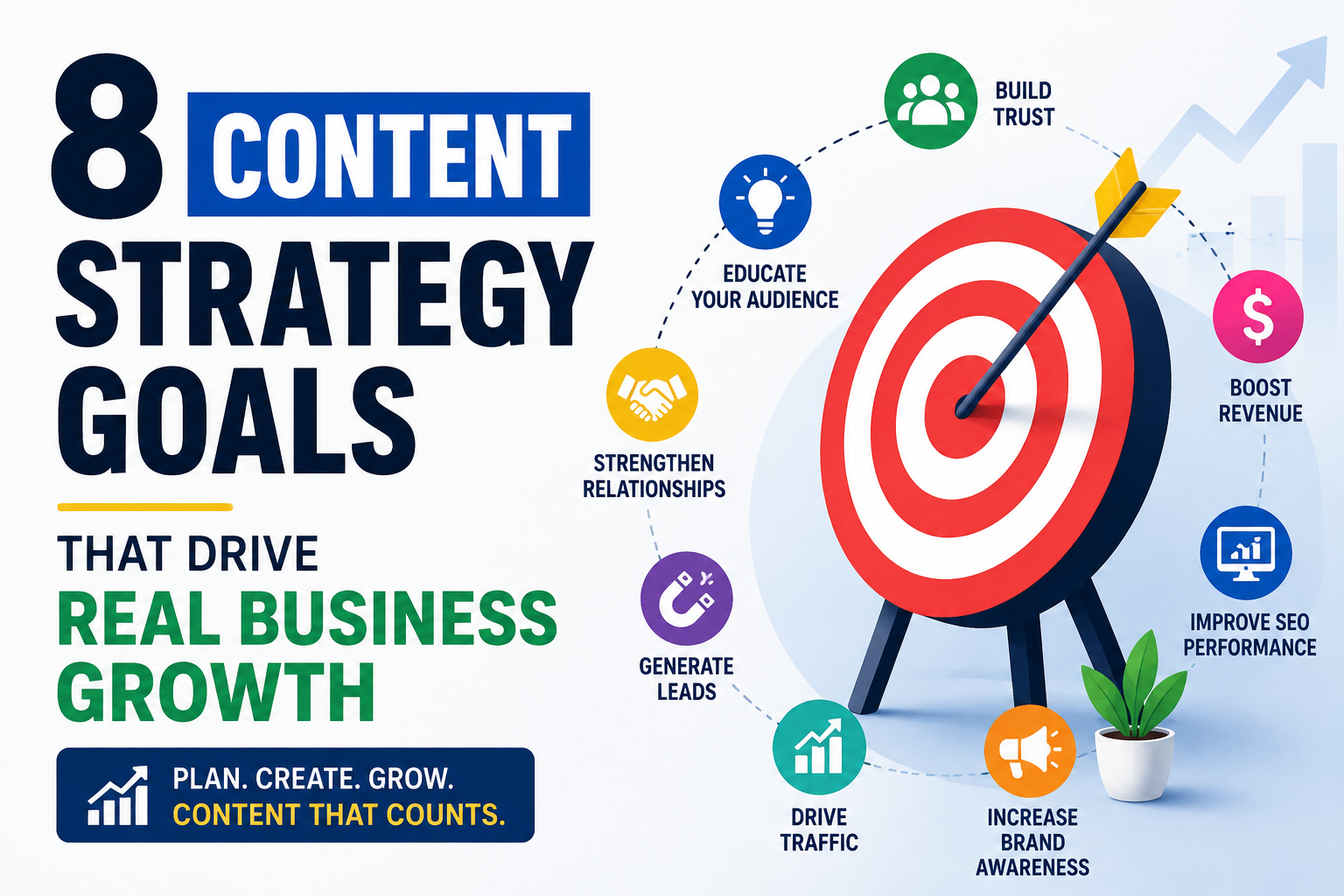
Most businesses are creating content with no real goal behind it
Here’s something I’ve noticed after years of building content plans for clients: almost everyone says they want “more content” before they’ve figured out what that content is actually supposed to do for the business.
They post blogs because a competitor does. They run ads because a friend said Meta Ads worked for their shop. They write captions late at night just to keep the page “active.”
And then they wonder why nothing moves the needle.
The truth is, content without a clear goal is just noise. It might look good. It might even get likes. But it won’t grow your business unless it’s tied to something specific you’re trying to achieve.
So in this post, I want to walk you through the 8 content strategy goals that actually matter. Not vanity metrics. Not “brand awareness” as a vague buzzword. Real, measurable goals that connect content to revenue.
Table of Contents
ToggleQuick Answer
A strong content strategy should aim for goals like building brand trust, generating qualified leads, improving search visibility, educating your audience, boosting conversions, retaining existing customers, establishing authority in your niche, and creating content assets that keep working long after publishing. When content is built around these goals instead of just posting for the sake of posting, it starts contributing directly to business growth.
What Is a Content Strategy Goal?
A content strategy goal is basically the “why” behind everything you publish. It’s the specific outcome you’re trying to create with your blogs, videos, social posts, or ad creatives.
Think of it like this. If you’re a hair studio owner and you post a reel of a hair transformation, your content strategy goal might be to drive bookings for that particular service. If you’re running a local service business and you write a blog about pricing, your goal might be to build trust before someone even calls you.
Without that goal, you’re just creating content and hoping something sticks.
I worked with a hair studio client last year who was posting nearly every day. Good quality reels too. But their bookings weren’t growing at the same pace. When we sat down and mapped their content to actual goals, like driving appointment bookings for specific services instead of generic engagement, their conversion rate from Instagram nearly doubled in two months. Same amount of content. Completely different results.
Why Content Strategy Goals Matter So Much
Here’s the thing most people miss. Content is expensive, even when it feels free. It costs you time, energy, and often a good chunk of your marketing budget if you’re outsourcing it or running ads around it.
If that content isn’t tied to a goal, you’re basically throwing resources at hope.
When you set clear goals, a few things happen:
You start measuring the right things instead of chasing likes and comments that don’t pay your bills.
Your team (or your agency) knows exactly what “success” looks like for each piece of content.
You stop wasting budget on content that looks nice but does nothing for the business.
You build a system that compounds over time instead of starting from zero every month.
I’ve seen small local businesses outperform bigger competitors purely because their content had direction. Bigger budget doesn’t always win. Better direction does.
The 8 Content Strategy Goals That Drive Real Growth
1. Building Brand Awareness The Right Way
What It Means This is about making sure the right people know you exist, and more importantly, remember you when they need what you offer.
Why It Matters People don’t buy from businesses they’ve never heard of, especially for services like salons, clinics, or local shops where trust matters. Before someone books an appointment or fills out a form, they usually need to see your brand a few times.
How To Do It Focus on consistent visual identity across platforms. Use short-form video since it gets the widest reach right now. Show your work, your team, your space. Don’t just talk about your business, show it in action.
Example hair studio client of mine started showing before-and-after transformations along with quick behind-the-scenes clips of the salon. Within a few weeks, people started tagging friends in the comments saying “we need to go here.” That’s brand awareness actually working.
Pro Tip Awareness content doesn’t need to sell anything directly. Its job is to get remembered. Save the selling for later in the funnel.
2. Generating Qualified Leads, Not Just Traffic
What It Means This goal focuses on attracting people who are actually likely to become paying customers, not just anyone who clicks.
Why It Matters Traffic feels good on paper. But if a thousand people visit your website and none of them are interested in your actual service, that traffic means nothing for your revenue.
How To Do It Create content that speaks directly to your ideal customer’s problem. Use lead magnets like free consultations, downloadable guides, or quizzes. Make sure your calls to action are specific, not generic “click here” buttons.
Example For a local service business, instead of a blog titled “Everything About Our Services,” we wrote one titled “How Much Does [Service] Actually Cost in Hyderabad?” That single blog brought in more consultation form fills than five generic posts combined, because it answered the exact question people were searching for.
Pro Tip Specificity attracts the right people. Vague content attracts everyone and converts almost no one.
3. Improving Search Visibility and Rankings
What It Means This is about making sure your content shows up when people actually search for what you offer, whether that’s on Google or increasingly, inside AI tools like ChatGPT and Gemini.
Why It Matters If you’re invisible in search, you’re relying entirely on paid ads or word of mouth. Organic visibility gives you a steady stream of people actively looking for what you sell.
How To Do It Target keywords with real search intent, not just high volume. Structure content with clear headings so both Google and AI tools can pull answers from it easily. Keep updating older content instead of only publishing new pieces.
Example One client’s website barely got any organic traffic. We rewrote their service pages with proper location targeting for Vizag and added FAQ sections addressing real customer questions. Within a few months, they started showing up on the first page for several local search terms, and calls started coming in without any extra ad spend.
Pro Tip AI Overviews and chat-based search are changing the game. Content that answers questions clearly and directly gets picked up more often than content that’s just trying to rank.
4. Educating Your Audience Before They Buy
What It Means This goal is about helping your audience understand something, whether that’s your product, your industry, or a problem they’re facing, before you ever ask for the sale.
Why It Matters People trust businesses that teach them something over businesses that just push products. Education builds credibility, and credibility shortens the sales cycle.
How To Do It Answer the questions your customers ask you most often, in blog posts, videos, or captions. Break down complicated topics into simple language. Avoid jargon that makes you sound smart but leaves the reader confused.
Example A client in the hair care space kept getting the same questions about hair fall treatments over and over on calls. We turned those exact questions into a content series. Not only did it reduce repetitive calls, it also positioned them as the experts people trusted before even walking in.
Pro Tip If you’re answering the same question for the fifth time this month, that’s a sign you need a piece of content around it.
5. Boosting Conversions From Existing Traffic
What It Means This goal focuses on getting more value out of the people already visiting your site or following your page, instead of only chasing new visitors.
Why It Matters It’s almost always cheaper to convert someone who’s already interested than to find a brand new customer. Yet most businesses ignore this and pour everything into acquisition.
How To Do It Improve your calls to action across every piece of content. Add testimonials and social proof near decision points. Simplify your booking or inquiry process so it takes seconds, not minutes.
Example We noticed one client’s Instagram bio had zero clear direction, just a plain link with no context. Adding a simple “Book your free consultation” with a direct WhatsApp link increased their inquiry rate noticeably, without changing a single piece of content strategy elsewhere.
Pro Tip Sometimes the biggest growth doesn’t come from creating more content. It comes from fixing the leaks in what you already have.
6. Retaining Customers Through Ongoing Content
What It Means This is about staying relevant to people who’ve already bought from you, so they come back and refer others.
Why It Matters Getting a new customer usually costs more than keeping an existing one happy. Content that nurtures past customers keeps your business top of mind for their next need or their friend’s recommendation.
How To Do It Send helpful follow-up content through WhatsApp or email after a purchase. Share maintenance tips, usage guides, or loyalty offers. Celebrate customer milestones or transformations publicly, with permission.
Example A salon client started sending a simple WhatsApp message with hair care tips a week after every major service. Small gesture, but it noticeably improved repeat bookings because customers felt looked after, not forgotten.
Pro Tip Retention content doesn’t need to be flashy. It needs to feel personal and timed well.
7. Establishing Authority in Your Niche
What It Means This goal is about becoming known as a go-to voice in your specific industry or local market, rather than just another option among many.
Why It Matters Authority reduces price sensitivity. People pay more for someone they see as an expert compared to someone who feels like a commodity.
How To Do It Share your actual process, not just results. Talk about mistakes you’ve seen others make and how to avoid them. Be willing to have opinions instead of playing it safe with generic advice.
Example Instead of just posting finished hairstyles, one client started sharing short clips explaining why certain treatments work better for certain hair types. That shift from “here’s the result” to “here’s why this works” changed how the audience perceived their expertise.
Pro Tip Authority isn’t built by claiming you’re the best. It’s built by consistently showing you know what you’re talking about.
8. Creating Long-Term Content Assets
What It Means This goal focuses on producing content that keeps bringing in traffic, leads, or trust long after you hit publish, instead of content that disappears in 24 hours.
Why It Matters Social media content has a short shelf life. But a well-written blog post or a solid landing page can keep working for months or years with almost no extra effort.
How To Do It Prioritize evergreen topics over trends when it makes sense. Update old blog posts with fresh information instead of always starting new ones. Repurpose one strong piece of content into multiple formats.
Example A single detailed blog post we wrote about a common service question still brings in inquiries more than a year later. That’s the compounding effect trend-based content simply doesn’t have.
Pro Tip Every business needs a mix. Some content for right now, and some content built to last.
Common Mistakes Businesses Make With Content Goals
Mistake: Treating every piece of content the same way
Impact: You end up measuring a brand awareness reel by conversion rate, and a lead generation blog by likes, which tells you nothing useful.
Solution: Assign a clear goal to each piece before you create it, and measure it against that specific goal.
Mistake: Chasing trends instead of strategy
Impact: You get short bursts of attention that don’t translate into actual business results.
Solution: Use trends as a format, not as your entire strategy. The message still needs to serve a real goal.
Mistake: Ignoring existing customers
Impact: Businesses spend everything on acquiring new customers while repeat business quietly declines.
Solution: Build at least some content specifically for people who’ve already bought from you.
Mistake: No consistency in posting or publishing
Impact: Algorithms and search engines both reward consistency. Sporadic posting makes it harder to build momentum.
Solution: A realistic, sustainable content calendar beats an ambitious one you abandon after three weeks.
Best Practices Worth Following
Set one primary goal per piece of content, even if it supports secondary goals.
Review your content performance monthly against those goals, not just overall engagement.
Mix TOFU, MOFU, and BOFU content so you’re nurturing people at every stage, not just the ones ready to buy today.
Repurpose high performing content into other formats instead of always creating from scratch.
Keep your content aligned with what your business can actually deliver. Overpromising in content creates problems down the line.
Tools and Resources Comparison
| Tool | Best For | Good For Local Businesses |
|---|---|---|
| Google Search Console | Tracking organic search performance | Yes |
| Meta Business Suite | Managing social content and ads | Yes |
| Canva | Quick content design | Yes |
| Google Analytics 4 | Understanding traffic and conversions | Yes |
| WhatsApp Business | Retention and follow-up content | Yes, especially in Indian markets |
Real life example
Situation A local service business was posting content regularly but saw almost no growth in bookings over three months.
Challenge Their content had no clear goal attached. Everything was posted with the same generic intention of “staying active” online.
Action We restructured their content calendar around specific goals. Educational content to build trust, location-targeted blogs to improve search visibility, and clear conversion focused captions with direct booking links.
Result Within two months, inquiries increased noticeably, and for the first time, the business could actually tell which piece of content brought in which lead.
Expert Tips
Don’t set more than two or three primary content goals at once. Trying to do everything usually means doing nothing particularly well.
Revisit your goals every quarter. What worked for awareness last year might not work the same way now, especially with how fast platforms and search behavior are changing.
Talk to your actual customers about what convinced them to buy. That real feedback is often better content research than any tool.
Frequently Asked Questions
What is the main goal of a content strategy?
The main goal is to guide your content creation toward specific business outcomes, like leads, trust, or sales, instead of publishing content randomly without direction.
How many content goals should a business have?
Most businesses do best with two or three primary goals at a time, so their content and resources stay focused instead of spread too thin.
Is brand awareness still an important content goal?
Yes, especially for local businesses. People need to recognize and trust your brand before they’re willing to book or buy from you.
How do I know if my content strategy is working?
Track performance against the specific goal you set for each piece, whether that’s leads, traffic, engagement, or conversions, rather than judging everything by likes alone.
Should small businesses focus on SEO or social media first?
It depends on where your customers search. Local service businesses often benefit from both, but a strong Google presence tends to bring in more ready-to-buy customers.
What is the difference between content strategy and content marketing?
Content strategy is the plan and goals behind your content. Content marketing is the actual execution, like publishing blogs, running ads, or posting on social media.
How often should I update my content goals?
Reviewing them quarterly works well for most businesses, though major changes in your services or market might require updating sooner.
Can one piece of content serve multiple goals?
It can, but it works best when it has one clear primary goal. Trying to force too many goals into a single piece often weakens its effectiveness.
Does AI search change how content goals should be set?
Yes, to some extent. Content now needs to answer questions clearly enough for AI tools to pull direct answers, which means clarity and structure matter more than ever.
What is the biggest mistake businesses make with content goals?
Not setting them at all. Publishing without a clear purpose is the fastest way to waste time and budget on content that goes nowhere.
Key Takeaways
Content without a clear goal rarely drives real business results.
The 8 goals that matter most are brand awareness, lead generation, search visibility, audience education, conversion improvement, customer retention, niche authority, and long-term content assets.
Measuring content against the wrong metric leads to wasted effort and unclear decisions.
Small, local businesses can outperform bigger competitors simply by having sharper content direction.
Reviewing and adjusting your goals regularly keeps your content strategy relevant as your business and platforms evolve.
Conclusion
Content strategy isn’t about posting more. It’s about posting with purpose.
Once you attach real goals to what you create, everything gets easier. You know what to measure, what to improve, and what to stop doing altogether. And more importantly, your content actually starts contributing to growth instead of just filling up your feed.
Your Next Step
If you’re not sure which of these 8 goals your current content is actually working toward, that’s usually the first thing worth fixing. Start with just one goal, build content around it intentionally for a month, and watch how differently it performs compared to posting without direction.
[…] Guide) Meta Ads Creative Strategy: Why More Ads Won’t Beat Better Creative Diversity 8 Content Strategy Goals That Actually Drive Business Growth (Not Just Views) How to Build Audience-First Content Briefs That Drive Better SEO Results How to Build an […]
[…] Guide) Meta Ads Creative Strategy: Why More Ads Won’t Beat Better Creative Diversity 8 Content Strategy Goals That Actually Drive Business Growth (Not Just Views) How to Build Audience-First Content Briefs That Drive Better SEO Results […]