

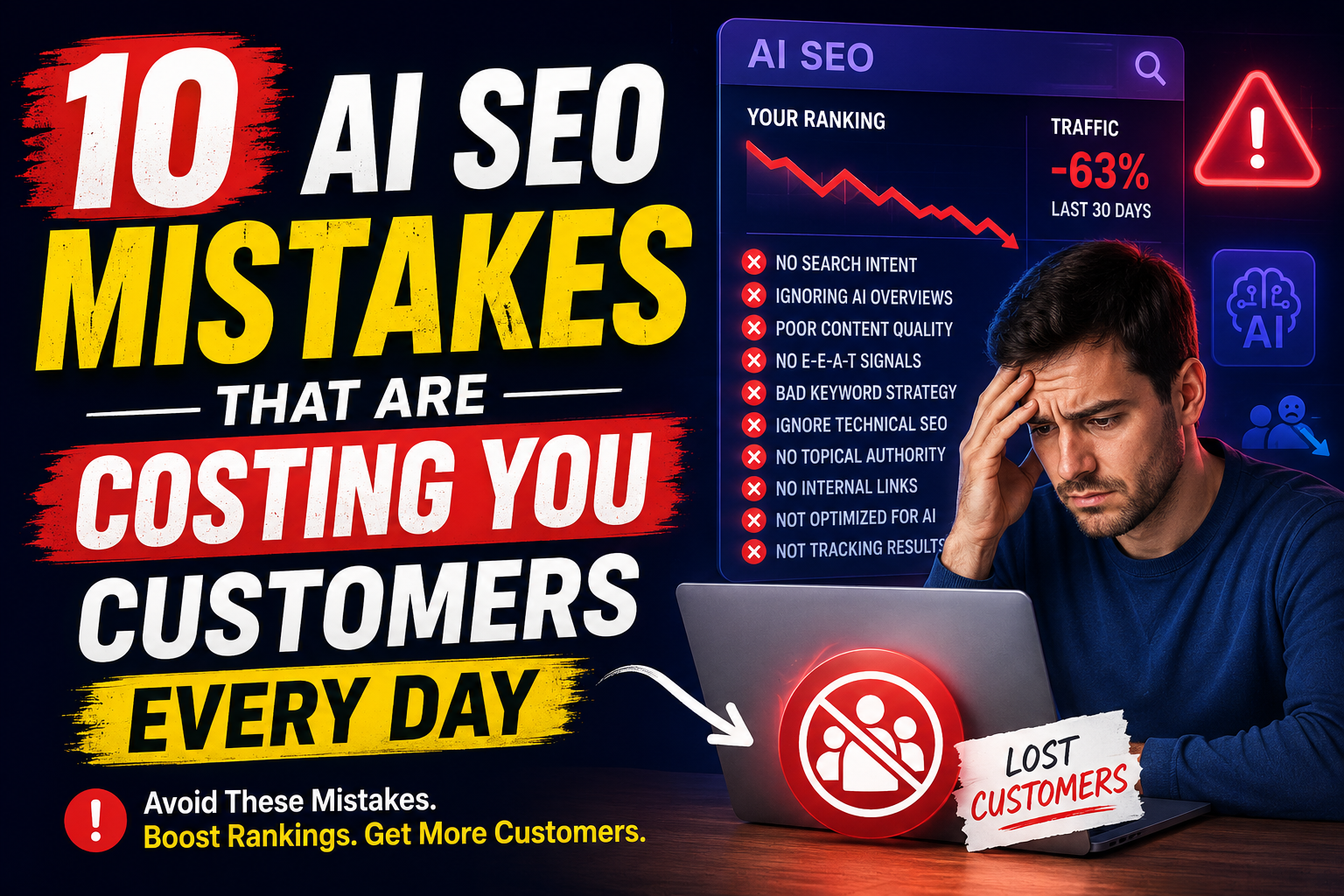
Someone spent three months building an AI-powered content strategy. Published 40 blog posts. Got almost no traffic.
The content looked fine on the surface. Good structure. Decent length. Keywords were there. But something was off. The posts felt empty. No real opinion, no useful detail, nothing a person would actually share or link to.
Google noticed. So did the readers.
This is happening to a lot of businesses right now. They are rushing into AI SEO without understanding the rules have changed. And the mistakes they are making are not small. They are the kind that quietly drain leads and traffic over weeks without anyone realising why.
Here is what those mistakes look like, and how to fix them before they cost you more than they already have.
Table of Contents
ToggleIntroduction
AI tools have made content creation faster than ever. That is the good part. The problem is speed without strategy is just noise. A lot of marketers and business owners are using AI to generate content, automate keyword research, and push out blog posts at scale. But they are skipping steps that actually matter. They are publishing thin content, ignoring intent, and treating AI like a magic button instead of a writing assistant.
The result? Rankings that stall. Traffic that does not convert. Content that AI Overviews and Google both ignore.
This post breaks down the 10 most common AI SEO mistakes businesses are making right now, why each one hurts, and what to do instead.
Quick Answer
What are the biggest AI SEO mistakes?
The most damaging AI SEO mistakes include publishing AI content without human editing, ignoring search intent, skipping E-E-A-T signals, stuffing keywords unnaturally, and failing to optimise for AI Overviews. These errors reduce content quality, hurt rankings, and cause potential customers to bounce without converting.
What Is AI SEO?
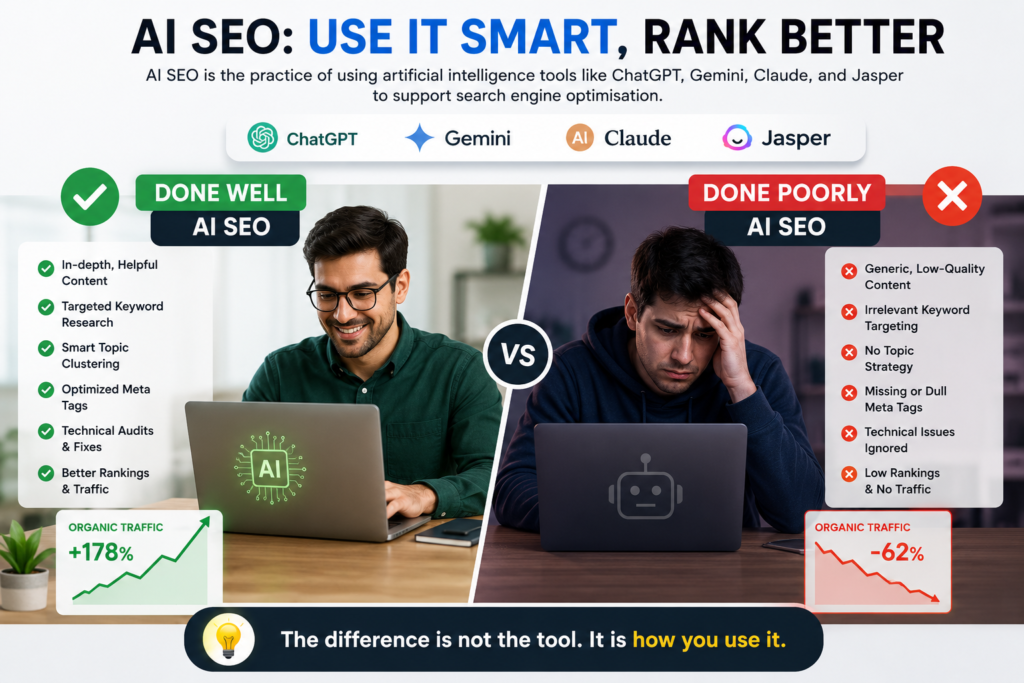
AI SEO is the practice of using artificial intelligence tools like ChatGPT, Gemini, Claude, and Jasper to support search engine optimisation. This includes content generation, keyword research, topic clustering, meta tag writing, and even technical audits.
Done well, AI SEO speeds up your workflow and helps you produce more relevant content at scale. Done poorly, it fills your website with generic text that ranks for nothing and connects with no one.
The difference is not the tool. It is how you use it.
Why Getting AI SEO Right Actually Matters
Google’s algorithms have gotten better at detecting low-effort content. AI Overviews now pull answers directly from pages that demonstrate real expertise and clear structure. Perplexity, ChatGPT, and Gemini do the same when someone asks a question in their interfaces.
If your content does not meet those standards, you lose visibility in traditional search and in AI search at the same time. That is a double loss most businesses cannot afford.
Getting AI SEO right means more organic traffic, more qualified leads, and less money spent on paid ads just to stay visible.
The 10 AI SEO Mistakes Costing You Customers
Mistake 1: Publishing AI Content Without Human Editing
What It Means
Using AI to write a blog post and hitting publish without reviewing it.
Why It Matters
AI tools write fast but they do not know your business, your audience, or your market. They fill gaps with generic statements that sound okay but say nothing useful. Google’s Helpful Content system is specifically designed to detect this kind of surface-level content.
How To Fix It
Treat AI output as a first draft, not a finished product. Add your own perspective, real examples, specific data, and anything that makes the content uniquely yours. If a reader cannot tell the difference between your post and one from a competitor, neither can Google.
Pro Tip
Read the AI draft out loud. Anywhere it sounds robotic or vague, rewrite it. That is usually where the real insight needs to go.
Mistake 2: Ignoring Search Intent
What It Means
Writing content around a keyword without understanding why someone is searching for it.
Why It Matters
Someone searching “AI SEO tools” might want a comparison. Someone searching “how to use AI for SEO” wants a tutorial. Someone searching “best AI SEO agency in Hyderabad” is ready to hire someone. These are completely different intents. If your content does not match what the searcher actually wants, they leave immediately. That hurts your rankings.
How To Fix It
Before writing anything, search the keyword yourself. Look at what types of content rank. Are they listicles, guides, landing pages, or product reviews? Match that format. Then go deeper than the competition.
Example
A business targeting “AI content writing services” found that ranking pages were all comparison articles. They had a service page. Once they created a detailed comparison post that naturally featured their service, traffic improved within six weeks.
Pro Tip
Ask AI: “What is the likely search intent behind [keyword]?” Use that as a starting point, then verify it manually by looking at actual search results.
Mistake 3: Skipping E-E-A-T Signals
What It Means
Publishing content with no author information, no credentials, no real-world examples, and no evidence that a human who knows their subject actually wrote it.
Why It Matters
Google’s E-E-A-T framework stands for Experience, Expertise, Authoritativeness, and Trustworthiness. It matters especially for topics that affect people’s money, health, or major decisions. AI-generated content without E-E-A-T signals gets treated as low-quality, no matter how well it is optimised technically.
How To Fix It
Add author bios with real credentials. Reference specific experiences, clients, or case studies. Get backlinks from credible sources. Mention real tools you have used and outcomes you have seen.
Pro Tip
Add a “Last Updated” date to your posts and update them regularly. Freshness is a trust signal AI Overviews factor in when pulling answers.
Mistake 4: Keyword Stuffing With AI Suggestions
What It Means
Pasting every keyword from an AI tool into the content without considering whether it reads naturally.
Why It Matters
AI keyword tools can generate hundreds of related terms. Some people try to include all of them. The result is content that feels unnatural to readers and triggers over-optimisation penalties from Google.
How To Fix It
Use AI to identify your primary keyword, three to five secondary keywords, and a cluster of semantic terms. Then write naturally and let those terms appear where they actually fit. Google understands context far better than it did five years ago.
Example
A blog post targeting “AI SEO strategy” does not need to say “AI SEO strategy” seventeen times. Using variations like “AI-powered search optimisation,” “machine learning in SEO,” and “search AI tools” covers the same semantic territory without stuffing.
Mistake 5: Creating Content Without a Topic Cluster Strategy
What It Means
Publishing standalone blog posts on random AI or SEO topics without any internal linking structure or content hierarchy.
Why It Matters
Google rewards websites that demonstrate topical authority. That means covering a subject deeply and thoroughly, not just writing one blog post and hoping it ranks. Without a cluster strategy, your posts compete with each other and none of them build the authority you need.
How To Fix It
Pick a core topic, say “AI SEO for small businesses.” Build a pillar page around it. Then create supporting posts on subtopics like “how to use ChatGPT for keyword research,” “AI content writing mistakes,” and “GEO vs SEO.” Link them all back to the pillar. Link the pillar to each one. This signals to Google that you own this subject.
Pro Tip
Use AI to generate a full topic cluster map. Prompt it with: “Give me 15 supporting blog post ideas for a pillar page about [topic].”
Mistake 6: Ignoring GEO and AEO Optimisation
What It Means
Writing only for Google rankings and ignoring how AI systems like ChatGPT, Perplexity, and Gemini pull answers from web content.
Why It Matters
A growing percentage of people now get answers directly from AI interfaces without clicking through to a website. If your content is not structured to be quoted by these systems, you are invisible in a channel that is growing every month.
How To Fix It
Write clear, direct answers to specific questions. Use question-based headings. Front-load the most important information. Keep paragraphs short. Make every section quotable as a standalone answer. This is what GEO and AEO optimisation actually looks like.
Example
A NexasAI client in the services sector rewrote their blog posts with this structure. Within two months, their content started appearing in ChatGPT responses when users asked about their niche.
Mistake 7: Over-Relying on AI for Local SEO
What It Means
Using AI to write generic location-based content without any real local knowledge, signals, or personalisation.
Why It Matters
Local SEO requires trust signals that AI cannot fabricate. Things like Google Business Profile reviews, local backlinks, NAP consistency, and genuine local references matter far more than keyword-stuffed city pages.
How To Fix It
Use AI to structure your local content but fill it with real local details. Mention actual landmarks, local events, or neighbourhood-specific context. Get reviews from real local customers. Build citations from local directories. AI can support this work but it cannot replace the local credibility that Google actually looks for.
Pro Tip
For every city or locality you are targeting, write at least one paragraph that only someone with real knowledge of that area could write. This separates your content from the hundreds of AI-generated location pages competing for the same keywords.
Mistake 8: Neglecting Technical SEO While Chasing Content Volume
What It Means
Publishing large amounts of AI-generated content while ignoring page speed, crawlability, Core Web Vitals, and site structure.
Why It Matters
Great content on a slow, poorly structured website does not rank. Google needs to be able to crawl and index your pages efficiently. Users need pages to load fast. Both of these are foundational.
How To Fix It
Run a technical SEO audit before scaling content production. Fix crawl errors, broken links, duplicate content, and page speed issues first. Then build on that foundation. AI tools like Screaming Frog, Ahrefs, and Semrush can help identify technical problems quickly.
Technical IssueImpact on RankingsPrioritySlow page speedHighFix firstCrawl errorsHighFix firstDuplicate contentMediumFix before scalingMissing schema markupMediumAdd during content buildBroken internal linksMediumFix regularly
Mistake 9: Not Tracking the Right Metrics
What It Means
Measuring AI SEO success by vanity metrics like total page views or keyword rankings alone, without tracking conversions, leads, or revenue.
Why It Matters
Traffic that does not convert is just noise. A lot of AI SEO strategies look successful on the surface but deliver no business results. This is usually because the content is attracting the wrong audience or failing at the bottom of the funnel.
How To Fix It
Set up GA4 properly. Track goal completions, form submissions, click-to-call events, and assisted conversions. Look at which pages drive actual leads, not just clicks. Then double down on what is working and cut what is not.
Pro Tip
Set up GA4 Explorations to trace the path from first organic visit to conversion. You will usually find a handful of pages doing most of the heavy lifting.
Mistake 10: Treating AI as a Replacement for Strategy
What It Means
Using AI to make decisions that require human insight, market knowledge, and business judgment.
Why It Matters
AI tools are excellent at execution. They are not great at strategy. They cannot tell you which market segment to go after, which product to lead with, or why your competitors are winning. When AI drives strategy instead of supporting it, businesses end up optimising for the wrong things.
How To Fix It
Start with a clear business goal. Define your target audience, their pain points, and the keywords that reflect real buying intent. Then use AI to execute faster, not to decide where to go. Strategy is still a human job.
Real-Life Example
Situation: A digital marketing agency in Hyderabad was generating 30 blog posts per month using AI. Traffic grew slightly but leads stayed flat.
Challenge: Content was generic, had no E-E-A-T signals, was not structured for AI Overviews, and targeted broad keywords with no conversion intent.
Action: They restructured their entire content approach. Moved to fewer posts with deeper research. Added author credentials and real case studies. Built a topic cluster around their core service. Rewrote meta descriptions and added FAQ schema to every post.
Result: Organic leads increased over the next quarter. Two blog posts started appearing in AI Overview responses for target keywords in their niche.
The lesson is simple. Less content done right beats more content done wrong.
Best Practices for AI SEO in 2025
Always edit AI content before publishing. Add experience, opinion, and specifics.
Match every piece of content to a clear search intent.
Build topic clusters, not isolated posts.
Optimise for AI Overviews with clear, direct, quotable answers.
Include schema markup for FAQs, articles, and local business pages.
Track conversions, not just traffic.
Update old content regularly to maintain freshness signals.
Use real data, real examples, and real author credentials.
Tools Worth Using
| Tool | Best For | Pricing |
|---|---|---|
| Surfer SEO | Content optimisation and NLP scoring | Paid |
| Ahrefs | Keyword research and backlink analysis | Paid |
| ChatGPT / Claude | First-draft content and ideation | Free and Paid |
| Screaming Frog | Technical SEO audits | Free up to 500 URLs |
| GA4 | Conversion and traffic tracking | Free |
| Google Search Console | Indexing, clicks, and keyword data | Free |
| Schema Markup Generator | Adding structured data without code | Free |
Expert Tips
On AI Overviews: Structure key sections as a direct answer to a question. Start with “Yes,” “No,” or a one-sentence summary. Then explain. This is exactly how AI Overviews format pulled answers.
On content freshness: Google factors in how recently a page was updated. Even small edits, adding a new stat, updating an example, or adding a FAQ section, signal that the content is being maintained.
On backlinks: AI can help you identify link-building targets and write outreach emails. But the relationship-building that earns real backlinks is still human work.
On local SEO: AI-generated city pages that all use the same template are easy to detect and easy to ignore. Real local content that references specific context performs far better.
Frequently Asked Questions
Is AI-generated content bad for SEO?
Not inherently. Google does not penalise AI content by default. It penalises content that is unhelpful, thin, or lacks genuine expertise. AI-generated content that is properly edited, factually accurate, and written for real users can rank well.
How do I make AI content pass Google's Helpful Content system?
Add first-hand experience, real examples, author credentials, and specific insights that only someone with genuine knowledge would include. Make sure the content fully satisfies the reader’s actual question.
What is GEO optimisation and why does it matter for SEO?
GEO stands for Generative Engine Optimisation. It is the practice of structuring content so it gets cited by AI systems like ChatGPT, Perplexity, and Gemini. As more users get answers from AI interfaces, GEO determines whether your content stays visible in those channels.
Can AI tools replace an SEO strategist?
No. AI tools are excellent at execution tasks like keyword research, content drafting, and data analysis. Strategic decisions about market positioning, audience targeting, and campaign direction still require human expertise.
How often should I update AI-generated blog posts?
Review and update key posts every three to six months. Add new data, update examples, expand FAQs, or refresh the structure. Regular updates signal freshness to Google and improve AI Overview eligibility.
What is the biggest difference between SEO and AEO?
SEO optimises for search engine rankings. AEO optimises for answer engines, meaning AI chatbots and voice assistants that pull direct answers without sending traffic to websites. A well-structured blog post can do both if written correctly.
How do I optimise for AI Overviews?
Write clear, direct answers to specific questions. Use structured headings in question format. Include short, quotable paragraphs. Add FAQ schema markup. Ensure your page loads fast and has strong E-E-A-T signals.
Does keyword density still matter in AI SEO?
Modern SEO cares far more about semantic relevance than raw keyword density. Focus on covering a topic thoroughly with naturally related terms rather than repeating the same phrase across the page.
What schema markup should I use for AI SEO?
Start with Article schema, FAQPage schema, and BreadcrumbList schema. For local businesses, add LocalBusiness schema. These help search engines and AI systems understand and categorise your content accurately.
How can small businesses compete with large brands using AI SEO?
Focus on niche topics where large brands produce generic content. Go deeper, be more specific, and write from genuine experience. Small businesses often win on local and long-tail searches where topical depth and local trust signals matter more than domain authority.
Key Takeaways
Publishing AI content without human editing is one of the fastest ways to hurt your SEO.
Search intent matters more than keyword volume. Match your content format to what people actually want.
E-E-A-T signals are non-negotiable. Add real credentials, real examples, and real expertise.
GEO and AEO are not optional anymore. Structure your content to appear in AI-generated answers.
Topic clusters build authority faster than isolated posts.
Technical SEO is the foundation. No content strategy works on a broken website.
Track leads and conversions, not just page views.
AI is an execution tool. Strategy still needs a human behind it.
Conclusion
The businesses winning at AI SEO right now are not the ones using the most tools or publishing the most content. They are the ones who understand what Google and AI systems are actually rewarding and they are building content that meets that standard.
The mistakes in this post are not hard to fix. But they do require honesty about what you are currently doing and a willingness to slow down and do it properly.
One high-quality post that genuinely helps your audience will always outperform ten average ones. That has always been true. AI just makes it easier to produce average faster, which means the bar for what actually stands out is higher.
Focus on the right things. The results will follow.
Key Takeaways
Publishing AI content without human editing is one of the fastest ways to hurt your SEO.
Search intent matters more than keyword volume. Match your content format to what people actually want.
E-E-A-T signals are non-negotiable. Add real credentials, real examples, and real expertise.
GEO and AEO are not optional anymore. Structure your content to appear in AI-generated answers.
Topic clusters build authority faster than isolated posts.
Technical SEO is the foundation. No content strategy works on a broken website.
Track leads and conversions, not just page views.
AI is an execution tool. Strategy still needs a human behind it.
Ready to Fix Your AI SEO Strategy?
At NexasAI, we work with businesses across Hyderabad and Visakhapatnam to build SEO and content strategies that actually generate leads, not just traffic.
If you want an honest audit of what is working and what is holding your content back, reach out to us. We will take a proper look and tell you exactly where the gaps are.
No fluff. Just the work that matters.
Contact NexasAI to get started today.