

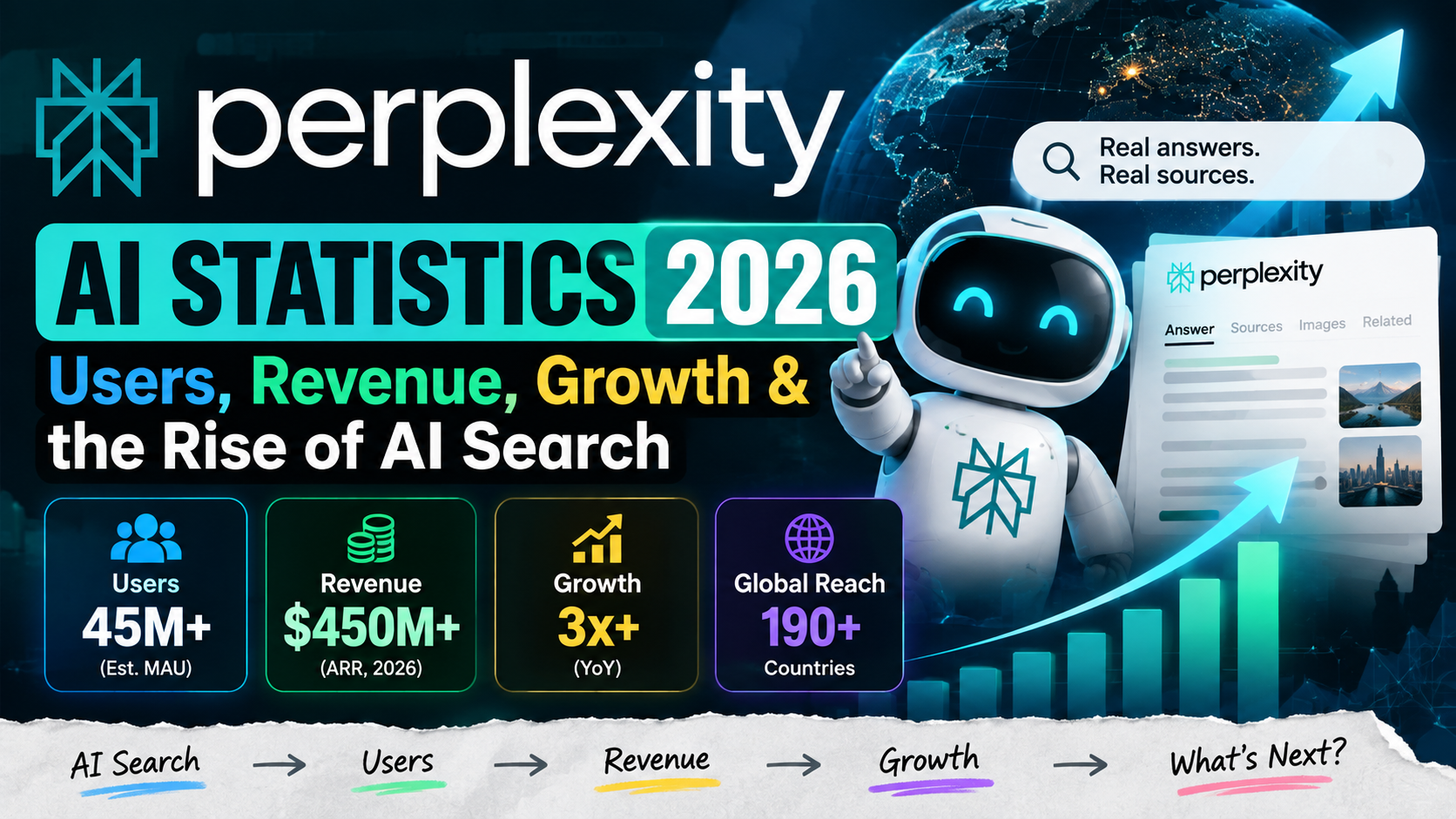
A few months back, a business owner asked me a question I couldn’t brush off. Anna, my customers say they ask Perplexity instead of Googling now. Should I be worried? Perplexity AI statistics 2026
Fair question. And honestly, a little uncomfortable if you’ve spent years building rankings on Google.
So I went looking for the real numbers. Not hype, not screenshots from LinkedIn, just what the data actually says about Perplexity in 2026 and what it means if your income depends on being found online.
Table of Contents
ToggleIntroduction
Perplexity is an AI answer engine. You ask a question, it searches the web, and it writes a short answer with numbered sources next to each claim. That last part is what makes it different, and it’s why SEO people are paying attention.
In this guide you’ll get the key Perplexity statistics for 2026, including users, revenue, valuation and market share. You’ll also see why the numbers disagree depending on where you look, and what you can do this month to get your pages cited. If you run a local business or handle marketing for one, there’s a section for you too.
Quick Answer
Perplexity AI is valued at about $22.6 billion after a January 2026 funding round, and the Financial Times reported annualized revenue above $450 million in March 2026. User estimates range from roughly 30 to 45 million monthly active users. For SEO, it matters because every answer carries clickable citations that can send real traffic.
What Is Perplexity AI?
Perplexity is a search tool built around conversation. Instead of ten blue links, you get a written answer, and each sentence points back to the page it came from.
Think of it like asking a well read friend who always tells you where they heard something. You can click through and check.
It runs a live web search for most queries, pulls back current sources, and feeds them to a language model that writes the answer. The citations are the sources it actually used, not decoration added later.
A simple example. Someone types “best hair smoothing treatment for humid weather.” Perplexity pulls pages from salons, dermatology sites and review blogs, writes a short summary, and credits each one. If your page is one of those credited sources, you just got in front of a buyer without winning a Google ranking.
Perplexity AI Statistics 2026: The Numbers That Matter
Let me start with the table, then I’ll explain how much to trust each row.
| Metric | Figure | How reliable is it? |
|---|---|---|
| Valuation | About $22.6 billion (January 2026) | Widely reported |
| Annualized revenue | Above $450 million (March 2026) | Reported by the Financial Times |
| Monthly active users | Roughly 30 to 45 million | Estimates only, no official number |
| Monthly website visits | About 138 to 171 million | Varies by tracking tool |
| Share of AI chatbot referrals | About 7.7% (April 2026) | Statcounter data |
| Total funding | About $1.72 billion | Reported by trackers |
| Queries | 780 million in May 2025 | Company figure, now out of date |
Valuation and funding
Perplexity reached a valuation of $22.6 billion after a January 2026 funding round, on roughly $450 to $500 million of annualized revenue. That works out to somewhere between 35 and 50 times revenue, which is high, but lower than the over 100 times investors paid in 2025.
Total funding sits near $1.72 billion across 11 rounds, according to one tracker. There were also reports of a new round with Nvidia in talks above a $30 billion valuation, though I couldn’t confirm that from a primary source.
Revenue
This is where Perplexity has genuinely surprised people. Annualized revenue went from about $100 million in March 2025 to $200 million in September 2025 and then $450 million in March 2026.
The Financial Times linked the jump to AI agents, enterprise deals and usage based pricing.
One tracker puts annualized revenue near $750 million by August 2026. That would be a huge leap, but I only found it on one site, so treat it as a possibility, not a fact. Quote the $450 million figure and name the Financial Times as the source. That’s the safer line.
Users
Here’s the messy part. One source says 34 million monthly active users in March 2026. Another says around 45 million. Some sites claim 100 million or more, but that number seems to count users across all Perplexity products, not just the main search app.
My honest read? Somewhere between 30 and 45 million people use Perplexity every month, and the real figure is probably nearer the middle. Nobody outside the company knows exactly.
Queries and traffic
Perplexity processed roughly 780 million queries in May 2025. That’s the last figure the company itself shared in public. Some 2026 sites claim 1.2 to 1.5 billion monthly queries, but I couldn’t trace those to a solid source.
Website visits sit between 138 million and 171 million a month depending on which tool you trust. Compared with Google, it’s tiny. Compared with where Perplexity was two years ago, it’s a different company.
Market share
Statcounter put Perplexity at 7.73% of worldwide AI chatbot referrals in April 2026. That’s referrals, meaning clicks sent out to websites, which is the number SEO people should care about most.
By overall user count Perplexity is much smaller, around 2% of the AI chatbot market. So it’s a small giant. Few people use it, but the ones who do click through to sources more often than ChatGPT users tend to.
Why Is Perplexity's Growth Important?
Because it changes what “being found” means.
When someone searches on Google, you compete for a position. When someone asks Perplexity, you compete to be one of a handful of cited sources. Different game, different rules.
Three reasons it deserves your attention:
- Citations are clickable, which means you can measure the traffic.
- The audience skews toward researchers and professionals who are comparing options.
- Early movers get cited more, because the engine keeps coming back to sources it trusts.
Perplexity is one of the few AI tools where referral traffic shows up in Google Analytics under perplexity.ai. Most other AI tools hide this. That alone makes it worth tracking.
There’s also a note of caution. Perplexity is fighting copyright lawsuits from News Corp and Encyclopaedia Britannica over how it sources content. And CEO Aravind Srinivas told CNBC in June 2026 that an IPO is planned for 2028. Rules around AI and publishers are still being written, so don’t build your whole strategy on one platform.
How Perplexity Picks Sources (And What That Means For You)
This is the part most statistics articles skip, and it’s the part that actually helps you.
Perplexity attributes citations to specific sentences, not whole pages. So each claim on your page needs to stand on its own. If a sentence only makes sense after reading the three before it, it’s less likely to get picked.
Pages that name their own sources tend to earn more citations than pages that don’t. And recency matters. Perplexity leans toward fresher content, so an article from 2022 with no updates is at a disadvantage.
It typically cites 3 to 8 sources per answer. That’s a small door. Being the 12th best result on Google doesn’t help here.
Another interesting finding: one analysis found only 11% of domains are cited by both ChatGPT and Perplexity. Different engines, different favourites. Don’t assume ranking in one means ranking in the other.
Perplexity SEO vs Google SEO
| Area | Google SEO | Perplexity SEO |
|---|---|---|
| Goal | Rank high on a results page | Get cited inside an answer |
| Backlinks | Very important | Helpful, but less dominant |
| Content shape | Full pages, topical depth | Clear, quotable sentences |
| Freshness | Matters for some queries | Matters a lot |
| Tracking | Search Console, rankings | Referral traffic, manual checks |
A Practical Process To Get Cited In Perplexity
Five steps. None need a big budget.
Step 1: Check where you stand today
What it means. Find out whether Perplexity already mentions you or your competitors.
Why it matters. You can’t improve what you haven’t looked at. And it takes about ten minutes.
How to do it. Ask Perplexity the ten questions your customers ask most. Note which sites get cited. Write down whether you appear.
Example. A dentist in Hyderabad types “best clinic for root canal near Banjara Hills” and sees three directory sites and one competitor. Their own site isn’t there. That’s the starting point.
Pro tip. Do this on a fresh browser and repeat it monthly. Answers shift.
Step 2: Write answers, not just pages
What it means. Put a clear, direct answer near the top of each page, in plain words.
Why it matters. Perplexity lifts sentences. Fluffy openings give it nothing to lift.
How to do it. Start each section with a one or two sentence answer, then explain. Keep each claim self contained.
Example. Instead of “Hair smoothing is a topic many people are curious about,” write “Hair smoothing usually lasts three to five months, depending on your hair type and how you care for it.”
Pro tip. Read your page aloud. If a sentence needs the previous one to make sense, fix it.
Step 3: Name your sources and add real data
What it means. Link to original sources and mention who said what.
Why it matters. Pages with named sources tend to earn more citations than pages with anonymous claims. It also builds trust with people reading.
How to do it. Instead of “studies show,” write “Statcounter reported in April 2026.” Add the date. Link to the primary source, not a blog that copied it.
Example. On a stats article like this one, every number gets a name and a month next to it.
Pro tip. If you have your own numbers, even small ones from your own clients, publish them. Original data is rare, and rare gets cited.
Step 4: Keep pages fresh
What it means. Update important pages on a schedule.
Why it matters. Recency pulls weight with Perplexity, and stale stats make you look careless.
How to do it. Put a “last updated” date on the page. Review your top ten pages every quarter. Replace old numbers.
Example. This article should be updated every few months, because Perplexity’s numbers are moving fast.
Pro tip. Don’t change the date without changing the content. It’s easy to spot and it hurts trust.
Step 5: Make sure Perplexity can reach you
What it means. Check that your site isn’t accidentally blocking Perplexity’s crawler.
Why it matters. You can write the best page in your niche and still never get cited if the crawler can’t read it.
How to do it. Open your robots.txt file and look for rules blocking PerplexityBot. Test that your pages load fast and don’t hide key text behind scripts.
Example. Some security plugins block unknown bots by default. Owners never notice until they check.
Pro tip. Ask your developer. It’s a five minute fix if something’s wrong.
Common Mistakes
Trusting one statistic site. As you’ve seen, the user numbers vary wildly. If you copy a number without checking, you may publish something wrong. Fix it by using ranges and naming the source.
Ignoring Google because AI is exciting. Perplexity is still small next to Google. Dropping your Google work to chase AI citations would be a costly mistake. Do both.
Writing for robots only. Pages stuffed with Q and A blocks and nothing human read badly, and people leave. Write for a person first.
Never checking the actual traffic. Many owners assume AI traffic is zero. Open Google Analytics and filter for perplexity.ai. You may be surprised, or you may confirm it’s small. Either answer helps.
Letting content go stale. An outdated stat on a page is a quiet signal that nobody is minding the shop.
Best Practices
Keep these in front of you when you publish anything new:
- Lead each section with a direct answer
- Name sources and add the month and year
- Use short paragraphs and clear headings
- Add an author name and a short bio so readers know who wrote it
- Update key pages every quarter
- Track perplexity.ai referrals in Google Analytics every month
- Keep doing the basics of Google SEO, because they still carry most of your traffic
Tools and Resources
You don’t need expensive software to start.
| Tool | What it does | Cost |
|---|---|---|
| Perplexity itself | Manual checks of who gets cited for your questions | Free |
| Google Analytics 4 | Shows referral traffic from perplexity.ai | Free |
| Google Search Console | Shows your Google performance for comparison | Free |
| Statcounter | Public data on AI chatbot referral share | Free |
| Your current SEO suite | Many are adding AI visibility tracking, so check what yours offers | Varies |
Real Life Example: A Local Salon And The Perplexity Test
This is an illustrative scenario, not a client result.
Situation. Picture a hair studio in Vizag with a decent Google presence for “hair spa in Vizag” but a thin website.
Challenge. When the owner asks Perplexity about hair smoothing aftercare, it cites two international brand blogs and a forum. The studio doesn’t appear, even though the team knows far more about local humidity and water quality.
Action. The studio publishes a clear aftercare page. It opens with a direct answer, names its stylists, mentions local conditions like coastal humidity, and cites a dermatology source. The page gets a visible updated date and a short author bio.
Result. What you can reasonably expect is a better shot at being cited for local, specific questions, since big international brands rarely cover those. The honest way to measure it is to repeat the same ten Perplexity questions each month and watch referral traffic in Analytics. I wouldn’t promise a number, and nobody honestly can.
Expert Tips
A few things I’d tell a friend over chai.
Local detail is your edge. Big publishers can’t write about water quality in Vizag or traffic near Jubilee Hills. You can. Perplexity users asking location specific questions often get weak answers, and that’s room for you.
Treat Perplexity as a research channel, not just a traffic source. Look at which sources it cites for your topic. Those are the pages shaping buyer opinion, and they show you what depth is expected.
Don’t bet everything on one platform. Perplexity changes how it ranks sources from time to time, and the legal fights over content could change things again. Build a site that works well for people, and good AI visibility tends to follow.
Watch the Publishers Program. Perplexity launched it in July 2024 to share revenue with partners. It’s aimed at larger publishers for now, but it tells you where the company is heading.
Frequently Asked Questions
How many users does Perplexity AI have in 2026?
Estimates range from about 30 to 45 million monthly active users. Perplexity hasn’t published an official figure, so numbers differ between trackers. Claims of 100 million or more usually count all its products together.
How much revenue does Perplexity make?
The Financial Times reported annualized revenue above $450 million in March 2026. One tracker suggests about $750 million by August 2026, but I couldn’t verify that.
What is Perplexity AI worth?
About $22.6 billion after a funding round in January 2026.
Is Perplexity bigger than ChatGPT?
No. Perplexity holds a small share of overall AI chatbot use, around 2%. It does send a meaningful share of referral clicks, about 7.7% in April 2026 per Statcounter.
Is Perplexity going to replace Google?
Not any time soon. It’s growing fast but starts from a much smaller base. For most businesses it works best as an extra channel next to Google.
How does Perplexity choose which websites to cite?
It runs a live search, ranks the pages it finds, and cites the ones its model uses in the answer. Clear, quotable sentences, named sources and fresh content all help.
Can small websites get cited in Perplexity?
Yes. Niche specialists often get cited over big publishers on narrow topics, especially local or very specific ones.
How do I check if Perplexity sends me traffic?
Open Google Analytics and filter referral traffic for perplexity.ai. Check your top landing pages to see which ones get the clicks.
Key Takeaways
- Perplexity is valued at about $22.6 billion and had annualized revenue above $450 million in March 2026
- User estimates run from 30 to 45 million monthly, and no official number exists
- It’s small compared with Google, but its citations send trackable clicks
- Perplexity cites roughly 3 to 8 sources per answer, so each spot matters
- Clear sentences, named sources and fresh content improve your chances
- Check your own data in Google Analytics before deciding how much effort to put in
- Keep investing in Google SEO, since it still brings most of the traffic
Conclusion
Perplexity isn’t going to wipe out search overnight, and anyone telling you otherwise is selling something. But it’s real, it’s growing, and it rewards the kind of content good marketers should be writing anyway.
Start small. Ask Perplexity ten questions about your business, see who gets cited, and look at your analytics. That one hour will tell you more than any statistics page, including this one.