

The Brief Nobody Reads Is the Reason Your Content Doesn’t Rank
You have probably lived this exact moment. A writer opens your content brief, skims two lines, and starts typing whatever comes to mind. Three days later you get back a piece that technically covers the keyword but says nothing your reader actually needed. It ranks on page four, gets a handful of visits, and quietly dies
This happens more often than most agencies admit. And the root cause is rarely the writer. It’s the brief.
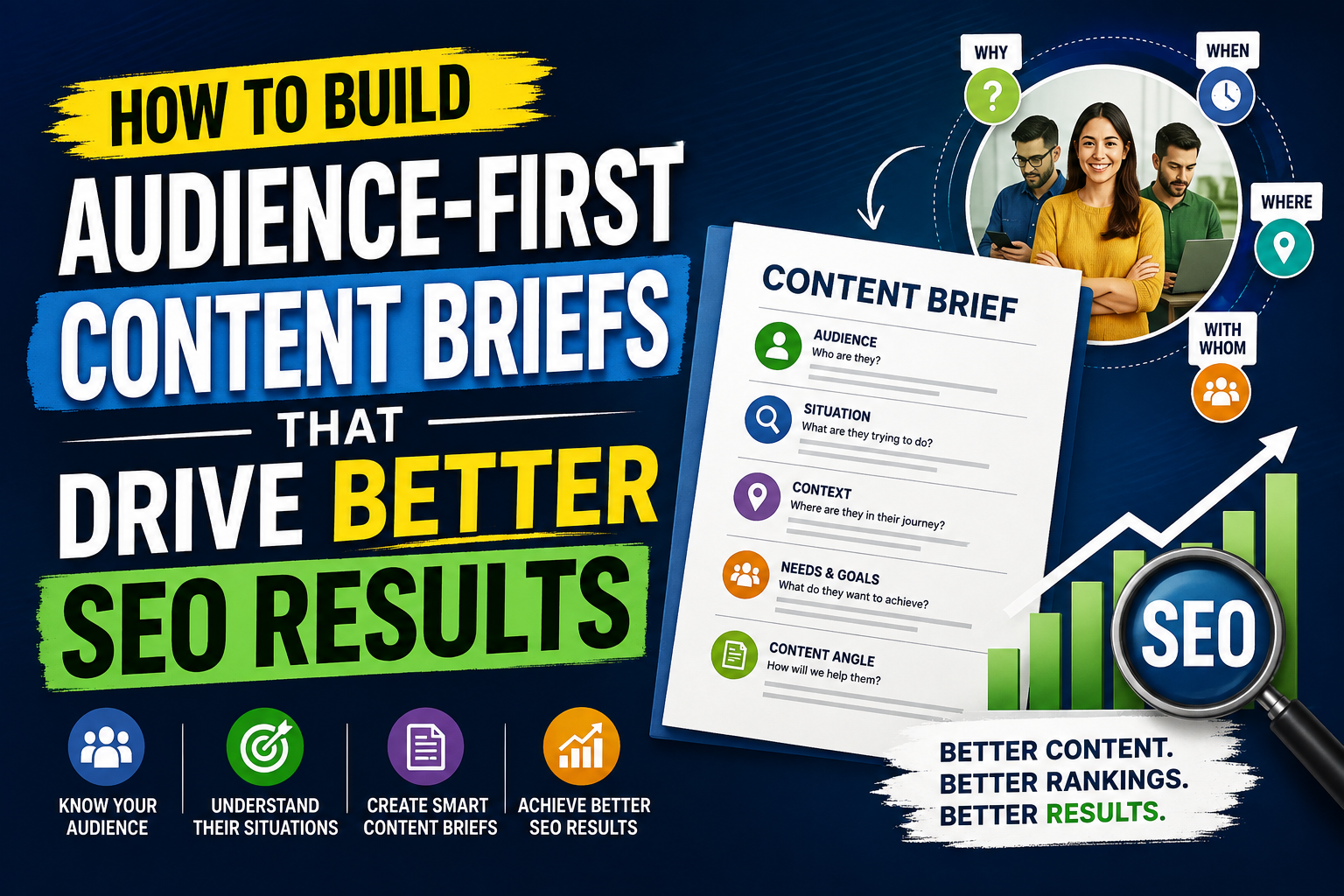
Most content briefs are built around a keyword and a word count. That’s it. No sense of who’s reading, what they’re worried about, or what question is actually running through their head at 11pm when they open Google. An audience first brief flips that entirely. It starts with the person, not the keyword, and everything else gets built around them Audience-First Content Briefs
If you run content for clients, or even for your own brand, this shift changes the entire game.
Table of Contents
ToggleQuick Answer Audience-First Content Briefs
An audience first content brief is a document built around reader intent, questions, and context rather than just keywords and structure. It defines who the reader is, what problem they’re solving, what stage of the buying journey they’re in, and what would genuinely help them. This approach leads to content that ranks better because it satisfies real search intent, matches what Google and AI engines look for in helpful content, and converts more readers into leads.
What Is an Audience First Content Brief?
Think of it like this. A regular brief tells a writer what to say. An audience first brief tells a writer who they’re talking to.
At its core, it’s a planning document that puts the reader’s problem at the center of every decision, from the headline down to the FAQs. Instead of starting with “write 1500 words on hair transplant cost,” it starts with “our reader is a 32 year old who’s embarrassed about thinning hair, has already Googled three other clinics, and wants to know if this is safe before they even think about price.”
See the difference? One is a topic. The other is a person with a real, specific worry.
A simple real world example. Say you’re writing about non surgical hair replacement for a client like a hair studio. A keyword only brief says “cover benefits, process, cost.” An audience first brief says “this reader has probably tried oils and supplements already, feels a bit hopeless, and is scared of looking fake or getting judged. Address that fear directly before selling the service.”
Same topic. Completely different content. And completely different results.
Why Audience First Briefs Matter So Much Right Now
Search has changed. Google’s helpful content system rewards pages that genuinely serve the person searching, not pages stuffed with keywords. AI Overviews, ChatGPT, and Perplexity pull answers from content that clearly understands intent and context, not content that just repeats a phrase fifteen times.
Here’s the honest truth from someone who’s run this process across dozens of client projects. Keyword stuffed content still occasionally ranks in the short term. But it almost never holds. It gets outranked the moment Google refreshes its algorithm, and it never earns the kind of engagement that builds topical authority over time.
An audience first approach fixes this at the source.
It improves dwell time because readers actually find what they came for. It improves conversion because the content speaks to a real emotional or practical need instead of a generic pitch. And it naturally builds the semantic depth search engines look for, because when you write for a specific person’s situation, you end up covering related questions, concerns, and terms without forcing them in artificially.
There’s also a trust dimension here that people underestimate. When content clearly understands the reader’s situation, it reads as more credible. That’s EEAT in action, not as a checklist you tick, but as something that happens naturally when you actually know who you’re writing for.
The Complete Step by Step Process for Building an Audience First Brief
Step 1: Define the Real Reader, Not a Demographic
What It Means This isn’t “women aged 25 to 45.” That’s a demographic, not a person. You need a specific situation. What’s happening in their life right now that brought them to this search.
Why It Matters Content written for a demographic feels generic because demographics don’t have problems, people do. When you know the actual situation, your word choices, examples, and tone all shift naturally toward something real.
How To Do It Pull this from actual sources. Client sales calls, WhatsApp inquiries, comment sections, Google reviews, competitor reviews, even Reddit threads on the topic. Look for the exact language people use to describe their problem.
Example Instead of “brides looking for hair extensions,” write “a bride three weeks out from her wedding who’s panicking because her hair looks thin in photos and she doesn’t want a wig, she wants something that looks like her own hair.”
Pro Tip Keep a running document of real customer language pulled from support chats or comments. This becomes gold for every future brief, not just one.
Step 2: Map the Actual Search Intent Behind the Keyword
What It Means Every keyword hides an intent underneath it. Someone searching “hair patch cost Hyderabad” isn’t just asking about price. They’re often asking “is this affordable for someone like me, and is it worth it.”
Why It Matters If your content only answers the surface question, it misses everything the reader actually needed to make a decision. That’s why so many “cost” pages have high bounce rates. They give a number and nothing else.
How To Do It Search the keyword yourself. Read what’s currently ranking. Check the “People Also Ask” box. Look at related searches at the bottom of the page. These are direct signals of what real people also wanted to know.
Example For “GEO vs SEO,” the surface intent is a definition. The deeper intent is usually “do I need to change my content strategy because of AI search, and if so, how.”
Pro Tip If a keyword has commercial intent hiding under an informational search, your brief should plan a soft transition toward a next step, not a hard sell.
Step 3: Structure the Brief Around Questions, Not Sections
What It Means Rather than listing generic headers like “Introduction, Benefits, Process, Conclusion,” structure the brief as a list of specific questions the reader is silently asking.
Why It Matters Question based structure naturally aligns with how Google and AI Overviews pull featured snippets and direct answers. It also keeps the writer focused on solving something instead of filling space.
How To Do It For each section, write it as a question first, then note what a genuinely useful answer would include. This forces clarity before a single sentence gets written.
Example Instead of a header called “Benefits,” use “Will this actually look natural, or will people notice?” That’s the real question behind the section, and it’s far more compelling as a header too.
Pro Tip Steal your best FAQ questions directly from client DMs and comments. Real questions almost always outperform ones you invent from a keyword tool.
Step 4: Add Emotional and Practical Context for Each Section
What It Means Every section should carry a note on tone and context, not just content points. Should this section be reassuring, direct, cautious, exciting?
Why It Matters Writers without this context default to a flat, neutral tone throughout, which is exactly what makes content feel AI generated or robotic, even when a human wrote it.
How To Do It Add a one line note under each section header describing the emotional temperature. “This section should feel reassuring, the reader is anxious about judgment.” “This section should feel confident, the reader already trusts the brand and just needs final details.”
Example A section on aftercare for a cosmetic procedure should feel calm and detailed, not salesy. A section comparing pricing plans should feel direct and transparent, not evasive.
Pro Tip If you’re producing content in Tenglish or another code switched style for a specific market, note that directly in the brief so the tone doesn’t get lost in translation.
Step 5: Structure the output into an actionable report
What it means Raw AI output is useful, but a formatted report is what actually gets used by a content team.
Why it matters If your writers have to dig through paragraphs to find what to fix, they won’t. A clean scorecard gets acted on.
How to do it Have Claude return its analysis in a consistent structure every time. Overall score, individual pillar scores, top three fixes, and a short summary a non-technical person could read in fifteen seconds.
Example Something like: Overall E-E-A-T Score: 6.4 out of 10 Experience: 5/10, missing first-hand detail Expertise: 7/10, claims are reasoned but underexplained Authoritativeness: 6/10, no outbound citations Trust: 8/10, factually accurate, clear tone
Pro tip Export this as a simple markdown or CSV file so it plugs straight into whatever reporting system you already use for clients.
Step 5: Build In Semantic and Entity Coverage Naturally
What It Means Rather than a rigid keyword list, include related entities, terms, and concepts the topic naturally touches, based on what a genuine expert would mention.
Why It Matters This is what search engines and AI models actually use to judge topical depth. Not repetition of the exact keyword, but the presence of related concepts that prove the content genuinely understands the subject.
How To Do It List out related terms, brand names, tools, locations, or concepts connected to the topic. For a local service business, this often includes neighborhood names, common comparison brands, and industry specific terminology.
Example A brief on non surgical hair replacement should naturally include related terms like hair bonding, hair weaving, scalp micropigmentation, and hair systems, even if the main keyword is just one of these.
Pro Tip Don’t force every related term into one piece. Spread them across a content cluster instead, and link the pieces together.
Step 6: Define the Action You Want the Reader to Take
What It Means very brief needs a clear answer to “what happens after they finish reading this.”
Why It Matters Content without a defined next step tends to end weakly, and readers leave without converting even when they were genuinely interested.
How To Do It Decide upfront whether this piece is meant to build awareness, nurture consideration, or drive a direct action like booking a consultation or messaging on WhatsApp. Write the CTA into the brief itself so it doesn’t get forgotten or feel bolted on.
Example A TOFU piece on “what is hair thinning caused by” might end with a soft nudge toward a free consultation. A BOFU piece on “hair patch cost near me” should end with a direct, specific CTA.
Pro Tip Match the CTA intensity to the funnel stage. A hard sell on a top of funnel piece usually hurts trust more than it helps conversion.
Common Mistakes People Make With Content Briefs
Mistake: Building the brief entirely around a keyword tool export. Impact: The content answers a search term but misses the actual human question behind it, leading to weak engagement even with decent rankings. Solution: Always pair keyword data with real customer language from calls, comments, or reviews.
Mistake: Writing generic buyer personas with no specific situation attached. Impact: Writers default to safe, forgettable language because there’s no real person to write for. Solution: Replace personas with specific scenarios pulled from actual customer interactions.
Mistake: Treating every section with the same tone. Impact: Content feels flat and often reads as AI generated, even when it isn’t. Solution: Note the emotional context for each section directly in the brief.
Mistake: Skipping the “why” behind each recommended section. Impact: Writers include sections just because a template says to, without knowing what purpose they serve. Solution: Explain the reasoning behind every section so writers understand intent, not just instruction.
Mistake: No clear CTA strategy tied to funnel stage. Impact: Pieces either feel pushy too early or end weakly with no direction at all. Solution: Define funnel stage and CTA intensity before writing begins.
Best Practices for Audience First Briefs
Keep briefs specific enough that two different writers would still produce content that serves the same reader, even with different wording.
Pull real questions from support conversations, reviews, and comments every single month. Audiences shift, and stale research produces stale briefs.
Write the brief in plain language, not marketing jargon. If a brief is confusing to read, it will produce confusing content.
Always separate informational and commercial intent within a topic cluster instead of cramming both into one piece.
Review briefs against actual ranking pages before finalizing, not just against a keyword list.
Tools and Resources for Building Better Briefs
| Tool | Best For | Notes |
|---|---|---|
| Google Search (manual) | Understanding real intent and current SERP structure | Free and often more accurate than tools for intent mapping |
| AnswerThePublic or similar question tools | Surfacing question based search queries | Good starting point, always cross check with real customer language |
| Customer support chats and reviews | Pulling authentic reader language | The single most underused research source in most agencies |
| SEO platforms like Ahrefs or SEMrush | Keyword volume and competitive gaps | Useful for prioritization, not for understanding emotional intent |
| AI Overview and Perplexity checks | Seeing what generative engines currently surface | Helps shape content for GEO and AEO, not just traditional SEO |
Real life example
Situation: A hair studio client was publishing blog content around hair replacement topics, ranking decently, but seeing very few consultation bookings from organic traffic.
Challenge: The existing briefs were keyword driven. Content covered “process” and “benefits” in a generic way that could have applied to almost any provider.
Action: Briefs were rebuilt around specific reader situations pulled directly from WhatsApp inquiries, things like fear of judgment, worry about maintenance, and confusion between different hair systems. Each brief included tone notes and a clearly defined next step tied to the funnel stage.
Result: Within a few content cycles, time on page increased noticeably, and more importantly, consultation inquiries from blog traffic started showing up consistently instead of sporadically. The content wasn’t just ranking, it was actually doing the job it was written for.
Expert Tips for Going Further
Build a shared “voice of customer” document that every brief pulls from, updated regularly with fresh language from support chats and reviews. This alone will improve every piece of content your team produces.
When writing for AI Overviews and answer engines specifically, make sure your Quick Answer section could stand entirely on its own as a 40 to 60 word response. Test it by reading it in isolation, away from the rest of the page.
Don’t treat FAQs as an afterthought at the bottom of the brief. Some of your best ranking opportunities live in long tail question keywords that only show up in FAQ sections.
For local service brands, weave in location specific context naturally rather than just inserting a city name for the sake of it. Readers can tell the difference between genuine local relevance and a find and replace job.
Frequently Asked Questions
What makes a content brief audience first instead of keyword first?
An audience first brief starts with a specific reader situation and their real question, then builds structure and keywords around that. A keyword first brief starts with search volume and builds content to match the term, often missing the actual intent behind it.
Do audience first briefs take longer to create?
They take a bit more research upfront, usually because you’re pulling from real customer conversations instead of just a keyword tool. But they save time later since content needs far fewer rewrites and revisions.
Can audience first briefs improve rankings for AI Overviews and ChatGPT results?
Yes. Generative engines favor content that clearly answers a specific question with genuine context, which is exactly what audience first briefs are built to produce.
What's the biggest source for finding real audience questions?
Customer support chats, WhatsApp inquiries, Google reviews, and comment sections almost always outperform keyword tools for finding the exact language and concerns of real readers.
How is this different from a buyer persona?
A buyer persona is usually a broad, semi fictional profile. An audience first brief uses a specific, real situation pulled from actual customer interactions, which tends to produce far more useful, grounded content.
Should every blog post have a different audience brief?
Ideally yes, even within the same target persona, because the specific question or concern often shifts from one piece to the next.
Does this approach work for local service businesses, not just big brands?
It actually works especially well for local businesses, since local audiences often have very specific, easily identifiable concerns that large competitors tend to miss.
How do I find search intent if I don't have access to expensive SEO tools?
Manually searching the keyword and studying the current top ranking pages, the People Also Ask box, and related searches gives you most of what you need for free.
What's the ideal length for a content brief itself?
Long enough to give a writer real direction, short enough that they’ll actually read it. Most solid briefs run one to two pages, focused on clarity over volume.
Can this method help with content that's meant to convert, not just rank?
Yes, and that’s really the point. Because the brief is built around a real reader’s situation and next step, the resulting content naturally guides toward action instead of just informing.
Key Takeaways
- Audience first briefs start with a specific reader situation, not a keyword or demographic
- Real customer language from support chats and reviews consistently beats generic keyword research
- Structuring briefs as questions instead of sections aligns better with how Google and AI Overviews serve answers
- Emotional and tonal context for each section prevents flat, robotic sounding content
- Every brief should define a clear next step tied to the reader’s funnel stage
- This approach improves both search performance and actual conversion, not just rankings
Conclusion
Content briefs are one of those things that seem small until you realize they’re actually the whole game. Get the brief right and everything downstream gets easier, the writing, the ranking, the conversions. Get it wrong and no amount of editing saves the piece.
The shift from keyword first to audience first isn’t complicated. It just asks you to slow down for a moment before writing anything and actually think about the person on the other end of the screen. What are they worried about. What do they need to hear. What would make them trust you enough to take the next step.
That one shift changes everything else that follows.
Ready to Build Briefs That Actually Work?
Start with your next piece of content. Before you write a single line, pull up three real customer conversations related to that topic and write down their exact words. Build your brief around that instead of a keyword list. You’ll notice the difference the moment you start writing, and your readers will notice it even faster.