

The problem nobody talks about
You spend three hours writing a blog post. It’s well researched, it answers the query, you’re proud of it.
Then it sits on page four of Google for six months.
If you’ve been doing SEO for a while, you already know why. Google isn’t just checking keywords anymore. It’s checking whether your content actually deserves to rank, based on Experience, Expertise, Authoritativeness, and Trust. That’s E-E-A-T, and most content teams still audit it by gut feeling instead of by process.
I run a digital marketing agency, and this exact gap cost us rankings on more than one client project before we fixed it. So we built something to fix it properly: an AI-powered E-E-A-T checker using Claude Code. Not a fancy SaaS tool, not a browser extension you pay monthly for. A working script that reads your content the way an actual human reviewer would, and flags what’s missing.
This guide walks you through building your own version, step by step.
Table of Contents
ToggleQuick answer AI-powered E-E-A-T checker
An AI-powered E-E-A-T checker is a script built with Claude Code that analyzes a piece of content against Google’s Experience, Expertise, Authoritativeness, and Trust signals, then returns a scored report with specific fixes. You build it by defining E-E-A-T criteria as structured prompts, feeding your content through Claude’s API, and having it return actionable, categorized feedback instead of a vague pass or fail grade.
What is an E-E-A-T checker, really
An E-E-A-T checker isn’t a keyword density tool wearing a fancy name. It’s meant to answer a much harder question: if a real subject matter expert read this page, would they trust it?
Google’s own Search Quality Rater Guidelines lay out what raters look for. Things like author credentials, first-hand experience, citations, factual accuracy, and whether the site itself has a reputation worth trusting. A proper checker tries to simulate that human judgment at scale.
Here’s a simple way to picture it. Imagine handing your article to an experienced editor and asking three questions: Does this person clearly know what they’re talking about? Have they actually done this thing they’re describing? Would I trust this page with my credit card details? That’s the entire spirit of E-E-A-T, just formalized into a checklist Google’s algorithms can approximate.
Why this matters more than most SEOs admit
A lot of SEO advice from a couple of years back doesn’t hold up anymore. Stuff more content, more backlinks, more keyword variations used to move the needle on its own. Now Google’s helpful content systems and AI Overviews are actively rewarding pages that show genuine expertise and punishing pages that read like they were assembled rather than written.
We saw this directly with one of our hair studio clients. Their blog had solid keyword coverage but almost zero experience signals, no author bio, no first-person detail, nothing showing the writer had actually worked in a salon. Once we rebuilt the content around real stylist input and added credentials, organic traffic climbed within weeks. Same keywords, same word count, completely different trust signal.
If you’re publishing content and E-E-A-T isn’t part of your process, you’re optimizing for a version of Google that doesn’t really exist anymore.
Complete guide: building your E-E-A-T checker with Claude Code
Step 1: Set up your Claude Code environment
What it means Claude Code is Anthropic’s coding assistant that runs from your terminal or IDE, and it can read files, write scripts, and execute code on your behalf. You’ll use it to build the checker itself, not just to analyze content manually.
Why it matters Manually running your content through a chat window every time is fine for one article. It falls apart the moment you’re auditing fifty pages a month. A proper script scales.
How to do it Install Claude Code, connect it to a project folder where your content lives, and give it access to run Python or Node scripts. If you’re on a team, set this up in a shared repo so everyone’s auditing against the same criteria.
Example A simple starting structure might be a folder with an articles directory holding your drafts, and a checker.py file that will hold your audit logic.
Pro tip Don’t overthink the folder structure early on. Get one article scoring correctly before you try to batch process twenty of them.
Step 2: Define your E-E-A-T scoring criteria
What it means Before Claude can grade anything, you need to tell it exactly what good looks like. This is the part most people skip, and it’s the part that decides whether your checker is actually useful or just generates generic feedback.
Why it matters Vague prompts get vague results. “Check this for E-E-A-T” will give you a mushy paragraph. A detailed rubric gives you a real audit.
How to do it Break E-E-A-T into checkable sub-signals. For Experience: does the content include specific details, numbers, or outcomes that suggest the writer actually did the thing. For Expertise: are claims backed by reasoning, not just assertion. For Authoritativeness: are there credentials, citations, or outbound links to credible sources. For Trust: is there transparency, accurate information, and no misleading claims.
Example A rubric entry might read: “Score 0 if the article makes claims with no supporting detail. Score 5 if claims are backed by specific numbers, named examples, or described first-hand outcomes.”
Pro tip Write this rubric the way you’d brief a new junior team member. If they’d understand exactly what to check, Claude will too.
Step 3: Build the prompt that drives the analysis
What it means This is the actual instruction set you send to Claude, combining your rubric with the content you want scored.
Why it matters A well-structured prompt is what separates a tool that gives you a real, usable audit from one that just flatters your content.
How to do it Ask Claude to act as an experienced content quality reviewer following Google’s Search Quality Rater Guidelines. Feed in your rubric from step two. Then ask it to score each E-E-A-T pillar out of 10, explain the score in plain language, and list specific fixes ranked by impact.
Example Something like: “Review the following article against these four E-E-A-T criteria. For each pillar, give a score out of 10, a one-line reason, and two concrete improvements. Be honest, don’t inflate scores.”
Pro tip Add the line “be honest, don’t inflate scores” every single time. Left unchecked, AI models tend to be generous graders, and generous grading defeats the entire point of building this.
Step 4: Automate content ingestion
What it means Instead of copy-pasting articles one at a time, set up your script to pull content directly from files, a CMS export, or a URL.
Why it matters This is where the tool actually starts saving you time instead of just being a fancier version of manual review.
How to do it Write a small script that reads markdown or text files from a folder, strips formatting where needed, and passes the raw content into your Claude prompt from step three. If you’re pulling from WordPress, export your posts or use the REST API to fetch content directly.
Example A basic loop that reads every .md file in your articles folder, sends each one through the checker, and saves the output as a matching .txt report.
Pro tip Keep raw content and generated reports in separate folders from day one. It gets messy fast otherwise, especially once you’re running this weekly.
Step 5: Structure the output into an actionable report
What it means Raw AI output is useful, but a formatted report is what actually gets used by a content team.
Why it matters If your writers have to dig through paragraphs to find what to fix, they won’t. A clean scorecard gets acted on.
How to do it Have Claude return its analysis in a consistent structure every time. Overall score, individual pillar scores, top three fixes, and a short summary a non-technical person could read in fifteen seconds.
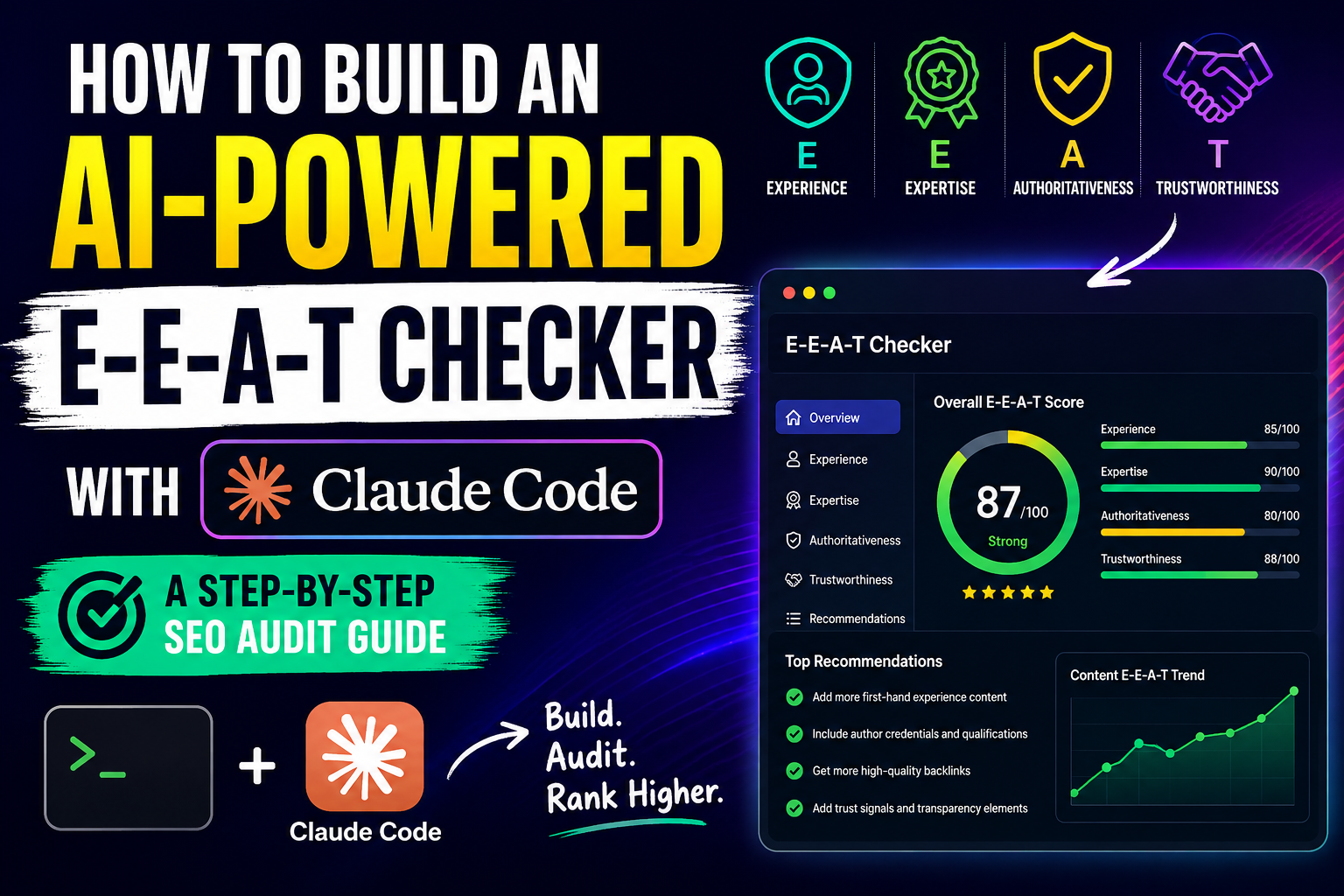
Example Something like: Overall E-E-A-T Score: 6.4 out of 10 Experience: 5/10, missing first-hand detail Expertise: 7/10, claims are reasoned but underexplained Authoritativeness: 6/10, no outbound citations Trust: 8/10, factually accurate, clear tone
Pro tip Export this as a simple markdown or CSV file so it plugs straight into whatever reporting system you already use for clients.
Step 6: Add author and site-level signals
What it means E-E-A-T isn’t only about the article text. It also depends on things around the content, like author bios, about pages, and site reputation.
Why it matters A brilliant article on a site with no author information and no trust signals still struggles to rank. Google looks at the whole picture.
How to do it Extend your checker to also review author bio pages and about pages, checking for real credentials, verifiable experience, and clear contact information.
Example Have Claude flag if an author bio is generic (“passionate writer and content creator”) versus specific (“certified hairstylist with 8 years of salon experience”).
Pro tip This step alone catches a huge number of missed opportunities. Most small business sites have thin or missing author information, and it’s often the easiest fix on the list.
Step 7: Run it against real content and calibrate
What it means Test the checker against content you already know performs well and content you know is weak, then compare the scores to your own judgment.
Why it matters No AI tool is perfectly calibrated out of the box. If your best-performing page scores a 4 and your worst-performing page scores an 8, something in your rubric needs adjusting.
How to do it Run five to ten pieces of known content through the checker. Where the scores don’t match reality, go back to your rubric from step two and tighten the language.
Example If Claude keeps giving high Authoritativeness scores to pages with zero outbound citations, add a hard rule: “Score no higher than 4 on Authoritativeness if there are no citations to external sources.”
Pro tip Calibration isn’t a one-time task. Revisit it every few months as Google’s guidelines and your own content standards evolve.
Common mistakes people make with this
Mistake: treating the AI score as gospel Impact: Teams stop thinking critically and just chase the number. Solution: Use the score as a starting point for discussion, not a final verdict. A human should still review the output.
Mistake: writing a vague rubric Impact: You get generic, unhelpful feedback that could apply to almost any article. Solution: Be painfully specific in your scoring criteria, the way you would brief a new hire.
Mistake: only checking the article, never the site Impact: You fix content-level issues while ignoring missing author pages, no HTTPS, or no contact information, all of which hurt trust. Solution: Build site-level checks into your process, not just article-level ones.
Mistake: running it once and forgetting about it Impact: E-E-A-T standards and your own content quality drift apart over time. Solution: Set a recurring schedule, monthly works well for most small teams.
Best practices worth following
Keep your rubric in a shared document your whole content team can see and edit. E-E-A-T standards shift, and your checker should shift with them.
Pair the AI score with a short human sign-off before anything gets published. The tool speeds up the process, it shouldn’t replace judgment entirely.
Prioritize fixing Experience and Authoritativeness first if you’re short on time. In our experience, these two pillars move the needle fastest for local business content, because they’re the ones most often left completely empty.
Store historical scores so you can track whether your content is actually improving over months, not just guessing.
Tools and resources
| Tool | Best For | Cost |
|---|---|---|
| Claude Code | Building and running the checker script | Included with Claude subscription or API usage |
| Google Search Quality Rater Guidelines | Source rubric material | Free |
| Screaming Frog | Site-wide crawl for author and about page audits | Free tier available, paid for larger sites |
| Google Search Console | Confirming ranking impact after fixes | Free |
Real life example
Situation One of our hair studio clients had a blog with decent traffic but flat conversions and stagnant rankings on competitive local terms.
Challenge The content read well but lacked any real signal that the writer had salon experience. No author bios, no specific outcomes, generic stock advice you could find on a hundred other sites.
Action We ran their top ten blog posts through our E-E-A-T checker. The average Experience score came back at 3 out of 10. We rewrote the posts with direct input from the stylists themselves, added real before-and-after style descriptions, and built out proper author bios with credentials.
Result Within eight weeks, three of the rewritten posts moved from page two to the top five results for their target local terms, and time on page went up noticeably across the board.
Expert tips
Don’t just score the body content. Run your title tags and meta descriptions through the same lens, since misleading titles hurt trust signals even when the article itself is solid.
Feed the checker competitor content occasionally. Seeing how a top-ranking competitor scores gives you a useful benchmark instead of grading in a vacuum.
If you’re auditing content across multiple writers, run the checker before publishing rather than after. Catching a weak Experience score at the draft stage is a lot cheaper than catching it after the page has been live and underperforming for months.
Frequently Asked Questions
What is E-E-A-T in SEO?
E-E-A-T stands for Experience, Expertise, Authoritativeness, and Trust. It’s the framework Google’s quality raters use to judge whether content deserves to rank, especially for topics that affect a person’s health, finances, or safety.
Can AI tools accurately judge E-E-A-T?
AI tools like Claude can approximate human judgment well when given a detailed rubric, but they work best as a first-pass filter, not a final decision maker. Human review still matters.
Is Claude Code free to use for this?
Claude Code usage depends on your Anthropic plan or API pricing. Costs are usually low for text-based analysis like this, especially compared to hiring manual auditors.
How often should I run an E-E-A-T audit?
Monthly works well for active content teams. If you’re publishing daily, consider auditing at the draft stage before anything goes live.
Does E-E-A-T affect small local business websites too?
Yes. Local service businesses, including salons, clinics, and law firms, are actually judged more strictly because their content often touches on health, money, or safety.
What's the difference between E-E-A-T and just good writing?
Good writing is about clarity and flow. E-E-A-T is about trust signals, things like credentials, citations, and demonstrated first-hand experience, which can exist even in average prose or be missing from beautifully written content.
Do I need coding skills to build this checker?
Basic scripting knowledge helps, but Claude Code can assist with writing most of the script itself if you describe what you want clearly.
Can this replace a human content editor?
No. Think of it as a second pair of eyes that never gets tired, not a replacement for editorial judgment.
Does author bio really affect rankings?
It’s one of many trust signals, not a single ranking factor on its own, but sites with clear, credentialed author information consistently show stronger E-E-A-T scores in our testing.
What score should I aim for?
There’s no universal passing score, but anything consistently below 5 across pillars signals content that needs real rework before it will compete for demanding search terms.
Key Takeaways
- E-E-A-T checkers work best when built on a specific, detailed rubric, not vague instructions
- Experience and Authoritativeness are usually the weakest pillars for small business content
- Site-level signals like author bios matter as much as the article text itself
- Calibrate your checker against known good and bad content before trusting its scores
- Human review should always sit alongside the AI score, not replace it
Final thoughts
Building an E-E-A-T checker with Claude Code isn’t about chasing another shiny AI tool. It’s about turning something Google evaluates constantly, but most teams evaluate rarely, into a repeatable part of your content process.
The teams that win in search right now aren’t necessarily writing more content. They’re writing content that actually earns trust, and checking for it before hitting publish instead of finding out six months later from a traffic graph heading the wrong direction.
If you’re publishing regularly and haven’t built something like this yet, start small. Score one article, calibrate your rubric, then scale it up from there.