

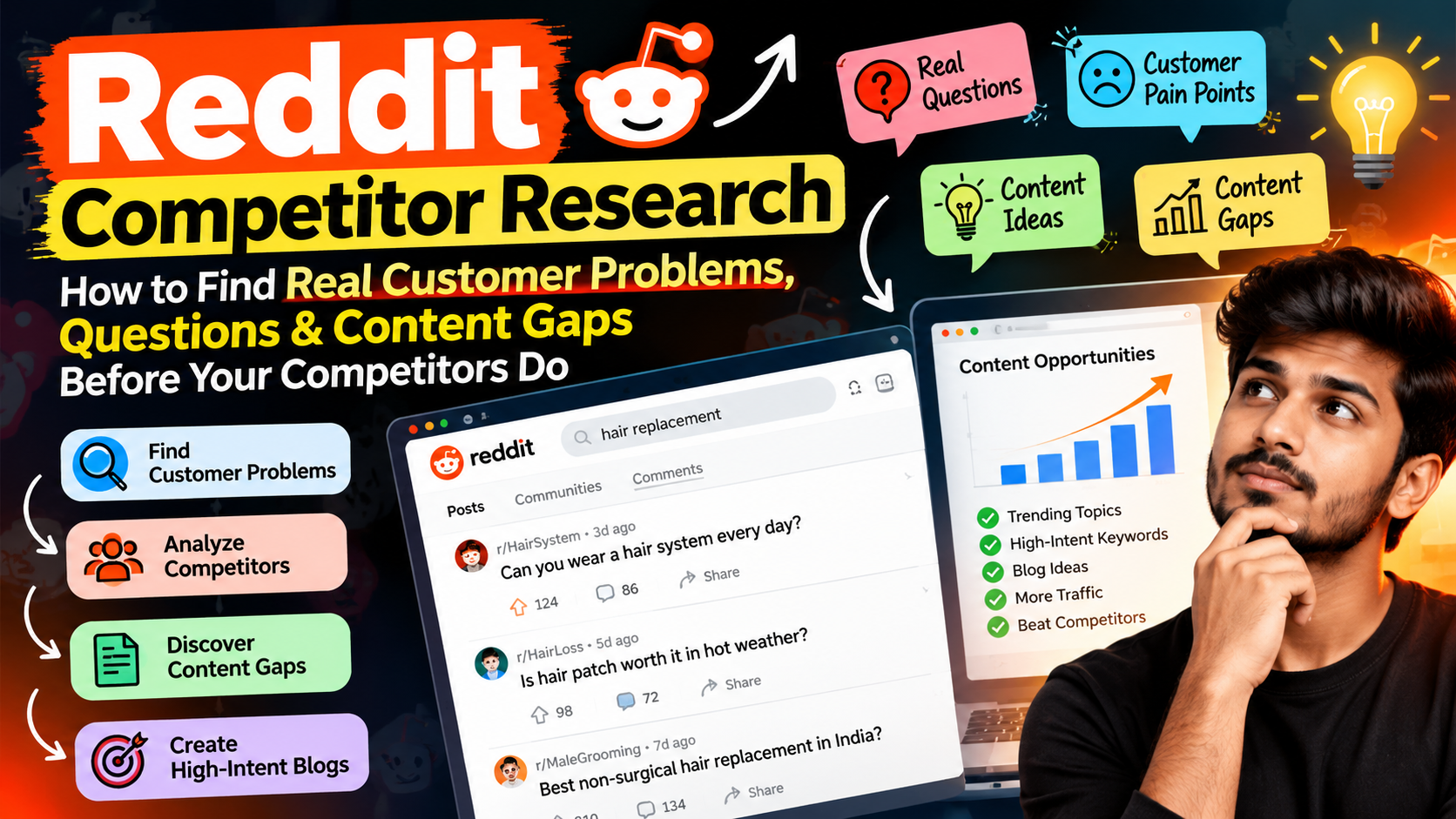
You spent two weeks on a blog post. Good keyword, clean structure, nice design. It went live, got a handful of visits, and nobody called Reddit competitor research
Meanwhile, three streets away (or three browser tabs away), a stranger on Reddit typed a messy, honest question about the exact thing you write about. Forty people replied. Half of them were angry about the same issue. Not one competitor has answered it properly
That thread was sitting there the whole time. Free. Public. Full of the exact words your customers use when they are not talking to a salesperson.
This guide shows you how to find those threads, read them the right way, and turn them into content your competitors will not see coming.
Table of Contents
ToggleIntroduction
Most competitor research stays on the surface. We look at their website, their pricing page, their ads, maybe run their domain through an SEO tool. All useful. But it only shows what competitors chose to publish. It never shows what customers wish someone would say.
Reddit is different. People go there to complain, compare, ask for help and warn each other. They do not write for brands. They write for other people, and that makes the language raw and very useful.
In this guide you will learn how Reddit competitor research works, how to do it step by step, what mistakes waste your time, and how to turn what you find into blogs, ads, landing pages and offers that actually answer real problems.
You do not need a paid tool. You need a free afternoon and a spreadsheet.
Quick Answer
Reddit competitor research means reading the threads where real customers discuss your competitors, your category, and their unsolved problems. Search brand names and category keywords, sort by top and new, note repeated complaints, questions, and phrases, then turn those patterns into content, ads, and offers that answer what competitors ignore.
What Is Reddit Competitor Research?
understand what customers in your market really think, struggle with and ask about, especially where your competitors are failing to answer them.
Think of it like sitting quietly at the next table in a busy cafe. You are not interrupting anyone. You are just listening to how people talk when they are not being polite to a business.
Here is a simple example. Say you run a service business and you search Reddit for the name of a bigger competitor. You find a thread where ten different people say the same thing: the pricing was never clear until the final bill. That is not just a complaint. That is a content idea (an honest pricing guide), an ad angle (no surprise charges), and a trust signal for your landing page. All from one thread.
Why Is It Important?
Because guessing is expensive. Every blog you write about the wrong topic, every ad with the wrong promise, costs time and money you do not get back.
Reddit helps in a few specific ways.
You find problems before they become keywords. Search tools show what people already typed into Google a lot. Reddit often shows what people are struggling with before it becomes a clean, searchable phrase. Early signals are where the opportunity lives.
You hear the real language. Customers rarely say “comprehensive solution” or “premium experience.” They say “I just want someone who will pick up the phone.” When your copy sounds like that, people feel understood. That feeling is what converts.
You see objections you did not know existed. In sales calls, people are polite. On Reddit, they are blunt. A blunt objection is a gift, because you can answer it in your content before the buyer ever raises it.
You spot content gaps. When people keep asking a question and the top answers are old, thin or wrong, that is a gap. Fill it well and you can earn search traffic, and increasingly, citations inside AI answers too.
It costs almost nothing. Compared to surveys, focus groups and paid research tools, this is the cheapest customer research available.
Step by Step: How to Do Reddit Competitor Research
What It Means Subreddits are topic based communities. Each one is its own little neighborhood with its own rules and its own regulars. Finding the right ones means finding where your customers actually hang out.
Why It Matters A broad subreddit gives you noise. A focused one gives you signal. If you research the wrong community, your insights will be about the wrong people.
How To Do It Search your main category on Reddit, then switch the results to the Communities tab.
Check three types: topic communities (your industry), problem communities (people asking for help), and location communities (your city or region, like r/hyderabad or r/india for broader Indian conversations).
Open each one and look at the sidebar. Note the member count, the rules, and how active the posts are.
Pick five to eight communities. Do not go bigger than that at the start.
Example Someone researching a home service business might pick a general home improvement community, a renters community, a budgeting community, and one local city subreddit. Different angles, same buyer.
Pro Tip Read the community rules before anything else. Many subreddits ban self promotion. You are here to listen, not to pitch. Staying quiet in the beginning is part of the job.
Step 2: Search Competitor Names and Category Terms
What It Means Now you hunt for conversations. You search for competitor brand names, product names, and the general problems your category solves.
Why It Matters Brand searches show you what customers think of your rivals. Category searches show you the problems nobody has solved well yet.
How To Do It Run these types of searches, one after the other:
The competitor name alone.
The competitor name plus words like “worth it,” “review,” “problem,” “alternative,” “scam,” or “cancel.”
Phrases like “anyone recommend,” “looking for,” “help with,” “how do I,” and “is it normal.”
Your own category keyword plus “vs” to see comparison threads.
You can also use Google for this. Typing site:reddit.com before your keyword often surfaces older threads that Reddit’s own search buries. Using both gives you better coverage.
Example Searching “[competitor name] alternative” is one of the quickest ways to find people who are actively unhappy and shopping around. Those readers are close to buying. That is bottom of the funnel gold.
Pro Tip Sort by Top for the all time winners, then sort by New to see what people are talking about this month. The first shows lasting problems. The second shows what is changing.
Step 3: Read the Comments, Not Just the Posts
What It Means The original post tells you the question. The comments tell you the truth.
Why It Matters The best insights are usually buried in replies. Someone says “I tried three of them and honestly the issue is always the same thing.” That sentence is worth more than the whole post.
How To Do It Open the threads with the most comments first.
Read the top replies, then scroll to the middle. The middle is where honest, unpolished opinions live.
Look at the replies that got upvotes. Upvotes are a rough vote of agreement.
Pay attention to disagreements. When two groups argue, you have found a topic people care about.
Example A thread asks which provider is best. The top comment recommends one brand, but a reply below it says “great until you need support, then you are on your own.” Ten people agree. That is a service gap, and now you know how to position yourself.
Pro Tip Do not just copy what people say. Ask what they really mean. “Too expensive” often means “I did not understand what I was paying for.”
Step 4: Sort What You Find Into a Simple Tracker
What It Means Raw reading turns into a mess fast. You need a place to drop what you find so patterns can show up.
Why It Matters One complaint is an opinion. Ten complaints about the same thing is a pattern. You will not see the pattern unless you track it.
How To Do It Open a spreadsheet with these columns:
Thread link
Subreddit
Problem or complaint
Question being asked
Objection or fear
Exact customer phrase (copy it word for word)
Which competitor was mentioned
Possible content idea
Fill it as you read. After thirty or forty entries, sort by problem and count the repeats.
Example After a week of reading, you might notice that “unclear pricing” shows up eleven times, “slow replies” shows up seven times, and “no before and after proof” shows up six times. Now you have a ranked list of what to build content around.
Pro Tip Keep the exact phrases in their own column. Those lines become your headlines, your ad hooks and your FAQ questions. Real language beats clever language almost every time.
Step 5: Compare Against What Competitors Already Publish
What It Means A customer problem is only an opportunity if nobody is solving it well. So you check.
Why It Matters If every competitor already has a great guide on the topic, you would be joining a crowded room. If none do, or theirs is weak, you can walk right in.
How To Do It Take your top ten problems from the tracker.
Search each one on Google as a customer would type it.
Look at what ranks. Is it thin? Outdated? Written for the company instead of the reader? Missing the real answer?
Check whether competitor sites answer the question on their blog, FAQ or service pages.
Mark each problem as covered well, covered badly, or not covered at all.
Example Customers keep asking how long a service really takes from start to finish. Every competitor page says “it depends.” You write a plain timeline with realistic ranges and what can slow things down. You have just built something useful that nobody else offers.
Pro Tip Look at the “People also ask” box and AI generated answers for the same search. If those answers feel vague, that is a strong sign the topic is open.
Step 6: Turn Insights Into Content, Ads and Offers
What It Means Research that sits in a spreadsheet earns nothing. This is the step where findings become things people can read, click and buy.
Why It Matters This is where the return on all that reading finally shows up.
How To Do It
Match each type of insight to a format:
Repeated questions become blog posts, FAQs and short videos.
Objections become landing page sections and sales call answers.
Complaints about competitors become your promises, but stated honestly and never as attacks.
Comparison threads become “X vs Y” or “alternatives” pages.
Customer phrases become ad headlines, email subject lines and social hooks.
Example If people keep saying they feel nervous about being upsold, you could write a short post called “What You Should Never Be Pushed to Buy,” publish a clear price list, and run an ad that says the same thing in plain words.
Pro Tip Write the first draft using the customer’s own wording, then polish it. If your copy sounds nothing like the thread you found it in, you have probably polished the life out of it.
Common Mistakes
Mistake 1: Pitching inside the threads. Impact: You get downvoted, banned, or remembered as that spammy brand. Solution: Listen first. If you ever join in, add real help with no links and no sales language.
Mistake 2: Only reading the top post. Impact: You miss the honest replies where the real insight lives. Solution: Always read at least the first twenty comments, plus a few from deeper down.
Mistake 3: Treating one loud opinion as the truth. Impact: You build a whole campaign around something one angry person said. Solution: Wait for the pattern. Three to five separate mentions is a decent starting signal.
Mistake 4: Ignoring who is actually talking. Impact: Reddit users skew a certain way. If your customers do not use Reddit much, you may misread the market. Solution: Treat Reddit as one input. Check it against your own sales calls, reviews and enquiries.
Mistake 5: Not saving the exact words. Impact: Your content ends up sounding generic. Solution: Keep a phrase column in your tracker from day one.
Mistake 6: Copying threads into your content. Impact: It feels cheap, and it can cause copyright and trust problems. Solution: Use threads for understanding only. Write your own answers from your own experience.
Mistake 7: Doing it once and stopping. Impact: Markets change. Last year’s problems are not this year’s. Solution: Put a monthly reminder on your calendar. Even thirty minutes is enough.
Best Practices
- Start with questions you already get from clients. Search Reddit for those first.
- Spend equal time on complaints and on praise. Praise shows what people value and what you must not lose.
- Watch for emotion words like frustrated, confused, scared, tired, ignored. Emotion points to the real problem underneath.
- Keep a running list of questions that make good FAQ entries. They help with search snippets and AI answers.
- Label each finding as top of funnel (learning), middle of funnel (comparing), or bottom of funnel (ready to buy). Then you know what to write for each stage.
- Combine Reddit with your own data. Search Console queries, Google Business Profile questions and WhatsApp enquiries often confirm what Reddit hints at.
- Be honest in your content. If a competitor is genuinely better at something, do not pretend otherwise. Readers can smell it.
- Share your insights with your team or clients in plain language. A one page summary beats a forty row spreadsheet.
Tools and Resources
You can do this with almost nothing. Here is what I would actually use.
- Reddit search and the Communities tab. Free, and where you will spend most of your time.
- Google with site:reddit.com added to your keyword. Free, and great for finding older high ranking threads.
- Reddit Answers. Reddit’s own search feature that summarises discussions. Handy for a quick scan, but always open the original threads before you trust a summary.
- Google Sheets or Excel. Free, and your tracker lives here.
- An AI assistant such as ChatGPT, Gemini or Perplexity. Useful for grouping similar complaints and summarising themes once you have pasted in your notes. Do the reading yourself first. Summaries miss tone.
- Google Search Console and Google Analytics. Free, and good for checking whether your own site already gets traffic around the topics you found.
- Paid SEO tools like Semrush or Ahrefs. Optional. Good for checking search volume once you have a shortlist of topics, but not needed to start.
Real Life Example: How This Plays Out for a Local Service Business
This is an illustrative scenario, not a promise of specific results, but it shows how the process works in practice.
Situation. A hair studio in a busy city wants more bookings from its blog and Google Ads. Their content so far is the usual stuff: “Top 10 hair treatments,” “Why you need a haircut every six weeks.” Traffic is low and calls are lower.
Challenge. They do not know what their customers are actually worried about. Everything they write sounds like every other studio.
Action. They spend one week on Reddit research. They look at hair care, grooming and city communities. They search things like “keratin treatment worth it,” “salon ruined my hair,” and “how much should a haircut cost.”
The same themes keep showing up. People are scared of damage. They hate surprise pricing. They are tired of being upsold products they did not ask for. And they do not know what to say when they walk in, so they get a haircut they regret.
The studio writes four pieces: an honest guide on what to expect from common treatments including the downsides, a plain price breakdown, a short post on how to explain the haircut you want, and a page called “What we will never push you to buy.” They also change their ad copy to mention clear pricing up front.
Result. The content now answers questions competitors skip. Visitors stay longer because the pages sound like a person who gets them. Enquiries are warmer, because people arrive already trusting the studio’s honesty. Over the next few months, that trust shows up in more calls and bookings.
The thing to notice is that none of this needed a big budget. It needed listening.
Expert Tips
Look for the second question. The first question is “which is best?” The second, buried in replies, is “what happened after you chose it?” The second question shows long term pain, and that is where trust gets built.
Track the word “alternative.” Any thread with a competitor’s name and “alternative” is a ready made shortlist of unhappy buyers. Study what they ask for next.
Mine the edges. Smaller subreddits are quieter but more honest. Niche communities often have the best problems.
Use Reddit to test headlines. If a customer question is phrased a certain way in five threads, that phrasing is a safer headline than anything you invent.
Think about AI answers. AI search tools and AI Overviews often pull from forum discussions and from clear, direct pages. If you write a direct, honest answer to a real Reddit question, you give those systems something solid to quote.
Watch for outdated answers. If the top reply to a popular question is three years old, a fresh, better answer can win both readers and rankings.
Build a content calendar from the tracker. One problem per week for three months is already a strategy.
Frequently Asked Questions
What is Reddit competitor research?
It is the process of reading public Reddit conversations to learn what customers say about your competitors and your category, so you can find unmet needs, common objections and content gaps.
Is Reddit good for market research?
Yes, especially for honest opinions and unfiltered language. It works best alongside other sources like reviews, sales calls and search data, because Reddit users do not represent every type of customer.
How do I find my competitors on Reddit?
Search their brand name, product names and common misspellings. Then search “[brand] review,” “[brand] alternative,” and “[brand] problem.” Also check which subreddits mention them most often.
Can I do Reddit research for free?
Yes. Reddit search, Google, and a spreadsheet are enough. Paid tools can help with scale, but they are not required to find useful patterns.
How much time does it take?
A first pass takes about three to five hours spread over a few days. After that, a monthly check of thirty to sixty minutes keeps your insights fresh.
Should I post on Reddit while researching?
Not at first. Listen and learn. If you do join later, follow each community’s rules, be helpful, and avoid promotion. Many subreddits remove brand posts quickly.
How do I know if a problem is worth writing about?
Look for repetition across several threads, strong emotion in the comments, and weak or missing answers on Google. When all three line up, it is a strong topic.
Does this work for local businesses in India?
It can, with some care. Large national and city subreddits exist, but local conversation may be thinner than in other markets. Use Reddit for category level insight, and combine it with Google reviews, Instagram comments and WhatsApp questions for local detail.
Can Reddit research help with SEO and AI search?
Yes. It shows real search language, question formats and content gaps. Direct, honest pages that answer those questions have a better chance of ranking and being used in AI generated answers.
What is the biggest mistake beginners make?
Reading only the post title and skipping the comments. The most useful details almost always sit a few replies down, where people stop being polite.
Key Takeaways
- Reddit shows what customers say when they are not talking to a brand.
- Search competitor names plus words like review, problem and alternative.
- Read the comments, not just the headline posts.
- Track problems, questions, objections and exact customer phrases in one sheet.
- A pattern means more than a single loud opinion.
- Check what competitors already publish before choosing a topic.
- Turn findings into blogs, FAQs, landing page sections, ad hooks and offers.
- Do not pitch in threads. Listen first.
- Repeat the process monthly so your content stays current.
- Honest, direct answers help you with readers, search engines and AI tools alike.
Final Thoughts
Your competitors are probably looking at the same keyword tools you are. They are reading the same blogs and copying the same outlines. That is why so much online content feels identical.
Reddit gives you a different starting point. Not what people searched, but what people actually struggled with, argued about and wished someone would explain. Once you have that, writing gets easier, and so does selling.
Start small. One subreddit, ten threads, one spreadsheet. By the end of the week you will know something about your customers that most of your competitors do not.