

The Hook
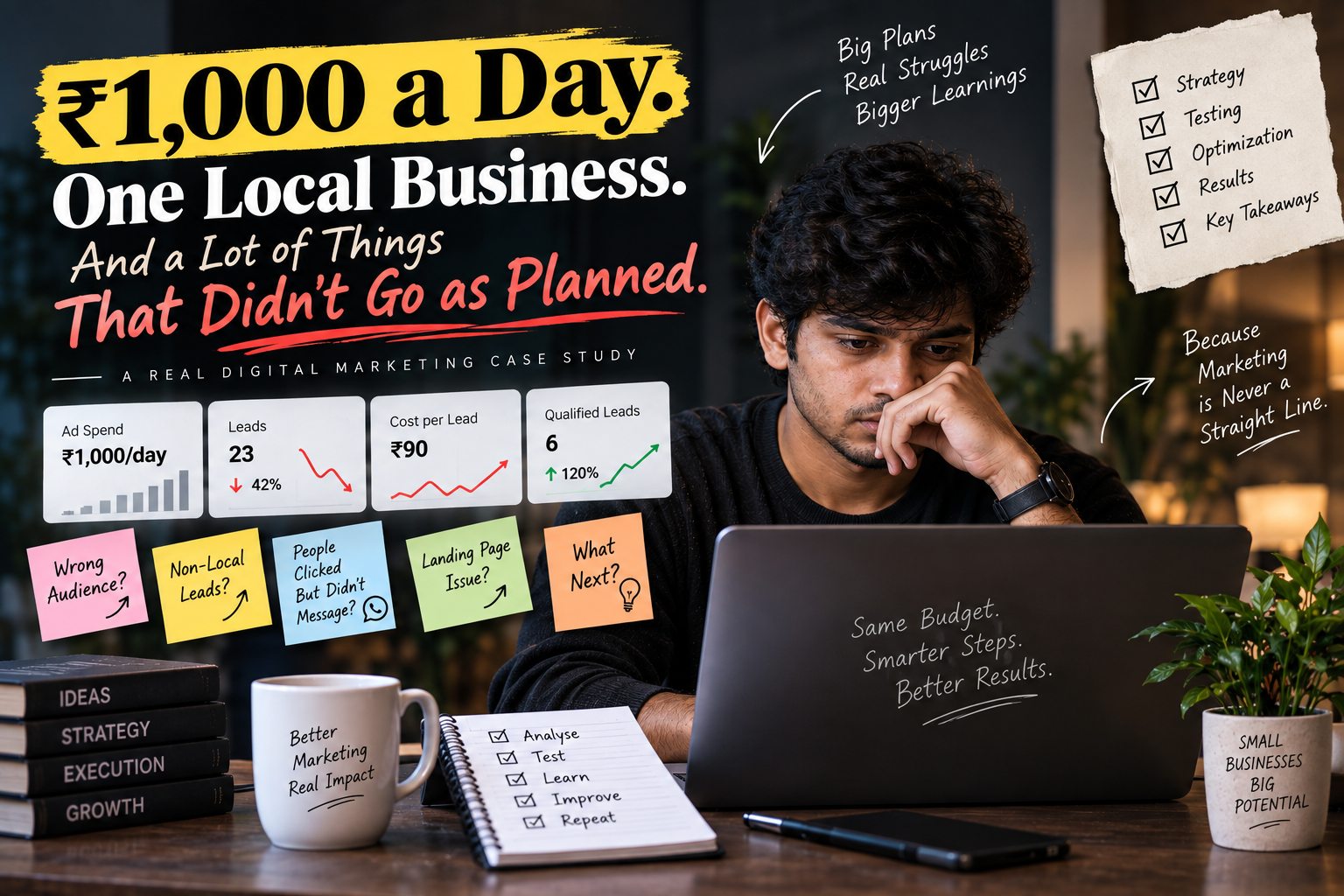
A shop owner once told me, Bhai, just give me ₹1,000 a day. That’s all I can spend. Show me results Meta Ads for Local Business
I said yes without thinking too much. I had run bigger budgets before. How hard could a small budget be?
Turns out, small budgets are their own kind of hard. Not because ₹1,000 is too little to work with. It’s because every mistake costs you a bigger percentage of that budget than it would on a ₹10,000 a day account. There’s no room to be sloppy.
This is the story of that campaign. What broke, what I got wrong, what I fixed, and what I’d tell anyone running local ads on a tight daily spend today.
Table of Contents
ToggleIntroduction Meta Ads for Local Business
If you run a local business, chances are someone has told you that ₹1,000 a day is “enough to get started” with ads. And technically, that’s true. You can run Google Ads or Meta Ads on almost any budget.
But what nobody tells you is how many small decisions matter more when the budget is small. A wrong targeting choice, a slow landing page, an ad that doesn’t say the right thing in the first three seconds — these things eat into a ₹1,000 budget a lot faster than people expect.
In this post I’m walking through an actual campaign I ran for a local service business, what went wrong along the way, and what eventually worked. If you’re a small business owner or someone managing ads for one, this should save you some pain.
Quick Answer
Running a local business on ₹1,000 a day in ads can work, but only if you narrow your targeting to a tight radius, focus on one clear offer, and fix your landing page before spending a single rupee. Most failures at this budget come from spreading the money too thin across audiences, platforms, or goals instead of picking one and going deep.
What Is a ₹1,000 a Day Local Ad Campaign?
At its simplest, this is a paid ad strategy where a business sets a fixed small daily budget, usually on Meta Ads or Google Ads, and targets people within a specific area around their shop or service zone.
It’s common with salons, gyms, clinics, restaurants, coaching centers, and repair shops. The idea sounds simple. Spend a little every day, get a steady trickle of leads or footfall, and grow slowly instead of burning cash on a big launch.
Here’s the thing though. A ₹1,000 daily budget on Meta might get you somewhere between 15 to 40 clicks depending on your niche and city. That’s not a lot of room for testing five different audiences or three different offers at once. You basically get one real shot a day to say the right thing to the right person.
Why Is It Important?
Small budgets force discipline, and that’s actually a good thing once you get past the frustration.
When you’re spending ₹1,000 a day, you can’t afford to run five ad variations and “see what sticks.” You have to think harder before you spend. You have to know your customer better. You have to make your offer sharper.
Businesses that get this right end up with campaigns that are lean and profitable, because they were forced to cut the fat early. Businesses that skip this step usually end up spending the same ₹1,000 for months without ever knowing why it isn’t working.
The Complete Process (And Where I Went Wrong at Each Step)
Setting the Budget and Goal
What it means Deciding how much to spend daily and what a “win” actually looks like. A lead? A call? A walk in?
Why it matters Without a clear goal, you end up optimizing for the wrong thing, like clicks instead of actual customers walking through the door.
How I did it I set the budget at ₹1,000 a day on Meta Ads, with the goal being WhatsApp inquiries. Simple enough on paper.
What went wrong I didn’t set a hard rule for what counted as a “real” lead versus someone just asking “what’s the price” and disappearing. Two weeks in, I had 60 WhatsApp messages and maybe 4 actual bookings. The client was upset. I had no clean way to explain the gap.
Pro Tip Before you spend a rupee, agree on what a qualified lead looks like. Not just “someone who messaged.” Someone who gave their name, asked about a specific service, and responded to a follow up.
Writing the Ad Creative
What it means The actual image, video, and text people see.
Why it matters You have about two seconds to stop someone from scrolling past. On a small budget, a weak hook means wasted spend on impressions that never convert.
How I did it First version was a generic “Best Salon in Town” style ad with a stock-looking photo.
What went wrong It performed terribly. No specificity, no reason to believe, nothing that made someone stop scrolling. Click through rate was under half a percent.
Pro Tip Real photos of the actual shop or actual results beat polished stock images almost every time in local ads. People trust what looks real, not what looks like an ad.
Building the Landing Experience
What it means Where people go after clicking, whether that’s a website, a WhatsApp chat, or a form.
Why it matters A confusing or slow landing experience kills conversions no matter how good your ad is.
How I did it I sent traffic straight to a WhatsApp click to chat button.
What went wrong This part actually worked well, until the client took hours to reply to messages. People messaging about a same-day service don’t wait around. By the time he replied, half of them had already gone somewhere else.
Pro Tip Fast response time is part of your ad campaign, not separate from it. If replies take more than 15 to 20 minutes, you’re leaking money you already spent to get that lead.
Monitoring and Adjusting
What it means Checking daily performance and making small changes based on what the data shows.
Why it matters On a small budget, you can’t afford to “wait and see” for two weeks. You need to catch problems in days, not weeks.
How I did it I checked the account every two to three days initially.
What went wrong Costs crept up on weekends when competition for the same audience increased, and I didn’t notice until the budget was nearly gone for that week.
Pro Tip Check daily for the first two weeks of any small budget campaign, even if it’s just five minutes. Small budgets don’t leave room for slow reactions.
Common Mistakes
Mistake: Targeting too wide an area Impact: Wasted spend on people who will never visit Solution: Narrow the radius to where people actually live and work near the business
Mistake: Trying to run multiple offers at once Impact: The budget gets split so thin that nothing gets enough data to actually work Solution: Pick one offer, run it properly, then test the next one after you have results
Mistake: Ignoring response time on leads Impact: Leads go cold and the client blames the ads, not the follow up Solution: Set a rule for how fast leads get replied to, and hold the business accountable to it
Mistake: Judging performance too early Impact: Panic and pausing the campaign before it has enough data to learn Solution: Give it at least 5 to 7 days before making major changes, unless something is clearly broken
Best Practices
Keep the offer specific. “20% off your first visit” beats “great service, come visit us” every single time.
Use real photos and videos from the actual business. Local audiences respond to familiarity, not polish.
Track everything in a simple spreadsheet, even manually. Date, spend, leads, bookings. You need this to actually know if it’s working.
Respond to leads within minutes, not hours. This one change often does more for results than any ad tweak.
Tools and Resources
| Tool | Best For | Cost |
|---|---|---|
| Meta Ads Manager | Running Facebook and Instagram ads for local reach | Free to use, you pay ad spend |
| Google Business Profile | Free local visibility alongside paid ads | Free |
| WhatsApp Business App | Managing and replying to leads quickly | Free |
| Canva | Creating quick, real-feeling ad creatives | Free with paid upgrade |
| Google Sheets | Tracking daily spend, leads, and bookings | Free |
Real Life Example
Situation A local service business owner wanted a steady stream of customers but had only ₹1,000 a day to spend on ads, no marketing team, and no real tracking in place.
Challenge Early campaigns were spread across a wide radius with a generic offer, resulting in a lot of clicks but very few actual bookings.
Action The targeting radius was narrowed to a smaller zone around the shop, the offer was simplified to one clear discount, real photos replaced stock images, and a rule was set for replying to leads within 15 minutes.
Result Cost per genuine lead dropped noticeably, and the ratio of bookings to inquiries improved because leads were being followed up on while still warm, not hours later.
Expert Tips
If your budget is under ₹1,500 a day, resist the urge to run more than one campaign at a time. Data gets split, and you learn nothing useful from either.
Set up a simple lead tracker on day one. Most small businesses figure out tracking after three months of guessing, and by then they’ve spent a lot of money without learning anything from it.
Treat the first two weeks as a testing phase, not a results phase. Tell the client this upfront so expectations are set correctly from day one.
Frequently Asked Questions
Is ₹1,000 a day enough to run ads for a local business?
Yes, it can work well for hyperlocal businesses with a tight radius and a clear offer, though results will be slower to scale compared to a bigger budget.
Which platform works better for small budgets, Google Ads or Meta Ads?
Meta Ads generally stretches further for visual local businesses like salons or restaurants, while Google Ads works well for services people actively search for, like plumbers or clinics.
How many leads can ₹1,000 a day realistically generate?
This varies by city and niche, but many local businesses see anywhere from 3 to 10 quality leads a day once targeting and offer are dialed in.
How long before a small budget campaign shows results?
Give it at least 5 to 7 days of consistent spending before judging performance, since the algorithm needs time to learn who responds.
Should I target a wide area to get more reach?
No, for most local businesses a narrow radius of 3 to 5 km performs better since people prefer nearby options for everyday services.
What's the biggest reason small budget campaigns fail?
Spreading the budget across too many offers or audiences instead of focusing on one thing at a time.
Do I need a website to run local ads?
Not necessarily. Many local businesses run successful campaigns sending traffic directly to WhatsApp instead of a website.
How fast should I reply to leads from ads?
As fast as possible, ideally within 15 minutes, since interest fades quickly for local, same day services.
Can I run ads myself without an agency?
Yes, especially at this budget level. The key is being consistent with tracking and quick with lead follow up.
What should I track daily for a ₹1,000 a day campaign?
Spend, number of leads, number of actual bookings, and cost per genuine lead, kept in a simple spreadsheet.
Key Takeaways
- A small daily budget forces discipline, which is actually good for the business long term
- Narrow targeting beats wide reach for local, everyday services
- One clear offer performs better than multiple offers running at once
- Real photos and videos outperform polished stock content
- Fast lead response time matters as much as the ad itself
- Give campaigns 5 to 7 days minimum before judging results
- Simple tracking, even manual, is non negotiable
Conclusion
That ₹1,000 a day campaign taught me more than a lot of bigger budget accounts ever did. When the margin for error is small, you learn fast what actually matters and what was just noise all along.
If you’re a local business owner working with a tight budget, don’t see it as a limitation. See it as a reason to get specific, get fast, and get disciplined about what you’re offering and to whom.
CTA
If you’re running a local business and want to figure out what a smart, low budget ad strategy could look like for you, start with your targeting radius and your response time before you touch anything else. Those two things alone will tell you more than any amount of ad spend ever will.