

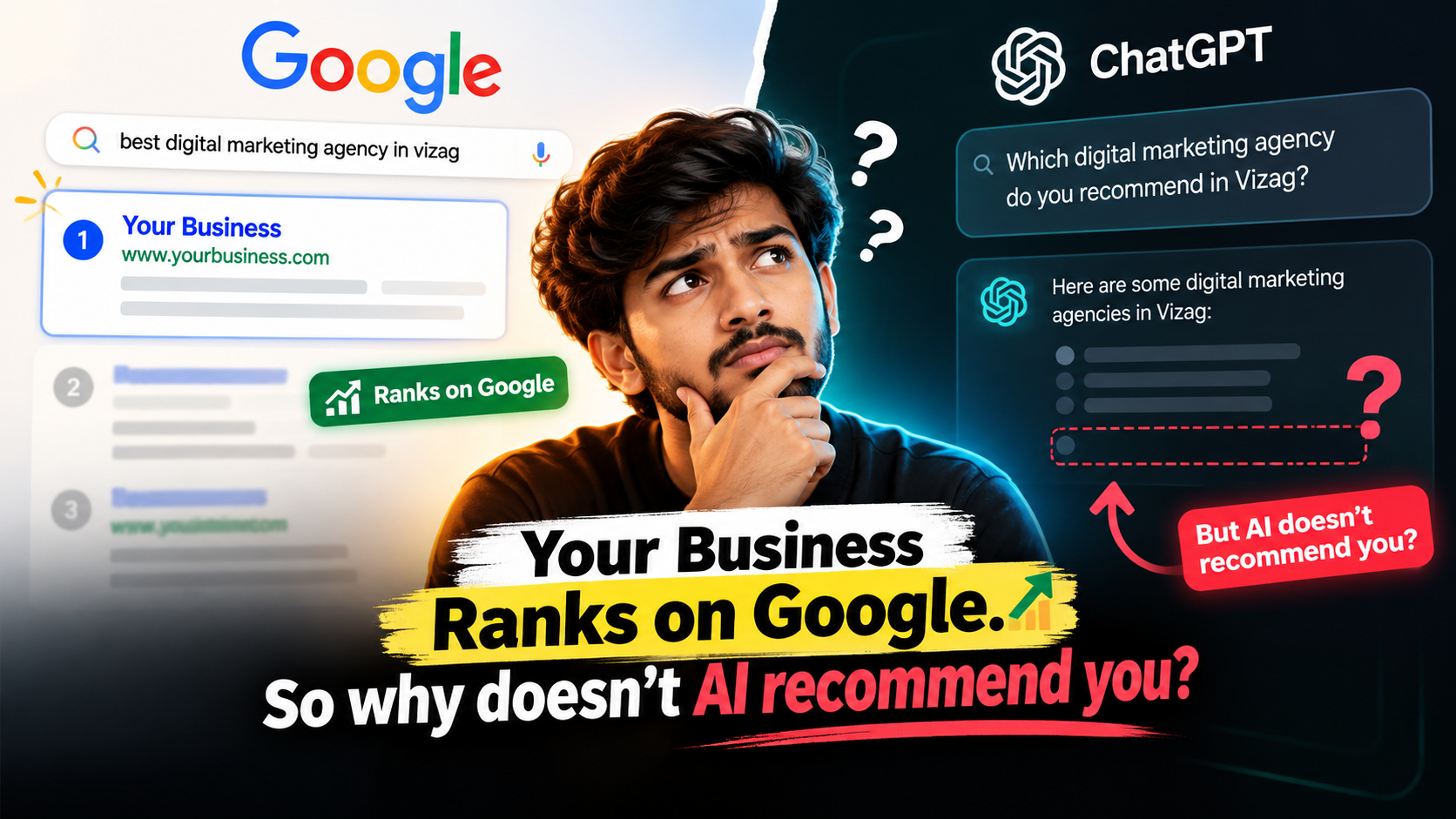
A few weeks ago, a salon owner told me something that stuck with me.
“I’m on page one for my main keyword. My phone still isn’t ringing like before. Then my nephew asked ChatGPT for the best salon near him, and my name wasn’t even there AI Search Visibility
She wasn’t wrong to be annoyed. She had paid for SEO, waited, and finally got the ranking. And now a new door had opened where nobody was holding it open for her.
If that sounds familiar, this post is for you.
Table of Contents
ToggleIntroduction
Search has quietly split into two worlds.
In the first one, people type something into Google, scan ten blue links, and click. You know this world. It is what SEO has always been about.
In the second one, people ask ChatGPT, Gemini, Perplexity or Google’s AI Overviews a full question and get one written answer with maybe three or four businesses named inside it. There is no page two here. You are either mentioned or you are invisible.
Ranking well in the first world does not automatically get you into the second. That gap catches a lot of business owners off guard, especially local ones in cities like Vizag and Hyderabad where competition is tight and every enquiry counts.
In this guide I will explain why AI skips businesses that rank fine on Google, what it looks for instead, and the exact steps you can take to fix it. No jargon for the sake of it. Just what works.
Quick Answer
Google ranks pages. AI tools recommend businesses they can understand and trust. If your name, services, location and reviews are inconsistent across the web, or your content never answers questions directly, AI skips you even when you rank well. Fix your entity clarity, answer real questions, earn mentions and keep your profiles consistent.
What Is AI Search Visibility
AI visibility is how often, and how accurately, AI tools mention your business when someone asks a relevant question.
You will also hear it called GEO (Generative Engine Optimization) or AEO (Answer Engine Optimization). Different names, same idea. You are no longer only trying to rank a page. You are trying to become a business that an AI model feels confident naming.
Here is a simple way to picture it.
Google works like a library catalogue. It sorts pages and shows you the ones that match best. AI works more like a well read friend. You ask, “Who is a good hair studio in Hyderabad for keratin treatment?” and the friend answers from everything they have seen, heard and read. If they have never really heard of you, or heard three different versions of your story, they simply do not bring you up.
A real example. Say you run a dental clinic in Visakhapatnam. Your website ranks for “dentist in MVP Colony.” But your Google Business Profile says the clinic opens at 9. Your Practo listing says 10. Your Facebook page still has an old phone number. Your website never clearly says which treatments you offer. An AI model looking for a confident answer sees a fuzzy picture and moves on to the clinic with a cleaner one.
Why Is It Important?
More people are starting their research inside AI tools. Not everyone, and not for every purchase. But for the questions that lead to real money, like “which agency should I hire” or “where can I get a good haircut for curly hair,” the habit is growing fast.
Three reasons this matters to you right now.
First, fewer slots. A search results page gives you ten chances. An AI answer might give you three. The competition for those spots is sharper.
Second, higher trust. When an AI tool recommends a business, the reader treats it almost like a personal referral. People arrive warmer and more ready to book.
Third, early advantage. Most of your competitors have not even thought about this yet. The businesses that fix their foundations now will be the ones AI keeps recommending later, because these systems tend to keep repeating sources they already trust.
I have seen this with local clients. The ones who cleaned up their online identity early started getting named in AI answers within a few weeks of the changes being picked up. It is not instant magic, but it is far less mysterious than people think.
Why Google Rankings Do Not Automatically Turn Into AI Mentions
This part clears up most of the confusion, so let me be direct.
Google ranking looks at a page. Does it match the search, is it fast, do other sites link to it.
AI recommendation looks at a business. Who are you, what exactly do you do, where, for whom, and can I find other places on the internet agreeing with all of that.
So you can have a strong page and a weak business signal at the same time. That is exactly what happens to a lot of local companies. The page is optimised. The business itself is scattered.
Complete Guide: How To Get AI To Recommend Your Business
There are six steps. Do them in order if you can. Each one supports the next.
Step 1: Make Your Business Identity Clear and Consistent
What It Means Your business name, address, phone number, services, opening hours and one line description should read the same everywhere. Website, Google Business Profile, Instagram, Facebook, JustDial, Practo, Sulekha, LinkedIn, everywhere.
Why It Matters AI models build a picture of your business by putting together many small mentions. When those mentions disagree, confidence drops. When they agree, your business becomes an “entity” the system recognises and can safely name.
How To Do It Write one master description of your business in two or three sentences. Include what you do, who you serve and the city. Something like: “We are a hair studio in Banjara Hills, Hyderabad, specialising in keratin, colour and bridal styling.”
Then copy that same description, with the same name spelling, into every profile you own. Fix old phone numbers. Remove duplicate listings. Yes, it is boring work. It is also the single most underrated fix I know.
Example A clinic listed as “Sri Sai Dental Care” on its website, “Sai Dental Clinic” on Google and “SSDC Vizag” on Instagram is basically three different businesses to a machine. Pick one name and stick with it.
Pro Tip Search your own business name on Google and scroll through five or six pages of results. Any listing you did not create or forgot about is a clue. Claim it or correct it.
Step 2: Answer Questions Directly on Your Website
What It Means Your key pages should state clearly, in plain words, what you offer, who it is for, what it costs roughly and how the process works. Not hidden behind slogans.
Why It Matters AI models pull from content that gives a clean, quotable answer. If your service page says “We craft transformative beauty journeys,” there is nothing for the model to quote. If it says “A keratin treatment at our studio takes about three hours and usually costs between 6,000 and 12,000 rupees depending on hair length,” that is a sentence an AI can actually use.
How To Do It For every main service, add a short section near the top that answers the obvious question in two or three sentences. Then go deeper below it. Add a proper FAQ block on the page with the real questions customers ask you on calls and WhatsApp.
Use INR pricing or price ranges where you can. Vague pricing makes both humans and AI hesitate.
Example Instead of a page titled “Our Services,” create separate pages such as “Digital Marketing Services in Visakhapatnam” or “Bridal Makeup in Hyderabad,” each with a straight answer, a price range, a short process and a few FAQs.
Pro Tip Read your service page out loud. If you would never say a sentence to a customer sitting in front of you, rewrite it.
Step 3: Add Structured Data and Fix the Technical Basics
What It Means Structured data, often called schema markup, is a small piece of code that tells search systems exactly what your page is about. LocalBusiness, Service, FAQPage and Review are the ones most local businesses need.
Why It Matters Humans read your page. Machines read the code behind it. Schema removes guesswork by labelling things clearly. This helps Google and it helps other systems that read the web.
How To Do It If you use WordPress, plugins like Rank Math or Yoast can add basic schema without touching code. Fill in every field properly, including your service area, hours, phone and social profile links.
Then check something most people forget. Some security plugins, hosting settings or a robots file block AI crawlers without you knowing. Look at your robots file and make sure you are not shutting the door on the very systems you want to be found by. If you are unsure, ask your developer to check.
Also keep the site fast, mobile friendly and easy to crawl. The basics still count.
Example A studio added LocalBusiness and FAQ schema to its main service pages and cleaned up a robots file that was blocking several crawlers by mistake. Nothing else changed on the site. That one cleanup made the pages readable to systems that could not see them before.
Pro Tip Test your important pages with Google’s Rich Results Test. Fix any errors it shows before moving on.
Step 4: Build Reviews and Real Mentions Around Your Business
What It Means AI models lean on what other people say about you, not just what you say about yourself. Reviews, local news mentions, directory listings, guest posts and even social conversations all count as outside proof.
Why It Matters Anyone can write “we are the best” on their own site. When independent places back it up, the claim becomes believable. This is trust in its simplest form, and it is the part of EEAT (experience, expertise, authoritativeness, trust) that businesses most often ignore.
How To Do It Ask happy customers for Google reviews right after a good experience, and ask them to mention the specific service and area. A review that says “Got my bridal makeup done in Jubilee Hills, the team was calm and on time” is worth far more than “Nice place.”
Reply to every review, good or bad, in a natural voice. Then look for a few genuine local placements. A feature in a city blog, a partnership listing, a local business directory you actually qualify for.
Example A Vizag agency sponsored a small local event and got listed on the organiser’s page with a link and a description. One honest mention, but it helped confirm to the wider web that the business was real, active and based where it claimed to be.
Pro Tip Never buy fake reviews. Systems and people both get better at spotting them every year, and the damage to trust is hard to undo.
Step 5: Create Content Around the Questions People Ask AI
What It Means People talk to AI differently than they type into Google. They ask longer, more natural questions. “Which digital marketing agency in Hyderabad is good for small businesses with a low budget?” instead of “digital marketing agency Hyderabad.”
Why It Matters If your content is built only around short keywords, you miss these conversational questions completely. And those questions usually come from people much closer to buying.
How To Do It Write down the real questions your customers ask you. Then turn each into a blog post or a section on a page. Answer the question in the first two sentences, then add your experience, a small example and next steps.
Cover all stages of the journey. Some people are just learning, some are comparing, and some are ready to book. A good site has content for each.
Example A hair studio might publish “How long does a keratin treatment last?” for the early stage reader, “Keratin vs smoothening, which is better for frizzy hair?” for the comparing reader, and “How to book a keratin session at our Kukatpally studio” for the ready reader.
Pro Tip Look at the People Also Ask box on Google for your main topic. Those are questions people have already been asking, and they are a goldmine.
Step 6: Test, Track and Repeat
What It Means You cannot improve what you never check. So go and ask the AI tools yourself.
Why It Matters AI answers change. What is true this month may shift next month. A regular check tells you what is working and what needs another look.
How To Do It Once a month, open ChatGPT, Gemini and Perplexity and ask ten questions your ideal customer would ask. Use your city and your service. Note whether you appear, which competitors appear instead, and what sources the tool seems to use.
Keep a simple sheet with the date, the question, the tool and the result. After three months you will see patterns you would never spot otherwise.
Example If a competitor keeps getting named and you keep seeing the same directory site cited next to them, that directory is worth getting listed on.
Pro Tip Ask the same question in slightly different words. AI answers can change a lot with small changes in phrasing, so test more than one version.
Common Mistakes
Most businesses stumble in the same few places.
The first mistake is inconsistent information. The impact is that AI cannot form a confident picture of you. The fix is a single master description and a clean up of every listing.
The second is vague, slogan style website copy. The impact is that there is nothing quotable, so the AI quotes someone else. The fix is to write direct answers in plain language.
The third is ignoring reviews. The impact is weak outside proof. The fix is a simple habit of asking every happy customer, and replying to every review.
The fourth is blocking crawlers by accident. The impact is that whole sections of your site may be invisible to some systems. The fix is a quick check of your robots file and security settings.
The fifth is expecting overnight results. The impact is that people give up right before things start moving. The fix is to treat this like SEO always was, steady work with compounding returns.
Best Practices
A few habits that keep paying off.
Update your Google Business Profile weekly with photos, offers and posts. Keep your service pages fresh, even if it is just adding a new FAQ each month. Use your real name, real photos and real team on your About page, because experience and authorship matter. Mention your city, neighbourhood and service area naturally, the way a local would. Link related pages together so your site reads like one connected story, not twenty separate pages. And keep your tone human. AI systems are getting better at telling the difference between content with real experience behind it and content stitched together to fill space.
Tools and Resources
You do not need an expensive stack. Here is what I would actually use.
For listings and local presence, Google Business Profile is non negotiable. Add Bing Places if you have not, since some AI tools draw on Bing’s data. For schema, Rank Math or Yoast on WordPress works for most small sites, and Google’s Rich Results Test checks your work for free.
For research, Google Search Console shows the questions people find you with, and Google’s People Also Ask box shows the ones they are asking. For testing your AI visibility, the tools themselves are the best resource. ChatGPT, Gemini and Perplexity are free to try, so just ask them.
For reviews, a simple WhatsApp message with your Google review link does the job better than any paid tool I have tried.
If you want to compare, think of it this way. Free tools handle the basics and cost you only time. Paid tools mostly save time, and are worth it once you are managing several locations or clients. Start free. Upgrade only when a real need shows up.
Real Life Example: A Hair Studio Story
Here is a scenario I see often, described in general terms so you can see how the steps fit together.
The situation. A hair studio in Hyderabad ranks on page one for “hair studio near Banjara Hills.” Bookings are steady but flat. The owner notices competitors getting mentioned when people ask AI tools for recommendations, while the studio never appears.
The challenge. When we looked closely, the studio’s name was written three different ways across the web. The website services page said little beyond “premium hair care.” There were only a handful of reviews, and hardly any mentioned a specific service. And there was no schema on the site at all.
The action. The studio did the six steps in a sensible order. It chose one official name and fixed every listing. It rewrote service pages to answer real questions with price ranges. It added schema and FAQs. It started asking each happy customer for a detailed review. It published a few helpful posts around common questions. And the owner checked AI answers once a month.
The result. Over the following weeks the studio began showing up in more local answers, and the enquiries coming from AI tools tended to arrive already informed and ready to book. I am keeping this example general on purpose because outcomes vary from business to business. What matters is the pattern. Clean identity, clear answers, outside proof, steady testing.
Expert tips
Here are a few things I have picked up from doing this work with local businesses.
Think in entities, not pages. Ask yourself, “If someone knew nothing about my business, could they describe it correctly after reading what is online?” If not, that is your to do list.
Own your niche and your city together. AI answers love specifics. “Bridal makeup artist in Visakhapatnam” is much easier to recommend than “makeup artist.”
Publish comparisons honestly. A post like “Keratin vs Botox for hair” that actually explains the difference, including when you would not recommend your own service, earns trust quickly.
Show your people. A named founder, real team photos and short bios make it easier for both readers and machines to see a real business behind the website.
Do not chase every new AI tool. The habits that help you in one usually help you in all of them. Clarity, consistency, proof.
Frequently Asked Questions
Why does my business rank on Google but not appear in ChatGPT?
Google ranks individual pages. ChatGPT and similar tools recommend businesses they can recognise and trust across many sources. If your details are inconsistent or your content is vague, you may rank well and still get skipped.
What is GEO in simple words?
GEO stands for Generative Engine Optimization. It means shaping your online presence so AI tools understand your business and feel confident recommending it.
What is the difference between SEO and AEO?
SEO helps your pages rank in search results. AEO helps your content become the direct answer that AI tools and featured snippets show. They work best together.
How long does it take to appear in AI answers?
There is no fixed timeline. Some businesses see movement within weeks after fixing basics, others take a few months. Consistency and outside proof usually decide the pace.
Do Google reviews affect AI recommendations?
Yes, in most cases they help. Reviews give independent proof of what you do and where. Detailed reviews that mention specific services are the most useful.
Does schema markup help with AI visibility?
It helps systems read your page more accurately. Schema alone will not get you recommended, but it removes confusion and supports everything else you do.
Can a small local business compete with big brands in AI answers?
Yes, especially for local questions. AI tools often prefer a clear, well documented local business over a big brand with weak local signals.
Should I block AI crawlers on my website?
If you want AI tools to recommend you, blocking their crawlers works against you. Check your robots file and security settings to make sure you are not doing it by accident.
Key Takeaways
- Ranking on Google and being recommended by AI are two different things.
- AI recommends businesses it can clearly understand, not just pages that match a keyword.
- Keep your name, address, phone and description identical everywhere online.
- Write direct, quotable answers on your service pages, with real price ranges.
- Add schema and make sure you are not blocking crawlers by accident.
- Detailed reviews and honest local mentions build the trust AI looks for.
- Test your visibility monthly by asking the AI tools yourself.
- Start with the basics. Small, steady fixes beat big one time pushes.
Conclusion
It is easy to feel frustrated when you have done the work and the results still do not show up where people are looking now. But this is a fixable problem, and honestly a fair one. AI simply wants what your customers want. A business that is clear, consistent and trusted by others.
You do not need to rebuild everything. Pick step one this week. Fix your listings. Rewrite one service page in plain words. Ask three happy customers for reviews. Small moves like these add up faster than you would expect.
And the earlier you start, the harder it becomes for competitors to catch up