

Hook
Most business owners open Facebook Ads Manager, put in a card, set a budget, and hit publish. No plan, no numbers, just hope Performance Marketing Metrics
Three weeks later they check the account, see ₹15,000 gone, and maybe two calls came in. One of them didn’t even convert.
If that sounds familiar, you’re not bad at marketing. You just started spending before you understood the numbers that actually run the show.
Table of Contents
ToggleIntroduction
Running ads without knowing your numbers is like driving with your eyes closed and hoping you stay on the road. You might get lucky for a bit. You won’t stay lucky for long.
This is something I see constantly with local business owners in Hyderabad and Vizag, salon owners, clinics, real estate folks, small D2C brands. They’re excited to run ads, and that excitement is good. But excitement without numbers just turns into wasted budget and a lot of frustration.
In this post, I’m walking you through the seven numbers you genuinely need to understand before you spend even a rupee on Google or Meta ads. Not textbook definitions. The real, practical version, the way I’d explain it to a friend opening a salon in Madhapur or a clinic in MVP Colony.
By the end, you’ll know exactly what to check before launching a campaign, and what to track once it’s live so you’re not just guessing anymore.
Quick Answer Performance Marketing Metrics
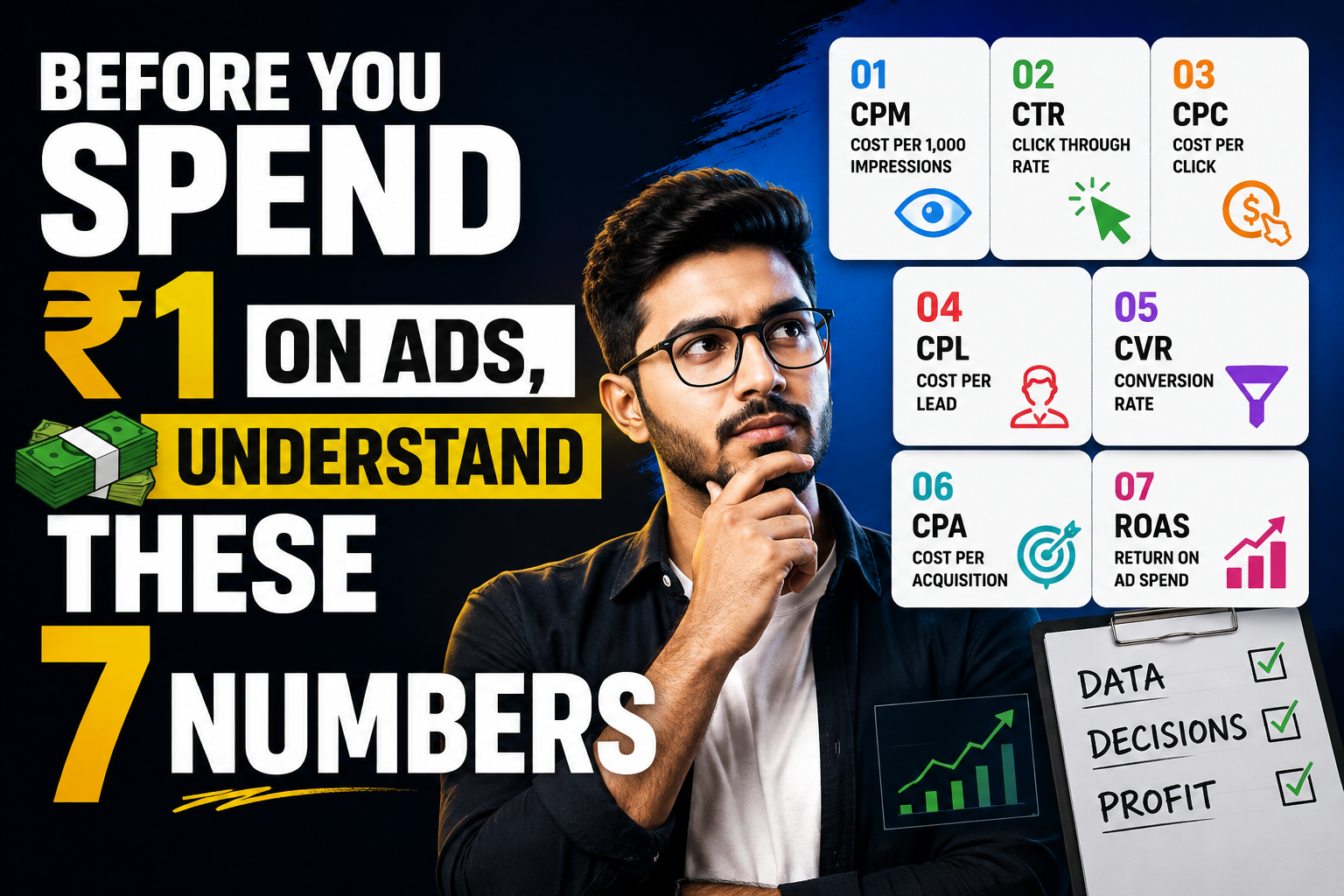
Before spending on ads, understand these seven numbers: CPC (cost per click), CTR (click through rate), CPM (cost per thousand impressions), conversion rate, CPL (cost per lead), CAC (customer acquisition cost), and ROAS (return on ad spend). Together they show whether your ads are actually bringing profitable customers, not just clicks and impressions that look busy on a dashboard.
What Are These Ad Metrics?
These seven numbers are the core metrics that tell you how your ad money is actually performing. Think of them as a health checkup for your campaign. Individually, each one tells you a small piece of the story. Together, they tell you whether your ads are making you money or quietly draining your account.
Here’s a simple example. Say you run a hair studio in Vizag and put ₹500 into a Meta ad. If you only look at “how many people saw it,” you’re looking at reach, which honestly means very little on its own. What you actually want to know is how many of those people clicked, how many of those clicks turned into a booking, and how much you paid to get that one paying customer through the door.
That’s what these numbers do. They turn a vague feeling of “the ad is running” into a clear answer of “the ad is working” or “the ad is bleeding money.”
Why These Numbers Matter
Here’s the honest truth. Ad platforms are built to spend your budget efficiently, not to make sure you’re profitable. Those are two different goals.
Google and Meta will happily show your ad to a thousand people and call it a success. But if none of those people ever became customers, that’s not success for you, that’s just a bill.
Understanding these numbers matters because it puts you back in control. You stop reacting emotionally to a dashboard full of colourful graphs and start making decisions based on what’s actually working. It also helps you spot problems early. If your CPC suddenly triples, you’ll know something changed before you’ve burned through half your monthly budget.
And honestly, once you understand these numbers, ad platforms become a lot less intimidating. You stop feeling like you’re gambling and start feeling like you’re running a business.
The Complete Guide: 7 Numbers to Know Before You Spend
1. CPC (Cost Per Click)
What It Means
CPC is simply how much you pay every time someone clicks your ad. If you spent ₹1000 and got 100 clicks, your CPC is ₹10.
Why It Matters
CPC tells you how competitive and expensive your industry or keyword is. A gym in Hyderabad targeting “gym near me” will likely pay a very different CPC than a jewellery brand targeting “bridal jewellery Hyderabad.” Knowing your average CPC helps you predict how far your budget will actually go.
How To Do It
Before launching, check Google’s Keyword Planner or Meta’s Ads Manager estimates for your industry and location. Run a small test budget, around ₹1000 to ₹1500, purely to see your real CPC before committing bigger money.
Example
A salon owner in Vizag tested ₹1200 on Google Search ads for “hair spa Vizag” and got a CPC of ₹18. That gave her a rough idea, roughly 65 to 70 clicks for that budget, before deciding whether to scale up.
Pro Tip
Don’t panic if CPC looks high on day one. Give the algorithm two to three days to settle before judging the number. It usually stabilises.
2. CTR (Click Through Rate)
What It Means
CTR is the percentage of people who see your ad and actually click it. If 1000 people saw your ad and 20 clicked, your CTR is 2 percent.
Why It Matters
CTR is basically a report card for how relevant and appealing your ad creative or copy is. A low CTR usually means your headline, image, or offer isn’t grabbing attention. A strong CTR often leads to lower CPC too, because platforms reward ads people actually engage with.
How To Do It
Test two or three creative variations at the same time. Keep everything else the same, just change the headline or image, and see which one people actually click on.
Example
For a clinic client in Hyderabad, we tested two Meta ads. One had a plain “Book Your Appointment Now” headline, CTR of 0.8 percent. The other led with “Skip the Long Wait, Book Online in 2 Minutes,” CTR jumped to 2.3 percent. Same budget, completely different result.
Pro Tip
A CTR under 1 percent on Meta usually signals a creative problem, not a budget problem. Fix the ad before you throw more money at it.
3. CPM (Cost Per 1000 Impressions)
What It Means
CPM is what you pay for every 1000 times your ad is shown, whether people click or not.
Why It Matters
CPM tells you how expensive it is to simply get in front of your audience. It’s affected by competition, audience size, season, and even the time of year. December and festival months, for instance, often see CPM spike because everyone’s advertising at once.
How To Do It
Check your CPM in the campaign reporting tab. Compare it against industry benchmarks so you know if you’re paying a fair price or getting overcharged for reach.
Example
A real estate client in Hyderabad saw CPM jump from ₹90 to ₹180 right before Sankranti, simply because every builder in the city was running ads at the same time. Knowing this helped him plan his budget around it instead of panicking.
Pro Tip
If CPM is unusually high, try narrowing or slightly widening your audience. Sometimes a targeting tweak brings costs down fast.
4. Conversion Rate
What It Means
This is the percentage of people who click your ad and then actually do what you wanted, book a call, fill a form, make a purchase, whatever your goal is.
Why It Matters
This is where the real story lives. You can have a fantastic CTR and still lose money if your conversion rate is weak. A lot of business owners obsess over clicks and completely ignore what happens after the click.
How To Do It
Track this through your landing page or form, not just the ad platform. If 100 people click and 5 actually book, your conversion rate is 5 percent. Anything below industry average usually points to a landing page or offer problem, not an ad problem.
Example
One of our hair studio clients had solid CTR but a conversion rate of just 1 percent. Turned out her booking form had eight fields including “how did you hear about us.” We cut it down to three fields, name, number, preferred date. Conversion rate more than doubled.
Pro Tip
Always test your own landing page on your phone before launching. If it’s slow or confusing for you, it’s slow and confusing for your customer too.
5. CPL (Cost Per Lead)
What It Means
CPL is how much you’re paying, on average, to get one lead, meaning one interested person who filled a form or messaged you.
Why It Matters
This number connects your ad spend directly to actual business activity. It’s far more meaningful than CPC because a click means nothing if it doesn’t turn into a conversation.
How To Do It
Divide total spend by total leads generated. If you spent ₹5000 and got 25 leads, your CPL is ₹200. Track this weekly, not just at the end of the month, so you can catch problems early.
Example
A skincare clinic in Vizag was getting a CPL of ₹450, which felt expensive until we worked out that each client was worth ₹8000 to ₹10,000 on average. Suddenly ₹450 didn’t look expensive at all, it looked like a bargain.
Pro Tip
Always compare CPL against your actual average order or service value. A number means nothing in isolation.
6. CAC (Customer Acquisition Cost)
What It Means
CAC goes one step further than CPL. It’s how much you actually spend to get one paying customer, not just a lead, an actual sale.
Why It Matters
This is the number that decides whether your ads are genuinely profitable. You might get cheap leads but if very few of them convert into paying customers, your real CAC could still be too high.
How To Do It
Divide your total ad spend by the number of new paying customers in a given period. Include the full funnel, not just ad platform data. Talk to your sales or front desk team to confirm actual conversions.
Example
A gym owner in Hyderabad had a CPL of ₹150, which sounded great. But only 1 in 20 leads actually joined the gym. That put his real CAC closer to ₹3000, which changed how he thought about his membership pricing entirely.
Pro Tip
Track CAC separately for each platform. Google leads and Meta leads often convert at very different rates even with similar CPL.
7. ROAS (Return On Ad Spend)
What It Means
ROAS tells you how much revenue you’re making for every rupee spent on ads. A ROAS of 4 means you’re earning ₹4 for every ₹1 spent.
Why It Matters
This is the number that ties everything together. All the earlier metrics build up to this one answer, is the campaign actually making you money.
How To Do It
Divide total revenue generated from the campaign by total ad spend. Most ad platforms can calculate this automatically once you’ve set up proper conversion tracking, but always cross check with your actual sales numbers.
Example
A boutique client spent ₹20,000 on Meta ads in a month and generated ₹95,000 in sales directly traceable to those ads. That’s a ROAS of 4.75, a genuinely strong result for a small local brand.
Pro Tip
A “good” ROAS is different for every business depending on your margins. A jewellery brand can be profitable at ROAS of 3, while a low margin product might need ROAS of 6 or more just to break even.
Common Mistakes
Mistake: Judging a campaign after just one or two days. Impact: You end up killing ads that just needed more time to optimise. Solution: Give campaigns at least 5 to 7 days before making major decisions, unless you’re clearly losing serious money.
Mistake: Only looking at CPC or reach. Impact: You think the campaign is doing well when it’s actually not generating real business. Solution: Always track the full chain, click, lead, customer, revenue.
Mistake: Not setting up conversion tracking properly. Impact: You’re flying blind and making decisions based on guesswork. Solution: Set up Meta Pixel and Google Tag properly before you launch, not after.
Mistake: Comparing your numbers to random benchmarks found online. Impact: You panic over numbers that might actually be fine for your specific industry and location. Solution: Build your own benchmark over time based on your own campaigns.
Best Practices
Start small and test before scaling. A ₹1000 to ₹2000 test budget tells you more than theory ever will.
Track numbers weekly, not just monthly. Problems caught early cost less to fix.
Always connect ad numbers back to actual rupees earned, not just leads or clicks.
Keep your landing page and offer as simple as possible. Complicated forms kill conversion rate faster than almost anything else.
Review creative performance regularly. What worked six months ago might be tired now.
Tools and Resources
| Tool | Best For | Cost |
|---|---|---|
| Meta Ads Manager | Tracking CPC, CTR, CPM, ROAS for Facebook and Instagram | Free with ad spend |
| Google Ads | Search intent campaigns, tracking CPC and conversion rate | Free with ad spend |
| Google Analytics 4 | Tracking full funnel from click to sale | Free |
| Google Tag Manager | Setting up conversion tracking without touching code | Free |
| Excel or Google Sheets | Manually tracking CPL and CAC across platforms | Free |
Real-Life Example
Situation: A hair studio client in Vizag was spending ₹15,000 a month on Meta ads with almost no idea what was actually working.
Challenge: Bookings weren’t matching the “good performance” numbers shown inside Ads Manager. She felt like she was spending money into a black hole.
Action: We set up proper CPL and CAC tracking, connected it to her actual booking sheet, and tested two creative variations against each other for two weeks.
Result: Her CPL dropped from ₹380 to ₹210, and her CAC came down enough that ROAS moved from around 1.8 to 3.6. Same monthly budget, nearly double the return, just from understanding and tracking the right numbers.
Expert Tips
Don’t chase vanity metrics like reach and impressions if they’re not backed by conversion rate and CAC. They look nice in reports but they don’t pay your rent.
Build a simple weekly tracking sheet with just these seven numbers. You don’t need fancy software, a basic spreadsheet is enough to start making smarter decisions.
Always calculate your break even CAC before launching, meaning the maximum you can afford to spend per customer and still be profitable. This one number alone will save you from a lot of bad decisions.
Remember that these numbers work together, not alone. A great CTR with a poor conversion rate still means a losing campaign.
Frequently Asked Questions
What is a good CPC for Facebook ads in India?
It varies a lot by industry, but for most local service businesses, CPC between ₹5 and ₹25 is common. Competitive niches like real estate or finance can run higher.
What is a good conversion rate for ads?
Anywhere between 2 and 5 percent is generally considered solid for local service businesses, though this depends heavily on your industry and offer.
How much should I spend on ads before judging results?
As a rough rule, spend at least 3 to 5 times your expected CPL before drawing firm conclusions about a campaign’s performance.
What is the difference between CPL and CAC?
CPL is the cost of getting one lead or enquiry. CAC is the cost of turning that lead into an actual paying customer. CAC is almost always higher than CPL.
Is a high CPM always bad?
Not necessarily. High CPM combined with a strong CTR and conversion rate can still be very profitable. Context matters more than the number alone.
How do I calculate ROAS?
Divide total revenue generated by the ad campaign by the total amount spent on that campaign. A ROAS of 3 means ₹3 earned for every ₹1 spent.
Should I focus on Google Ads or Meta Ads first?
Google Ads generally works better for high intent searches, someone already looking to buy. Meta Ads works well for building awareness and reaching people who aren’t actively searching yet. Many local businesses benefit from using both.
Why are my leads cheap but sales still low?
This usually points to a mismatch between your ad targeting and your offer, or a weak follow up process. Cheap leads mean little if your team isn’t converting them into customers.
How often should I check these numbers?
Weekly is a good rhythm for most small businesses. Daily checking often leads to overreacting to normal fluctuations.
Do these numbers apply to small budgets too?
es, actually they matter more with smaller budgets. When you don’t have money to waste, understanding exactly where every rupee goes becomes even more important.
Key Takeaways
- CPC tells you the cost of getting attention, but it’s only the starting point
- CTR shows whether your ad creative is actually connecting with people
- CPM reflects how competitive your audience and timing are
- Conversion rate reveals what happens after the click, often the real problem area
- CPL connects your spend to real business interest
- CAC shows the true cost of winning an actual paying customer
- ROAS is the final scoreboard, telling you if the whole campaign was worth it
Conclusion
None of these seven numbers are complicated on their own. What trips people up is trying to run ads without ever looking at them together.
Once you understand CPC, CTR, CPM, conversion rate, CPL, CAC, and ROAS, ad platforms stop feeling like a gamble. You start making decisions based on actual data instead of hoping something sticks.
It doesn’t take a marketing degree to get this right. It takes a habit of checking the right numbers regularly and being honest about what they’re telling you.
CTA
If you’re planning to run ads for your business and want someone to set this tracking up properly before you spend a single rupee, that’s exactly the kind of groundwork we handle at NexasAI for businesses across Hyderabad and Vizag. Reach out and let’s make sure your ad budget actually works for you, not against you.