
The wake up call
A friend of mine applied for an SEO executive role last month. Five years of experience, a solid portfolio, decent rankings to show for it. He didn’t even get a callback search marketing jobs 2026
Turns out the job description wasn’t asking for “SEO” anymore. It was asking for someone who understands AI Overviews, structured data, and how ChatGPT decides which brand to mention in an answer. Same industry. Completely different job.
That’s search marketing right now. The channel hasn’t disappeared, it’s just been rewired. And if your skill set is stuck in 2022, you’re going to feel it in your job search or your client meetings before the year is out.
Table of Contents
ToggleWhat this article actually covers
We’re going to walk through what’s happening to search marketing jobs in 2026, which roles are actually hiring, what skills recruiters are circling in red pen, and how you position yourself whether you’re a fresher, a mid career switcher, or an agency owner trying to staff a team that doesn’t fall behind.
No fluff. Just what’s real right now, based on hiring patterns and what’s showing up in job postings this year.
Quick answer search marketing jobs 2026
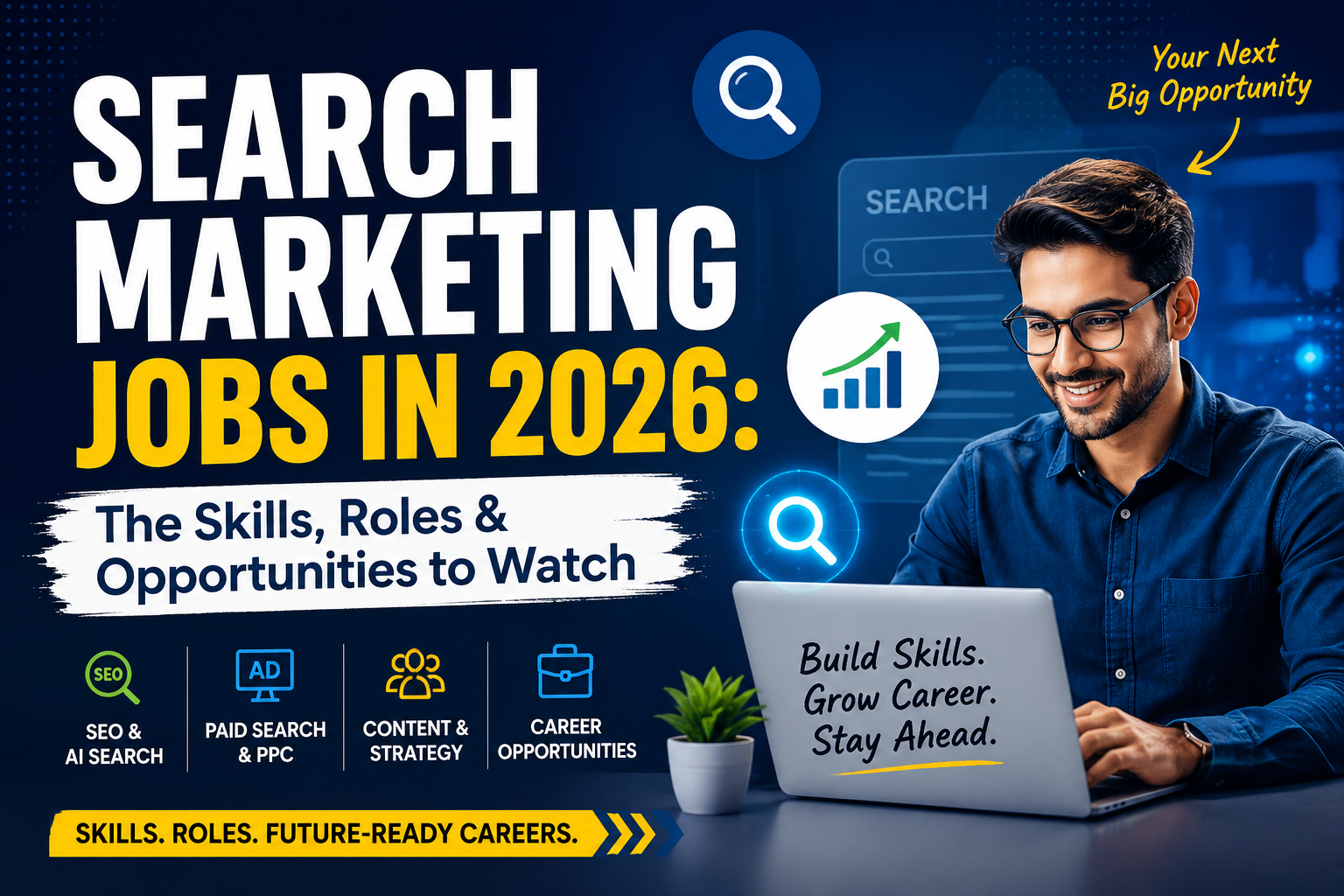
Search marketing jobs in 2026 are shifting from pure keyword and ranking work toward hybrid roles that blend SEO, paid search, content strategy, and AI visibility. The hottest titles include AI Search Specialist, Growth Marketer, and Search and Content Strategist. Employers want people who can connect search performance to revenue, not just traffic.
What is search marketing, really, in 2026
Search marketing used to mean two lanes. SEO on one side, PPC on the other. You picked a lane, got good at it, and that was your career.
That split is getting blurry now. Google’s AI Overviews answer questions directly on the results page. ChatGPT, Gemini, and Perplexity are becoming places people search instead of Google. Voice assistants are picking up more everyday queries too.
So the job isn’t “rank on page one” anymore. It’s “show up wherever someone is asking a question and get chosen.” That could be a search engine, an AI chat window, or a voice assistant on someone’s kitchen counter.
A simple example. A hair studio client of an agency I know used to measure success by rankings alone. Now their team also tracks whether the salon gets mentioned when someone asks an AI assistant “best hair studio near me.” Same intent, new battlefield.
Why this matters for your career or your business
If you’re job hunting, this shift decides whether your resume gets shortlisted or skipped.
If you’re running an agency or a marketing team, it decides whether you’re staffing for the market that exists now or the one that existed two years ago.
Companies are still spending on search. Digital ad budgets keep climbing, and marketing leaders across sectors report aggressive hiring plans for the back half of 2026. The demand hasn’t dropped. It’s just pointed at a different skill set.
People who adapt early get paid more, get hired faster, and get picked for the interesting projects. People who don’t end up competing for a shrinking pool of “traditional SEO only” roles.
The roles to watch in 2026
Here’s the honest breakdown of where the opportunity actually sits right now.
SEO Specialist, evolved
What it means Still exists, still hires, but the job description has grown teeth. Technical SEO, content strategy, and now AI visibility all sit under one roof.
Why it matters Organic search is still one of the cheapest ways to bring in qualified traffic, so companies aren’t giving up on it. They just want someone who understands how AI systems read and summarize a website, not only how Google’s crawler does.
How to break in Learn structured data and schema markup properly, not just copy paste templates. Get comfortable auditing a site for both classic technical SEO and AI readability. Build a portfolio showing before and after results, even from your own blog if you have to.
Example An SEO specialist working on a local business site notices that competitors are being cited in AI Overviews for a “best salon in Hyderabad” style query and theirs isn’t. She restructures the content into clear question and answer blocks, adds FAQ schema, and within weeks their business starts appearing in those AI generated answers too.
Pro tip Stop obsessing purely over rankings. Start tracking whether your content actually gets cited or quoted by AI tools. That’s the new scoreboard.
AI Search or GEO Specialist
What it means Generative Engine Optimization, or GEO, is the practice of getting your content picked up, cited, and trusted by AI answer engines. It’s new enough that job titles are still settling, but the work itself is very real.
Why it matters When someone asks ChatGPT or an AI Overview a question, only a handful of sources get referenced. Businesses that show up there get free, high trust visibility. Businesses that don’t, become invisible even if they rank fine on a regular search page.
How to break in Study how AI answer engines pull and summarize information. Practice writing content that answers questions directly and clearly, in the first few lines, not buried three paragraphs in. Track brand mentions across AI tools the same way you’d track backlinks.
Example A digital marketing analyst starts testing how different phrasing changes whether a client’s business gets mentioned in AI generated answers about local services. Small changes in how a service page answers “how much does X cost” end up making a measurable difference in AI citations.
Pro tip Answer the exact question a real customer would type, in plain language, right at the top of the page. AI engines love a clean, direct answer.
Paid Search or Growth Marketer
What it means Paid search hasn’t gone anywhere, but the standalone “PPC manager” title is merging into broader growth roles that also touch paid social, conversion rate optimization, and analytics.
Why it matters Businesses want people who can move a rupee or a dollar from one channel to another based on what’s actually converting, not someone locked into managing Google Ads alone.
How to break in Get certified, yes, but also learn to read a full funnel. Understand attribution, not just click through rate. Learn to talk about paid search results in terms leadership actually cares about, cost per lead, return on ad spend, revenue impact.
Example A paid search manager for a chain of hair studios notices Meta Ads are bringing cheaper leads than Google Search for a particular service. Instead of defending “his” channel, he shifts budget and reports the win as a team result.
Pro tip The marketers who get promoted fastest are the ones who stop thinking in channels and start thinking in outcomes.
Search and Content Strategist
What it means Part SEO thinker, part content planner, part brand voice guardian. This role decides what gets written, why, and how it serves both human readers and AI systems.
Why it matters Content is still the raw material every search and AI system runs on. Someone has to plan it strategically instead of just producing volume.
How to break in Build a habit of researching real search intent before writing a single line. Learn basic keyword research, then go further and map out what questions your audience is actually asking across search engines and AI tools.
Example A content strategist working with a service business builds an FAQ heavy content calendar based on actual customer questions collected from WhatsApp and phone inquiries, not just keyword tools. That content starts getting picked up in both search snippets and AI answers.
Pro tip Your customer service chats and DMs are a goldmine for real search intent. Use them.
Marketing Analyst or Data Storyteller
What it means Someone who can pull numbers from GA4, ad platforms, and CRM tools, then explain what they mean in a way that actually changes decisions.
Why it matters Every role above generates data. Someone still needs to connect the dots and tell a clear, honest story with it.
How to break in Get genuinely comfortable in GA4 and at least one ad platform’s reporting suite. Practice building simple dashboards. Practice explaining a chart to someone non technical in under a minute.
Example An analyst notices website traffic is up but leads are flat, and traces it back to a landing page that was recently redesigned. That single insight saves a client’s ad spend from being wasted for another month.
Pro tip A number without a story is just noise. Always answer “so what should we do about this” alongside the data.
Common mistakes people are making right now
Mistake: Treating AI search as a passing trend. Impact: You keep optimizing only for classic blue link rankings while competitors quietly start showing up in AI answers. Solution: Start tracking AI citations now, even informally, so you’re not starting from zero next year.
Mistake: Staying a narrow channel specialist by choice. Impact: You get passed over for hybrid roles that pay better and have more job security. Solution: Pick one adjacent skill each quarter and actually get functional in it, not just familiar.
Mistake: Chasing certifications without applying them. Impact: A resume full of badges that don’t translate into real results in an interview. Solution: Pair every certification with one real project, even a personal one, that proves you can use it.
Mistake: Ignoring local and small business search work. Impact: Overlooking a huge, steady demand pool in favor of chasing big brand jobs alone. Solution: Local service businesses need this expertise badly and often pay well for people who genuinely understand it.
Best practices for building a search marketing career in 2026
Specialize, but stay T shaped. Go deep in one area, SEO or paid search or content, then build working knowledge across the rest.
Learn to read AI generated answers critically. Understand why a source got picked and another didn’t.
Build a public portfolio. A personal blog, a LinkedIn presence, or case studies from real client work speak louder than a list of tools on a resume.
Get comfortable with data. Even a working knowledge of GA4 and spreadsheet analysis puts you ahead of a large chunk of applicants.
Keep an eye on smaller markets too. Cities outside the usual metro hubs are seeing real digital marketing hiring growth as local businesses finally invest in this seriously.
Tools and resources worth knowing
| Category | What it’s used for | Why it matters in 2026 |
|---|---|---|
| Google Analytics 4 | Website and conversion tracking | Still the backbone of most reporting work |
| Google Search Console | Search performance and indexing data | Core for diagnosing SEO issues |
| Semrush or Ahrefs | Keyword research, competitor analysis | Helps map both search and AI visibility opportunities |
| Schema markup generators | Structured data for pages | Improves chances of being cited by AI answer engines |
| Meta Ads Manager | Paid social campaign management | Increasingly tied to growth roles, not siloed |
| AI answer trackers | Monitoring brand mentions across AI tools | An emerging must have for GEO work |
A real example worth learning from
A small digital agency serving local service businesses used to run search campaigns the old way. Set up Google Ads, write a few SEO blog posts, check rankings monthly, call it done.
One client, a hair studio chain, wasn’t seeing new client walk ins despite decent rankings. The team dug in and found something interesting. Potential customers were asking AI assistants and Google’s AI Overview things like “best hair studio for keratin treatment near me” and the studio simply wasn’t showing up in those answers, even though their website ranked reasonably.
They restructured service pages to directly answer common questions, added proper FAQ schema, and built content around real customer queries instead of guessed keywords. Within a couple of months, the studio started appearing in AI generated recommendations, and walk ins picked up alongside it.
The lesson isn’t complicated. Rankings alone stopped telling the full story. Visibility across every place a customer actually asks a question is the new target.
Expert tips for standing out
Don’t just learn AI tools, learn to explain their limits. Clients and employers value someone who can say “AI got this wrong, here’s why” just as much as someone who can use the tools.
Build relationships with people in adjacent roles, developers, designers, customer support. A lot of AI visibility work depends on technical implementation, and knowing who to loop in matters.
Track your own experiments publicly if you can. Even a simple before and after on your own site or a small side project becomes a talking point in interviews that beats any certificate.
Say yes to messy, unglamorous work like structured data cleanup or content audits. That’s exactly where the AI visibility gains are hiding right now, and few people want to do it.
Frequently asked questions
Is SEO still a good career in 2026?
Yes, but it looks different than before. SEO specialists who also understand AI search visibility and content strategy are in stronger demand than those who only focus on traditional rankings.
What is GEO in digital marketing?
GEO stands for Generative Engine Optimization. It’s the practice of optimizing content so it gets picked up, cited, and referenced by AI tools like ChatGPT, Gemini, and Google’s AI Overviews.
Do I need to know coding for a search marketing job in 2026?
Not deep coding, but basic HTML and an understanding of schema markup will set you apart. Most roles don’t require you to be a developer.
Which pays more, SEO or paid search?
It depends on seniority and company, but hybrid growth roles that combine both, plus data analysis skills, tend to command higher salaries than single channel specialists.
Is voice search optimization still relevant?
It’s a smaller slice of the puzzle now compared to AI chat based search, but it hasn’t disappeared, especially for local and mobile focused searches.
What certifications actually help in 2026?
Google Analytics and Google Ads certifications still carry weight, but pairing them with a real portfolio project matters more than the certificate itself.
Can someone switch into search marketing from another field?
Yes, and it happens often. Backgrounds in writing, data analysis, linguistics, and even customer service translate surprisingly well into search marketing roles.
How important is AI visibility for small local businesses?
Very. Local businesses, from salons to clinics to restaurants, are increasingly being discovered through AI generated recommendations, not just traditional search results.
What's the biggest mistake beginners make in this field?
Trying to learn everything at once. It’s better to get genuinely good at one core skill, like technical SEO or content strategy, before spreading into adjacent areas.
Will AI replace search marketing jobs?
Not the strategic and judgement heavy parts. AI is changing what the work looks like, but someone still needs to decide strategy, interpret data, and make the calls AI can’t make on its own.
Key takeaways
- Search marketing jobs in 2026 are shifting toward hybrid roles that combine SEO, paid search, content, and AI visibility
- AI Overviews and answer engines like ChatGPT and Gemini are becoming real discovery channels, not side experiments
- Employers want people who connect search work to actual business outcomes, not just traffic or rankings
- Local and small business search marketing is a strong, steady demand pool, especially outside major metro hubs
- Building a real portfolio and hands on experiments beats collecting certifications alone
Where this leaves you
Search marketing hasn’t slowed down, it’s just gotten more interesting. The people who’ll do well over the next few years aren’t necessarily the ones with the most experience. They’re the ones willing to keep testing, keep learning how AI tools actually work, and connect their work to real results instead of vanity metrics.
Whether you’re job hunting, switching careers, or building out a team for your own agency, the same rule applies. Get comfortable being a generalist with one or two sharp specialties, and stay close to what customers are actually asking, wherever they’re asking it.
What to do next
If you’re job hunting, pick one AI search skill this month and actually build something with it, even a small case study on your own website.
If you’re hiring or building a team, look past the resume keywords and ask candidates to show you a real example of adapting to a channel shift.
And if you’re a business owner wondering whether your own search visibility is keeping up with where 2026 is heading, that’s usually the first thing worth auditing before anything else.
[…] Reddit’s ChatGPT Citations Fell 86% in 4 Days: What Actually Happened to AI Search Search Marketing Jobs in 2026: The Skills, Roles and Opportunities Nobody Told You About Google August 2026 Spam Update: What Changed, Who’s Affected & How to Recover LLM Prompt […]
[…] Reddit’s ChatGPT Citations Fell 86% in 4 Days: What Actually Happened to AI Search Search Marketing Jobs in 2026: The Skills, Roles and Opportunities Nobody Told You About Google August 2026 Spam Update: What Changed, Who’s Affected & How to Recover […]
[…] Reddit’s ChatGPT Citations Fell 86% in 4 Days: What Actually Happened to AI Search Search Marketing Jobs in 2026: The Skills, Roles and Opportunities Nobody Told You About Google August 2026 Spam Update: What Changed, Who’s Affected & How to Recover […]