
Hook
Here’s something I see almost every week. A client comes to me frustrated because their Meta Ads spend keeps climbing but the results stay flat. Their first instinct is always the same. Make more ads. Launch more campaigns. Throw more creatives into the account and hope something sticks.
It rarely works that way. I have run Meta Ads for hair studios and local service businesses across Vizag and Hyderabad for a while now, and the pattern is almost always identical. The account isn’t short on ads. It’s short on genuinely different ads. Ten variations of the same offer, same colours, same hook, same shot of the salon interior, dressed up as ten different creatives. Meta’s algorithm sees straight through that.
Table of Contents
ToggleIntroduction
Meta Ads creative strategy is about how you plan, structure, and diversify the actual ad content you show people, not just how much of it you show them. It matters because ad fatigue sets in fast, especially in smaller local markets where the same audience keeps seeing your ads on repeat.
In this piece, I want to walk you through why volume alone stopped working a while back, what real creative diversity actually looks like, how to build it into your campaigns without burning your whole month’s budget on production, and where most local businesses go wrong. I’ll also share a few real examples from client accounts because theory only takes you so far.
Quick Answer
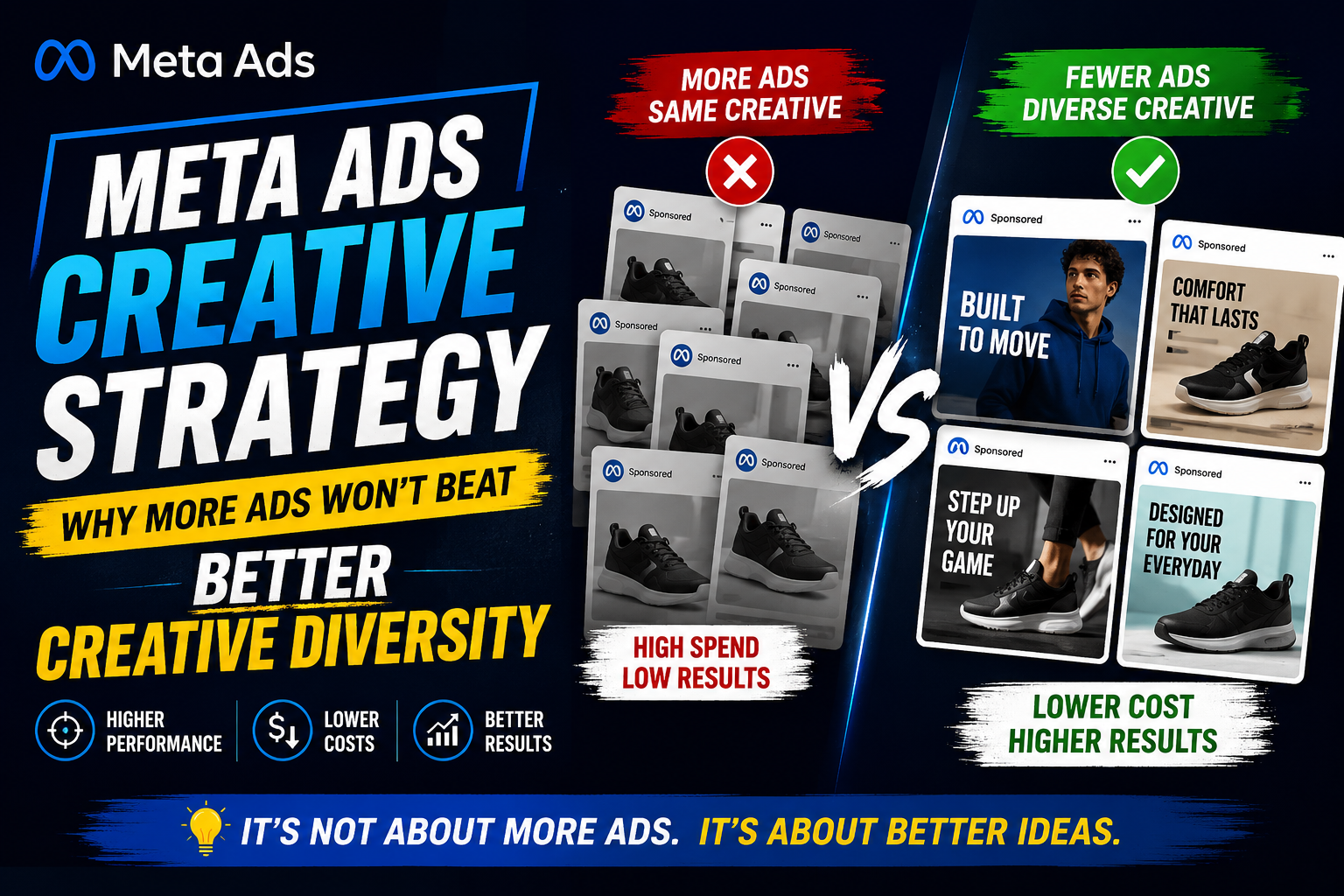
More ads don’t beat better creative diversity because Meta’s algorithm rewards variety in format, message, and visual style, not sheer quantity. Running five distinctly different ad concepts, each testing a different angle, hook, or format, almost always outperforms twenty near-identical variations. Diversity slows down ad fatigue and gives the algorithm more signals to find your best audience.
What Is Creative Diversity in Meta Ads?
Creative diversity means your ads differ in a way that actually matters to a viewer scrolling their feed. Not just a different headline on the same image. A different angle entirely.
Think of it in three layers. Format diversity covers static images, short videos, carousels, and Reels style content. Message diversity covers whether you’re leading with a price offer, a transformation story, a testimonial, or urgency. Visual diversity covers whether the shoot, lighting, colour palette, and pacing genuinely look and feel different from your last set of ads.
A real example. For one of my hair studio clients, instead of running five posters with slightly different fonts announcing the same haircut offer, we ran one before and after video, one client testimonial clip filmed on a phone, one carousel walking through the salon’s services, and one simple static offer post. Same budget, same offer underneath, four completely different experiences for the viewer.
Why Is It Important?
Meta’s ad delivery system is built around learning. Every time it shows your ad, it collects signals on who engages, who scrolls past, who converts. When all your ads look and sound the same, you’re basically asking the algorithm the same question over and over. You get the same answer, and that answer gets weaker every time because the same audience is seeing repeated creative.
Creative diversity fixes this in a few real ways.
It slows ad fatigue. Frequency climbs naturally in smaller cities where your audience pool is limited. If every ad they see looks identical, they tune out within days, sometimes hours if your budget is aggressive.
It widens your data. Different formats and hooks appeal to different segments of your audience, even within the same target group. A video might pull in people who wouldn’t stop scrolling for a static image. A price led post might convert someone who ignored your emotional storytelling ad.
It protects your cost per result. I’ve watched CPMs and CPCs creep up within a week purely because the same three creatives had been running on loop for too long. Refreshing with genuinely different content, not just a colour swap, brought those numbers back down without touching the budget.
Complete Guide: Building a Creative Diversity Strategy
Step One: Map Your Angles Before You Shoot Anything
What It Means Before touching a camera or opening Canva, list out the different reasons someone would actually book your service or buy your product. Not one master pitch. Several distinct angles.
Why It Matters If you jump straight to production without mapping angles first, you end up with creative that looks different but says the exact same thing underneath. That’s not diversity, that’s decoration.
How To Do It Sit down and write out four or five separate reasons a customer chooses you. For a hair studio this could be affordability, the skill of a specific stylist, a trending style they offer, convenience of location, or social proof from existing happy clients. Each of these becomes the backbone of a separate creative, not a variation of the same one.
Example For Antidot Hair Studio, we mapped out angles around a specific stylist’s expertise with keratin treatments, a budget friendly student offer, and a walk in convenience angle for working professionals nearby. Three angles, three completely different ad sets, each pulling a different kind of customer.
Pro Tip Keep this angle list somewhere permanent. Every time you plan a new batch of ads, pull from it instead of starting from a blank page and defaulting to whatever worked last time.
Step Two: Diversify Format Before You Diversify Design
What It Means Before you obsess over five different colour schemes, make sure you’re covering different formats. Static image, short form video, carousel, and if your budget allows, a Reels style piece filmed vertically for mobile.
Why It Matters Format changes how someone experiences your ad in their feed. A video autoplays and grabs attention differently than a static post someone has to actually stop scrolling for. Skipping format diversity and only changing visuals within one format limits how much data you’re actually generating.
How To Do It Take your top angle from step one and produce it in at least two formats. If your main hook is a client transformation, shoot it as a short video and also create a static before and after image. Same story, two very different viewing experiences.
Example One local client kept running only static posters for months. We introduced a fifteen second phone shot video of the same offer, nothing fancy, just a stylist talking to camera for ten seconds. That single video outperformed the static version by a wide margin on cost per lead, simply because it was the first moving content their audience had seen from the brand in weeks.
Pro Tip You don’t need studio equipment for video diversity. A steady phone, decent lighting near a window, and a genuine voice saying something useful beats an overproduced ad that feels like every other ad in the category.
Step Three: Rotate Hooks, Not Just Headlines
What It Means The hook is the first two seconds of a video or the first line of text someone reads. This is where most local businesses accidentally repeat themselves without noticing.
Why It Matters People decide whether to keep watching or keep scrolling almost instantly. If every one of your ads opens the same way, even with different visuals, the pattern becomes predictable and easy to ignore.
How To Do It Build a small bank of hook types. A question hook. A bold claim hook. A relatable problem hook. A curiosity hook. Rotate between these across your active ad sets instead of reusing the same opening line with new imagery behind it.
Example Instead of every ad starting with “Best hair studio in Vizag,” we tested one opening with a question, “Tired of your hair colour fading in two weeks?” and another opening with a relatable line, “Every monsoon, the same hair problem comes back.” Both outperformed the generic claim, because they actually spoke to something the viewer had felt.
Pro Tip Write five hooks for every one final ad you plan to run. You’ll only use one or two, but the process forces you out of your default phrasing.
Step Four: Build a Testing Rhythm, Not a One Time Batch
What It Means Creative diversity isn’t a project you finish once. It’s a rhythm you maintain, testing new angles and formats on a schedule instead of only refreshing creative when performance has already dropped.
Why It Matters Waiting until an ad set is clearly fatigued means you’ve already lost days or weeks of efficient spend. Businesses that treat creative refresh as routine maintenance stay ahead of fatigue instead of reacting to it.
How To Do It Set a simple internal calendar. Every two to three weeks, introduce at least one genuinely new angle or format into your active campaigns, even if current ads are still performing fine. Keep the winners running, but never let the account go stale.
Example For a Hyderabad based service client, we set a rule of introducing one new creative concept every two weeks regardless of how well the current set was doing. Over three months, this kept frequency and CPM noticeably more stable compared to the previous quarter where creative only changed when performance dipped.
Pro Tip Keep a simple spreadsheet logging what angle, format, and hook each ad used. Over time this becomes your own internal data on what actually resonates with your specific audience, which is more valuable than any generic best practices list.
Common Mistakes
Mistake: Treating colour or font changes as creative diversity. Impact: The algorithm and the audience both still perceive it as the same ad, so fatigue sets in just as fast. Solution: Change the underlying angle, format, or hook, not just the surface design.
Mistake: Producing everything in one expensive shoot and stretching it for months. Impact: You run out of genuinely fresh content quickly and start repeating angles without realising it. Solution: Mix high production shoots with quick, low cost phone content so you always have a pipeline of fresh material.
Mistake: Ignoring format and only focusing on static images. Impact: You miss out on the engagement and lower costs that video and carousel formats often bring, especially for local service businesses. Solution: Commit to at least one video style creative in every batch, even a simple one.
Mistake: Changing everything at once so you can’t tell what actually worked. Impact: You lose the ability to learn which specific angle or hook drove the improvement. Solution: Change one variable at a time when testing, angle or format or hook, not all three together.
Best Practices
Keep a running list of customer objections and turn each one into its own ad angle.
Reuse your best performing hooks across new visuals instead of retiring a working hook too early.
Batch produce low cost video content monthly so you’re never scrambling for fresh creative when an ad set fatigues.
Watch frequency, not just cost per result. Rising frequency with flat performance is usually your earliest warning sign that diversity is needed.
Involve real customers or staff in content occasionally. Genuine, slightly imperfect video often outperforms polished studio shoots in local markets because it feels more trustworthy.
Tools and Resources
| Tool | Best For | Cost Level |
|---|---|---|
| Meta Ads Manager | Campaign structure, testing, and performance tracking | Free with ad spend |
| Canva | Quick static and carousel creative production | Free to low cost |
| CapCut | Simple mobile video editing for Reels style ads | Free |
| Meta Creative Hub | Previewing ad formats before launch | Free |
| A basic smartphone | Authentic, low cost video content | One time cost |
Real life example
Situation A hair studio client in Vizag had been running the same three static ad creatives for close to six weeks. Cost per lead had crept up steadily and engagement had dropped to almost nothing.
Challenge Budget was limited, so a full reshoot wasn’t realistic. The account needed fresh creative without a big production spend.
Action We mapped three new angles based on actual customer questions we’d seen in the DMs and comments. Then we produced one short phone shot video, one carousel breaking down their most popular service, and one static post using a genuine client testimonial screenshot. Each used a different hook style, and we changed only the creative, keeping targeting and budget untouched so we could isolate the impact.
Result Within the first week of the new creative set going live, cost per lead dropped noticeably and frequency reset to a healthier range. The testimonial carousel in particular became the best performing asset in the account for the following month, something a static offer post had never achieved on its own.
Expert Tips
Don’t wait for an ad to completely die before refreshing it. A slow decline in click through rate over several days is usually your earliest signal.
Build a small swipe file of hooks and formats you notice performing well for other brands in your city, not to copy them, but to understand what your local audience is currently responding to.
If you only have budget for one new creative this month, make it a video. In most local service categories I’ve worked with, video consistently pulls in cheaper engagement than static images right now.
Don’t underestimate raw, slightly unpolished content. In categories like hair and beauty, overly staged ads can actually reduce trust compared to something that looks like it came from a real person at the salon.
Frequently Asked Questions
Does running more ads always increase reach in Meta Ads?
Not necessarily. Running more ads with the same core creative concept usually just splits your budget across similar content, which slows learning rather than expanding reach.
How often should I refresh my Meta Ads creative?
For most local businesses running consistent daily budgets, introducing at least one new creative angle every two to three weeks helps prevent fatigue before it hurts performance.
What counts as a truly different ad creative?
A different angle, hook, or format counts as truly different. Changing only the colour, font, or background image of the same message does not.
Is video always better than static images for Meta Ads?
Not always, but video frequently performs well for local service businesses because it holds attention longer and builds more trust than a static post.
How do I know if my ads are suffering from creative fatigue?
Watch for rising frequency alongside falling click through rate or rising cost per result, even when targeting and budget haven’t changed.
Can small businesses build creative diversity without a big budget?
Yes. A smartphone, natural lighting, and a clear customer angle can produce effective, diverse creative without expensive equipment or a professional shoot.
Should I test multiple creatives in the same ad set or separate ad sets?
Meta’s algorithm generally handles multiple creatives well within the same ad set for testing purposes, though separating drastically different angles into their own ad sets can make performance easier to read.
How many creative variations should I run at once?
Quality matters more than quantity. Three to five genuinely distinct creatives usually outperform ten near-identical ones.
Does creative diversity help with lower Meta Ads costs?
Yes, in many cases. Fresh, varied creative tends to reduce ad fatigue, which often helps stabilise or lower cost per result over time.
What's the biggest mistake local businesses make with Meta Ads creative?
Assuming a small design tweak counts as a new creative, when in reality the underlying message and format haven’t actually changed.
Key Takeaways
More ad volume without creative variety just splits your budget across similar content and speeds up fatigue.
Real creative diversity comes from changing the angle, format, or hook, not the colour scheme.
Map out your different customer angles before producing any content.
Mix formats deliberately. Static, video, and carousel each pull in engagement differently.
Build a regular creative refresh rhythm instead of waiting for performance to drop first.
Low cost, authentic content like phone shot videos can genuinely outperform expensive, polished shoots in local markets.
Conclusion
If your Meta Ads account feels stuck no matter how much you spend, the fix usually isn’t a bigger budget. It’s a closer look at whether your creatives are actually saying different things to different people, or just repeating the same message in a new outfit.
I’ve seen this play out again and again with local businesses in Vizag and Hyderabad. The accounts that grow steadily aren’t the ones pumping out the most ads. They’re the ones treating creative like an ongoing conversation with their audience, always bringing something a little different to the table.
Your Next Step
If you’ve been running the same handful of creatives for weeks and your results have started to plateau, that’s usually the first sign your account needs a diversity refresh, not a bigger budget. Start by mapping out three different customer angles this week and testing them against what’s currently running. Small shift, often a noticeably different result.