

You’re spending money on ads but nobody’s buying. Here’s why.
If you’ve ever run a Facebook ad, gotten a hundred likes and comments, and then… nothing. No calls, no bookings, no sales. That’s not a bad product problem. That’s a funnel problem.
Most business owners think marketing is just “post something and hope people buy.” It isn’t. There’s a journey every customer takes before they hand you money, and if you don’t understand that journey, you’re basically throwing budget into a black hole.
I’ve built funnels for local businesses, from salons to service brands, and the pattern is always the same. The ones who understand the funnel grow steadily. The ones who don’t, burn cash and blame the platform.
This guide breaks the whole thing down in plain language. No jargon, no textbook definitions. Just what a marketing funnel actually is, why it matters, and how you can build one for your own business, even if you’re starting from zero.
Table of Contents
ToggleQuick Answer
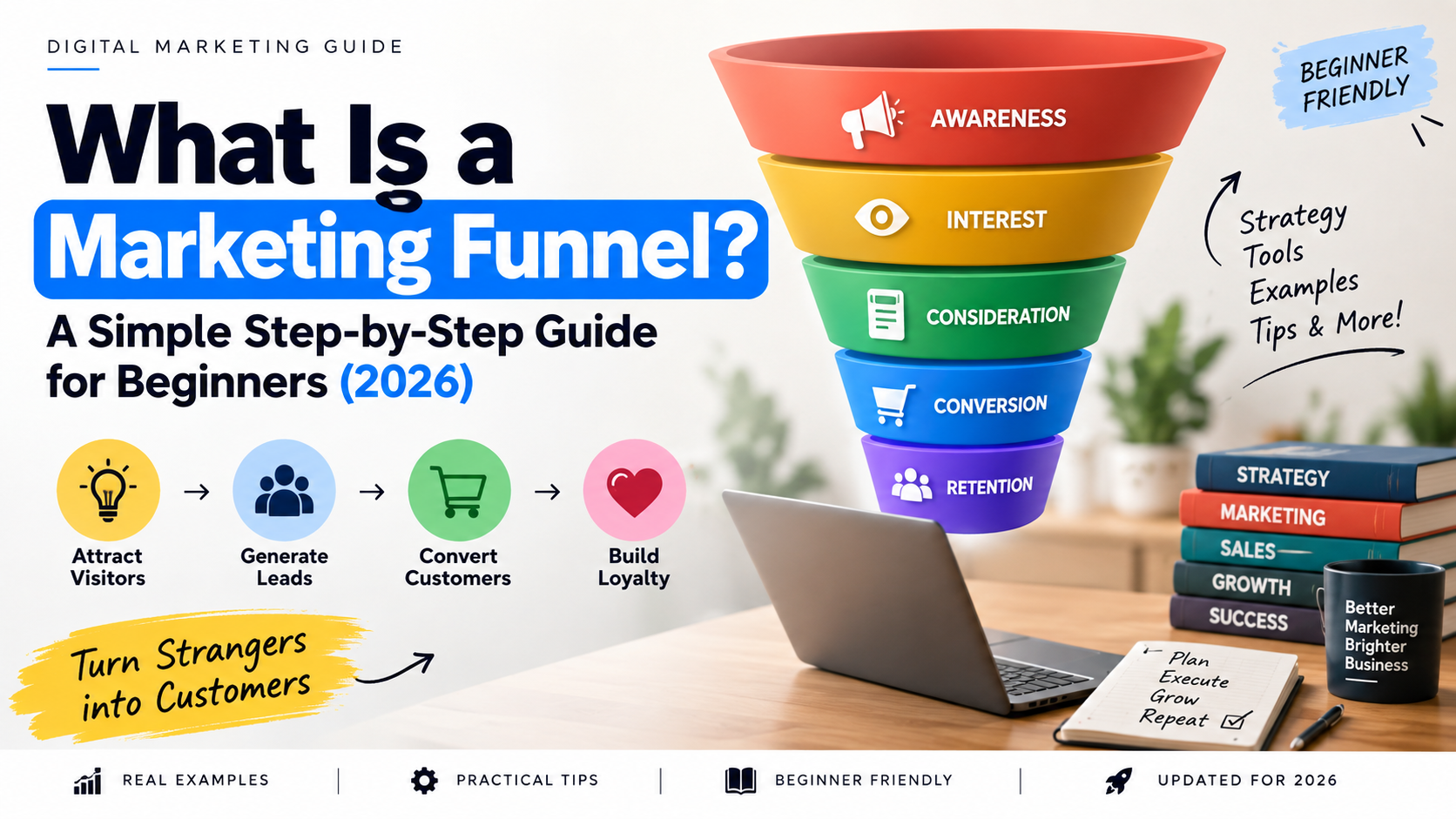
A marketing funnel is the journey a person takes from first hearing about your business to becoming a paying, repeat customer. It usually has three stages: awareness (they discover you), consideration (they compare and research), and conversion (they buy). A good funnel guides people through each stage instead of expecting them to jump straight from stranger to buyer.
What Is a Marketing Funnel?
A marketing funnel is simply a way of mapping out how strangers become customers. Picture a real funnel, wide at the top, narrow at the bottom. Lots of people enter at the top just becoming aware you exist. Fewer move to the middle where they’re actually considering you. And only a small percentage reach the bottom and actually buy.
That’s not a flaw in the system. That’s how buying decisions work for basically every product or service, whether it’s a hair studio, a software tool, or a car.
Here’s a simple example. Say someone scrolls past your Instagram reel about hair spa treatments. They didn’t know your salon existed an hour ago. That’s the top of the funnel. A few days later, they check your Google reviews and compare prices with two other salons nearby. That’s the middle. Then they message you to book a slot. That’s the bottom.
Nobody skips straight from “never heard of you” to “here’s my payment.” There are steps in between, and your job as a marketer is to guide people through those steps instead of just hoping they figure it out themselves.
Why Is It Important?
Here’s the honest truth. Without a funnel, you’re just guessing. You post content randomly, run ads without a clear next step, and wonder why your conversion rate is terrible.
When you actually map out your funnel, a few things change.
You stop wasting ad spend on people who were never going to buy anyway. You start creating content for the right stage instead of just pushing “buy now” at people who’ve never heard of you. And you can actually track where people are dropping off, so you know exactly what to fix.
I had a client running Meta ads for a hair studio, spending around 15,000 rupees a month, and getting almost no bookings. The problem wasn’t the ad creative. It was that the ad sent cold traffic, people who’d never heard of the brand, straight to a booking form. No trust built, no reason to choose them over a competitor. Once we added a middle stage, a simple landing page with before and after results and real client reviews, bookings picked up within two weeks. Same budget. Different funnel.
That’s the power of understanding this stuff. It’s not about spending more. It’s about spending smarter.
Complete Guide: The Marketing Funnel Step by Step
Stage 1: Awareness (Top of Funnel)
What It Means This is the moment someone first learns your business exists. They’re not thinking about buying yet. They’re just discovering you.
Why It Matters If nobody knows you exist, nothing else matters. This stage fills the funnel. Skip it or do it half heartedly, and every stage after it suffers, no matter how good your offer is.
How To Do It Focus on visibility, not selling. Use short form content like reels and shorts, run broad awareness ads, get featured through local SEO, and show up on Google Maps when people search nearby. This is also where a strong social media presence pays off, people notice you before they ever need you.
Example A skincare clinic posts a reel showing a common skin problem and a quick explanation of what causes it. No pitch, no “book now.” Just useful, watchable content that gets shared. That’s awareness done right.
Pro Tip Don’t try to sell at this stage. It almost always backfires. People aren’t ready, and a hard sell this early makes you look desperate rather than trustworthy.
Stage 2: Consideration (Middle of Funnel)
What It Means The person now knows you exist and is actively comparing you against other options. They’re checking reviews, comparing prices, reading about your services.
Why It Matters This is where most businesses lose people, honestly. You got their attention, but if you don’t give them a reason to trust you over the competitor down the road, they’ll just pick whoever seems more credible.
How To Do It Show proof. Client testimonials, before and after photos, case studies, detailed service pages, FAQs that answer the objections people are silently thinking about. Email or WhatsApp follow ups work well here too, gentle nudges, not spam.
Example Someone visits your website after seeing your ad. Instead of a generic homepage, they land on a page with real client results, pricing clearly laid out, and answers to “does this actually work” style questions. That builds enough trust to move forward.
Pro Tip Answer the questions people are too shy to ask directly. If price is a concern, address it. If they’re worried about results, show proof. Silence just creates doubt.
Stage 3: Conversion (Bottom of Funnel)
What It Means This is the moment they actually become a customer. They book, they buy, they sign up.
Why It Matters All that awareness and trust building means nothing if the actual buying step is confusing or has too much friction. A clunky checkout or a hard to reach WhatsApp number can lose a customer at the finish line.
How To Do It Make the next step obvious and easy. One clear call to action, a simple booking form, a direct WhatsApp link, limited time offers if genuine urgency exists. Remove every unnecessary step between “I want this” and “I got this.”
Example A local business adds a single “Book Your Slot” button connected straight to WhatsApp instead of a five field contact form. Conversions jump because there’s almost no effort required to take action.
Pro Tip Test your own buying process. Actually go through it as a customer would. You’ll be surprised how many unnecessary steps you find once you look at it from their side.
Stage 4: Retention (Beyond the Funnel)
What It Means The funnel doesn’t end at the sale. Retention is about turning a one time buyer into someone who comes back and tells others about you.
Why It Matters Getting a new customer costs far more than keeping an existing one happy. Repeat customers also tend to spend more over time and refer others without being asked.
How To Do It Follow up after the purchase. Ask for feedback, offer loyalty perks, stay visible through email or WhatsApp updates, and genuinely check in rather than only reaching out when you want another sale.
Example A salon sends a simple message two weeks after a service asking how the results are holding up, along with a small discount for the next visit. That one message often brings people back.
Pro Tip Retention marketing is quieter than acquisition marketing, but it’s usually where the real profit lives. Don’t ignore it just because it’s less flashy.
Common Mistakes
Mistake: Sending cold traffic straight to a sales page. Impact: People who’ve never heard of you feel like they’re being pushed, so they bounce without buying. Solution: Build awareness first, then guide them toward consideration content before asking for the sale.
Mistake: Treating every customer the same regardless of funnel stage. Impact: You end up showing “buy now” ads to people who don’t even know your brand yet, wasting budget. Solution: Segment your audience and match your message to where they actually are in the journey.
Mistake: Ignoring the middle of the funnel completely. Impact: You get plenty of attention but very few actual conversions, because nobody trusts you enough to buy yet. Solution: Add proof, testimonials, and clear answers to objections before pushing for the sale.
Mistake: Making the final step complicated. Impact: Interested buyers give up simply because booking or purchasing takes too much effort. Solution: Simplify to one clear action, whether that’s a button, a form, or a direct message link.
Mistake: Forgetting about customers after the first sale. Impact: You keep spending on new customer acquisition while ignoring cheaper, easier repeat revenue. Solution: Build a simple follow up system, even something as basic as a monthly WhatsApp check in.
Best Practices
Map your funnel before you spend a single rupee on ads. Know exactly what happens after someone clicks.
Create content specifically for each stage instead of one generic message for everyone.
Track where people drop off. If most people leave at the consideration stage, that’s where you need to focus your energy, not the top.
Keep your call to action simple and singular. Confused visitors don’t convert.
Don’t neglect retention. It’s the quiet engine behind sustainable growth.
Revisit and adjust your funnel every few months. What worked six months ago might not work now, audiences shift and platforms change constantly.
Tools and Resources
| Tool | Best For | Funnel Stage |
|---|---|---|
| Meta Ads Manager | Awareness and retargeting ads | Awareness, Consideration |
| Google Ads | Capturing search intent | Consideration, Conversion |
| WhatsApp Business | Direct communication and follow up | Conversion, Retention |
| Google Analytics 4 | Tracking drop off points | All stages |
| Landing page builders | Building trust based consideration pages | Consideration |
| Email or WhatsApp automation | Staying in touch after purchase | Retention |
There’s no single tool that handles everything well. Most businesses end up combining two or three of these depending on budget and how hands on they want to be.
Real Life Example
Situation: A hair studio in Vizag was running Meta ads with a decent budget but almost no bookings coming through.
Challenge: Their ads sent cold, unaware audiences straight to a booking link. No trust building step in between.
Action: We restructured the funnel. Awareness ads focused on educational reels about hair problems people actually search for. A dedicated consideration page followed, with real client transformations and reviews. Only after that did we push the booking link, mainly through WhatsApp for ease.
Result: Bookings increased noticeably within a month, without increasing the ad budget. The difference wasn’t the offer or the price. It was simply guiding people through the right steps instead of skipping straight to the ask.
Expert Tips
If you’re just starting out, don’t try to build a perfect five stage funnel on day one. Start simple. Awareness content, one consideration piece, one clear conversion action. Improve it as you learn what your specific audience responds to.
Pay close attention to your actual data rather than assumptions. I’ve seen business owners convinced their awareness content was the problem, when the real issue was a confusing booking process at the very last step.
Retarget people who engaged but didn’t convert. Someone who watched 75 percent of your reel or visited your page but left is warmer than a brand new stranger. Don’t let that interest go cold.
And be patient. Funnels compound over time. The first month rarely tells the full story.
Frequently Asked Questions
What is a marketing funnel in simple terms?
It’s the path a person takes from first discovering your business to actually becoming a paying customer, usually moving through awareness, consideration, and conversion stages.
How many stages does a marketing funnel have?
Most funnels have three core stages, awareness, consideration, and conversion, with retention often added as a fourth stage after the sale.
Why do most small businesses fail at funnel marketing?
They usually skip straight from awareness to conversion, asking for the sale before building any trust, which causes most potential customers to drop off.
What's the difference between a sales funnel and a marketing funnel?
A marketing funnel covers the entire journey from stranger to customer, while a sales funnel usually refers more narrowly to the steps closer to the actual purchase.
How do I know where people are dropping off in my funnel?
Tools like Google Analytics 4 and Meta Ads Manager show you engagement and click through data at each stage, which helps you spot exactly where interest fades.
Do I need a big budget to build a marketing funnel?
No. Even a simple funnel with organic content for awareness, a basic landing page for consideration, and a WhatsApp link for conversion can work well on a modest budget.
What content works best for the awareness stage?
Educational and relatable content, like reels or shorts addressing common problems your audience faces, tends to perform best since it doesn’t feel like a sales pitch.
How long does it take to see results from a marketing funnel?
It varies, but most businesses start seeing clearer patterns within four to six weeks, once there’s enough data to see where people move and where they drop off.
Can a marketing funnel work for a local, offline business?
Yes, and often very well. Local businesses like salons, clinics, and service providers benefit hugely from a proper funnel since trust plays such a big role in local buying decisions.
What's the biggest mistake to avoid when building a funnel?
Sending unaware audiences straight to a sales pitch. Give people a reason to trust you first, then ask for the sale.
Key Takeaways
A marketing funnel maps the journey from stranger to customer, usually through awareness, consideration, conversion, and retention.
Skipping stages, especially the middle one, is the biggest reason funnels fail to convert.
Match your content and messaging to each specific stage instead of using one generic pitch for everyone.
Track where people drop off so you know exactly what part of your funnel needs fixing.
Retention is often overlooked but tends to be the most profitable part of the entire funnel.
Conclusion
A marketing funnel isn’t some complicated corporate concept meant for big companies with huge budgets. It’s just a clearer way of thinking about how real people actually decide to buy something. Once you understand that people need to move through stages, not jump straight from stranger to customer, everything about your marketing starts making more sense.
You don’t need to overhaul everything overnight. Start by mapping your own funnel. See where people are, and where they’re dropping off. Fix one stage at a time.
Ready to Build Your Funnel?
If reading this made you realize your current marketing has been missing a proper structure, that’s actually a good sign. It means you now know exactly what to fix.
Start small. Pick one stage, awareness, consideration, or conversion, and improve it this week. The compounding effect of a well built funnel is worth the effort.