

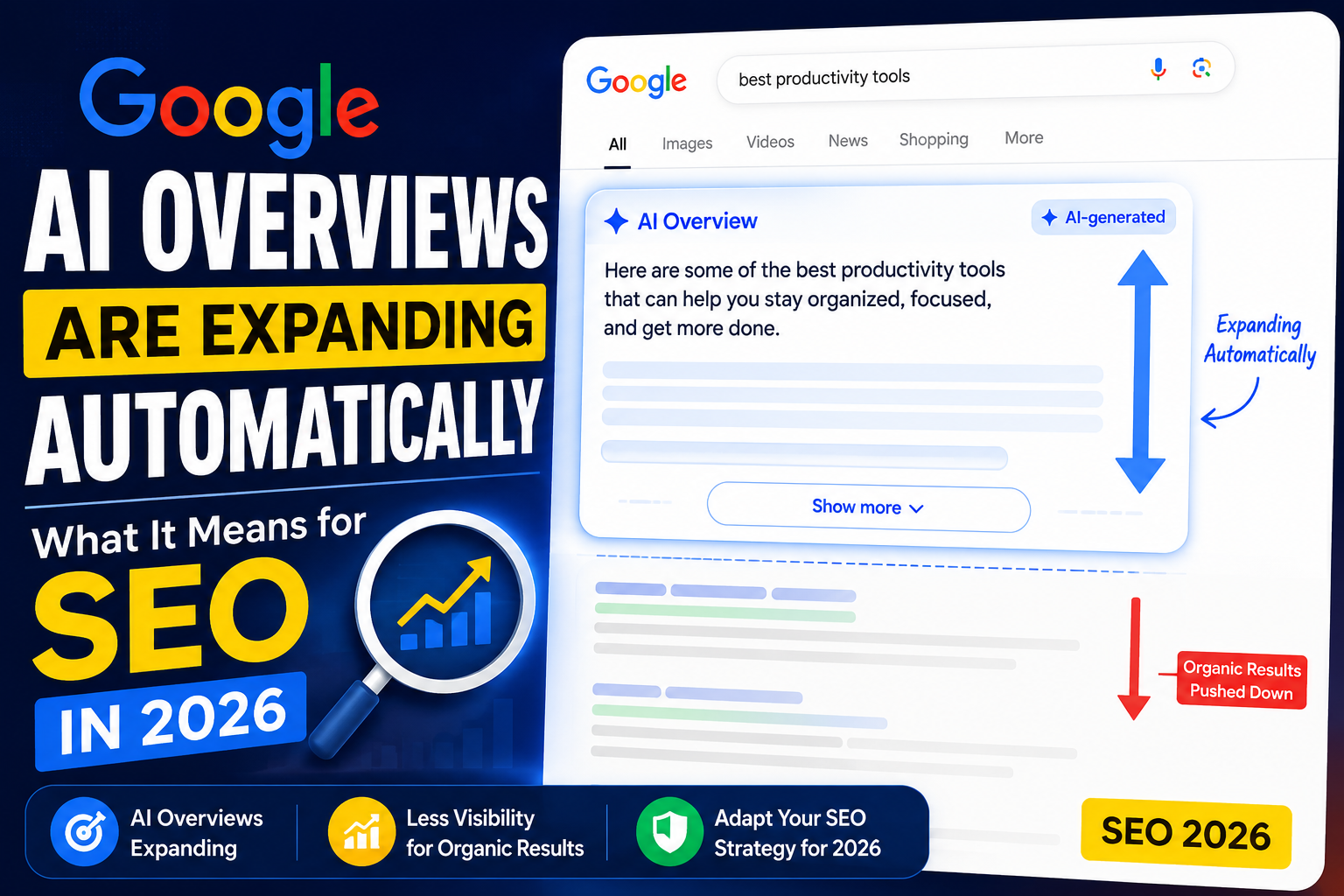
The Search Results Page You Grew Up With Is Gone
Type something into Google right now. Anything. Before you even scroll to the first blue link, there’s a good chance you’ll hit a big AI generated answer box sitting right at the top, pulling bits and pieces from five or six websites and stitching them into one neat little summary.
That’s an AI Overview. And if you run a business, manage a website, or write content for a living, you’ve probably already felt its effect even if nobody explained why your traffic dipped.
I’ve been watching this shift closely because it directly affects the clients I work with, mostly local service businesses that depend on search traffic to survive. And here’s the honest truth. This isn’t a small algorithm update you can ignore for a quarter and catch up on later. It’s a structural change in how people find information.
Let’s get into what’s actually happening, why it’s happening faster than most people expected, and what you need to do about it if you want your website to still matter in 2026 and beyond.
Table of Contents
ToggleQuick Answer
Google’s AI Overviews now appear on roughly half of all search queries in the US, up from about 25 percent just a year ago, and they’re expanding into commercial and local searches, not just informational ones. For SEO, this means ranking in the top ten is no longer enough. You now need to earn a citation inside the AI answer itself, which means writing content that’s direct, well structured, and backed by real expertise rather than fluff.
What Are Google AI Overviews, Really?
Think of it like this. You ask a knowledgeable friend a question instead of handing you a stack of ten magazines and telling you to figure it out yourself, they read through the magazines quickly and just tell you the answer, then point to a couple of good sources if you want to dig deeper.
That’s basically what an AI Overview does. Google’s system scans through multiple ranking pages, pulls out the relevant facts, and generates a short answer that sits above the regular search results. It usually pulls from three to eight different sources, which is different from the old featured snippets that leaned on just one page.
Here’s a simple example. Say someone searches “best time to post on Instagram for a salon business.” A few years ago, they’d click through two or three blog posts to piece together an answer. Now, Google often just tells them directly, with small citation links tucked in beside the summary. Some users click through. Many don’t need to.
Why This Is Such A Big Deal Right Now
A year ago, AI Overviews were mostly showing up for simple informational searches, things like “what is,” “how does,” or “why do.” Commercial searches, the ones with actual buying intent, were mostly left alone.
That’s changed. Fast.
Recent data shows AI Overviews now trigger for close to half of all search queries in the US, and in some analyses even higher once you account for both desktop and mobile. Commercial investigation queries, the kind where someone is comparing options before buying, are seeing trigger rates around 28 percent. Local searches are catching up too, often pulling from Google Business Profiles and local content sources.
What does this mean in plain terms? It means the safe zone where AI Overviews “don’t really apply to my industry” is shrinking every month. If you run a hair studio, a clinic, a real estate agency, or any business that depends on people searching for answers before they buy, this now touches you.
And the traffic impact is not subtle. Multiple large studies have measured click through rate drops ranging from 15 percent all the way up to nearly 47 percent for certain query types when an AI Overview appears above the results. One widely cited study across sixty eight thousand queries found organic clicks fell from around 15 percent down to about 8 percent once an AI Overview showed up on the page.
That’s not a dip. That’s almost half your potential clicks disappearing before the user even scrolls.
The Silver Lining Nobody Talks About Enough
Here’s something I tell clients who panic when I show them this data. Getting cited inside an AI Overview is, in some ways, more valuable than a normal ranking.
Why? Because when Google’s AI pulls your content into its answer, it’s essentially vouching for you. It’s telling the user, this source is trustworthy enough to build my answer around. That kind of implied endorsement carries weight. And the traffic that does click through from an AI Overview citation tends to arrive with sharper intent, they already trust what they read about you, so conversion rates on that smaller slice of traffic are often noticeably better.
So the real question isn’t “how do I stop AI Overviews from stealing my clicks.” It’s “how do I become the source Google’s AI actually wants to quote.”
The Complete Guide: How To Actually Adapt Your SEO For 2026
Step One: Restructure Your Content To Lead With The Answer
What It Means Stop burying your best insight in paragraph four after three paragraphs of introduction. AI systems favor content that states the answer clearly near the top, then supports it with detail afterward.
Why It Matters Google’s AI is scanning for a clean, quotable chunk of text it can lift and summarize. If your answer is wrapped in fluff, storytelling, or a slow build up, the system will likely skip your page and grab a competitor’s instead.
How To Do It Open each major section with a direct two or three sentence answer. Save the storytelling, examples, and nuance for right after. This also happens to make your content easier for actual human readers to scan, which is a nice bonus.
Example Instead of starting a section titled “How Often Should A Salon Post On Social Media” with a long history of social media marketing, open with something like: “Most salons see the best engagement posting four to five times a week, mixing before and after shots with quick tips.” Then explain why underneath.
Pro Tip Read your opening sentence out loud. If it sounds like it’s warming up rather than answering, rewrite it.
Step Two: Build Real Topical Authority, Not Just Individual Pages
What It Means Google’s AI increasingly favors sources that show consistent expertise across a subject, not a single lucky blog post that happened to rank once.
Why It Matters Citation patterns in 2026 have become more predictable, and sources with sustained content depth around a topic earn steadier placement. A one off article rarely holds its spot for long.
How To Do It Build a cluster of related content around your core services. If you run a hair studio, that means content covering hair care routines, seasonal styling trends, product recommendations, and treatment guides, all linking back to each other and to your service pages.
Example A single blog post about “best hair treatments for dry hair” performs weaker than a whole hub of content covering hair types, treatment options, aftercare, and product comparisons, all written by the same trusted brand.
Pro Tip Don’t chase every keyword under the sun. Pick five or six core topics your business genuinely knows well and go deep instead of wide.
Step Three: Add Structured Data And Clear Entity Signals
What It Means Structured data, also called schema markup, helps search engines understand exactly what your content is about, who wrote it, and what kind of business you are.
Why It Matters Entity authority, meaning clear and consistent signals about your brand, your author, and your credentials, directly influences whether Google’s AI trusts your content enough to cite it.
How To Do It Add schema for your business type, your services, your FAQs, and your author bios if you publish under specific writers. Keep your business name, address, and contact details consistent everywhere online, your website, Google Business Profile, and social pages.
Example A local clinic that consistently uses the same name, address, and phone number across its website, directory listings, and social profiles builds a stronger entity signal than one with inconsistent details scattered across the web.
Pro Tip Run your site through a schema validator every few months. Small markup errors quietly cost you visibility without any warning.
Step Four: Track Citations, Not Just Rankings
What It Means Ranking number three on Google no longer tells the full story. You now need to know whether you’re actually being cited inside AI Overviews for your target queries.
Why It Matters Traditional rank tracking misses the bigger picture entirely. You could be ranking well and still losing most of the clicks to an AI Overview that ignores your page completely.
How To Do It Manually search your top target queries and note which brands get cited. There are also emerging tools built specifically for AI Overview citation tracking. Even a simple spreadsheet, updated monthly, beats flying blind.
Example A client of mine ranked second organically for a competitive local search term but wasn’t appearing anywhere in the AI Overview. Once we restructured the page with a direct answer block, we started showing up in the citation within about six weeks.
Pro Tip Check on both desktop and mobile. Overview behavior sometimes differs between the two.
Step Five: Rethink How You Measure Success
What It Means Click through rate alone is becoming a misleading metric. You need to look at impressions, brand visibility, and conversion quality together.
Why It Matters Some businesses are seeing impressions climb even while raw clicks flatten out. That’s not failure, that’s a shift in how visibility works. Fewer people click, but the ones who do are often more ready to buy.
How To Do It Track branded search volume over time. If more people are searching your business name directly after seeing you referenced in an AI Overview, that’s a real win even if it doesn’t show up as a direct click.
Example A business that gets quoted often in AI Overviews for its niche often sees a slow, steady rise in people searching its name specifically, a sign the brand is sticking in people’s minds even without the click.
Pro Tip Don’t panic over a single month’s CTR drop. Look at the trend across a full quarter before making big decisions.
Common Mistakes Businesses Are Still Making
Mistake: Treating AI Overview optimization as identical to old school SEO. Impact: Content stays vague, keyword stuffed, and slow to get to the point, which AI systems tend to skip over. Solution: Rebuild your content templates around direct answers first, keyword density second.
Mistake: Ignoring local and commercial queries because “AI Overviews are only for informational searches.” Impact: Businesses get blindsided when their category suddenly starts triggering overviews at a much higher rate. Solution: Assume every query type is fair game now and prepare content accordingly, especially for local service searches.
Mistake: Only tracking rankings, never citations. Impact: You think you’re doing fine because you rank well, while a competitor quietly eats your clicks by getting quoted inside the overview. Solution: Add citation tracking to your monthly reporting, even if it’s manual for now.
Mistake: Writing content that reads like a textbook instead of a person who’s actually done the work. Impact: Neither readers nor Google’s AI trust it enough to prioritize it. Solution: Write with real examples, actual numbers, and a voice that sounds like an experienced human, because that’s exactly what both users and AI systems are learning to favor.
Best Practices Worth Repeating
Keep your paragraphs short. Nobody, human or AI, wants to wade through walls of text to find one useful sentence.
Answer the question in the first two sentences of every section, then build on it.
Update older content regularly instead of only publishing new posts. Freshness signals matter more than people assume.
Use real data, real case studies, and specific numbers wherever you can. Vague claims get skipped, specific ones get quoted.
Build author credibility. A named, credentialed author with a real bio carries more weight than an anonymous “admin” byline.
Tools and Resources
| Tool | Best For | Notes |
|---|---|---|
| Google Search Console | Tracking impressions and click trends | Free, and the first place to notice AI Overview impact on your existing pages |
| Schema markup generators | Adding structured data quickly | Useful for FAQ, local business, and article schema |
| Manual SERP checks | Citation tracking | Slower but reliable until dedicated tools mature further |
| Content clustering tools | Building topical authority | Helps map out related content gaps around your core services |
A Real Example From My Own Client Work
One of the businesses I work with runs a hair studio chain across Vizag and Hyderabad. Earlier this year, we noticed organic clicks on a few of their most popular blog posts, things like hair treatment guides, had started slipping even though rankings hadn’t dropped much.
The situation was frustrating because everything looked fine on paper. Rankings steady, content quality good, nothing obviously broken.
The challenge turned out to be structural. Their posts opened with long introductions before ever answering the actual question in the title. Great for storytelling, terrible for AI Overview extraction.
The action we took was simple but time consuming. We rewrote the opening two to three sentences of every major section to directly answer the implied question, then restructured supporting content underneath. We also added FAQ schema and tightened up their Google Business Profile consistency across all three locations.
The result within about two months was a noticeable uptick in AI Overview citations for several treatment related queries, along with a small but real increase in branded searches for the studio names. Clicks didn’t fully recover to old levels, nothing does anymore, but the traffic that did come through converted at a higher rate than before, because people arrived already trusting the brand.
Expert Tips For Getting Ahead Of The Curve
Write for the person who’s scanning, not reading. Most users skim the opening lines of an AI Overview looking for a fast answer, and that behavior is spilling over into how they read regular content too.
Don’t chase every AI platform separately. Optimizing for clarity, structure, and genuine expertise tends to help you across Google AI Overviews, ChatGPT, Gemini, and Perplexity all at once, because they’re all pulling from similar signals of trustworthy, well organized content.
Watch your competitors’ citation patterns, not just their rankings. If a competitor keeps showing up inside AI Overviews for your shared keywords, study exactly how their content is structured and figure out the gap.
Invest in original research or unique data where you can. Multi source citation patterns favor content that brings something genuinely new to the table, not another rehash of the same five points everyone else has already written.
Frequently Asked Questions
What percentage of Google searches now show an AI Overview?
Recent data puts it somewhere between 25 and 50 percent of US searches depending on the study and query type, with informational and commercial investigation queries seeing the highest exposure.
Do AI Overviews completely replace organic search results?
No. They sit above the traditional results and link out to a handful of cited sources, but the regular blue links are still there underneath for anyone who wants to explore further.
Will AI Overviews hurt my website's traffic?
For many informational queries, yes, click through rates have dropped noticeably. But if your content earns a citation inside the overview, you can actually gain visibility and often see better quality traffic.
How do I know if my content is being cited in AI Overviews?
Search your target keywords manually and check whether your domain appears among the cited sources. Dedicated AI Overview tracking tools are also becoming more common.
Does schema markup guarantee an AI Overview citation?
No single factor guarantees a citation, but structured data does help Google’s systems understand and trust your content, which improves your odds.
Are local businesses affected by AI Overviews?
Yes, and increasingly so. Local queries are triggering AI Overviews more often now, frequently pulling from Google Business Profile data alongside website content.
Should I stop writing long form content?
Not necessarily, but you should restructure it so answers appear early, with supporting depth afterward rather than a slow build up.
Is featured snippet optimization the same as AI Overview optimization?
They’re related but not identical. Featured snippets typically cite one source, while AI Overviews often pull from several, so the strategy leans more toward broad topical authority than a single perfect paragraph.
How often should I update old content for AI Overview visibility?
Reviewing and refreshing your top performing pages every few months keeps them competitive, since freshness and continued relevance play into citation selection.
What's the single biggest mistake businesses make with AI Overview SEO?
Treating it as identical to old SEO tactics. Keyword stuffed, slow to the point content simply doesn’t get picked up the way direct, well structured, genuinely expert content does.
Key Takeaways
- AI Overviews now appear on a large and growing share of Google searches, expanding well beyond simple informational queries into commercial and local searches too.
- Click through rates drop significantly when an AI Overview appears, but citation inside that overview can bring higher quality, higher converting traffic.
- Structuring content to answer questions early, building genuine topical authority, and strengthening entity signals through schema and consistent business details all improve your citation chances.
- Tracking citations, not just rankings, needs to become part of your regular reporting from here on.
- Businesses that treat this as a side project keep losing ground to competitors who treat it as a core part of their SEO strategy.
Conclusion
Search isn’t disappearing. It’s just changing shape, and honestly, it’s changing faster than most business owners have time to notice. The businesses that come out ahead won’t be the ones with the most content. They’ll be the ones whose content Google’s AI actually trusts enough to quote.
That shift takes real work, restructuring old pages, building genuine expertise, cleaning up your entity signals across the web. It’s not a one time fix you do and forget.
If you’ve been watching your traffic dip without understanding why, there’s a good chance this is exactly what’s happening behind the scenes. And the good news is, it’s fixable once you know what to look for.
Ready To Fix Your AI Overview Visibility?
If your content still reads like it was written for 2022 style SEO, it’s probably invisible to the AI Overviews shaping search results right now. Start with your top five pages. Rewrite the openings to answer the question directly, add proper schema, and keep at it consistently. Small, steady changes here compound faster than most people expect.