

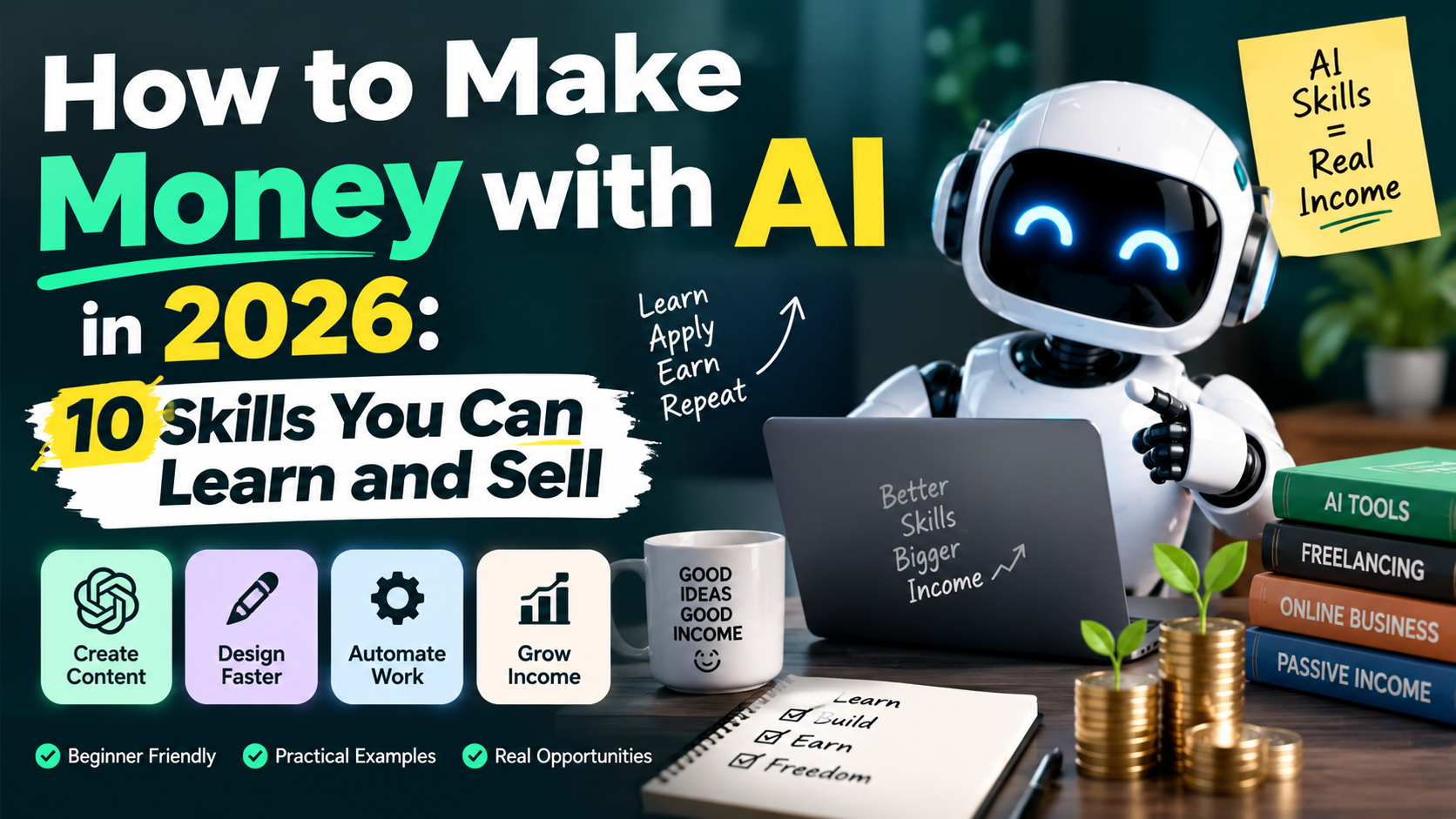
The AI Gold Rush Is Real, But Most People Are Digging in the Wrong Spot
Everyone’s talking about AI right now. Your cousin is using ChatGPT to write emails. Your neighbor just automated her Instagram captions. And somewhere in your feed, someone’s posting a screenshot of a five figure month thanks to AI how to make money with AI
Here’s what nobody tells you though. AI isn’t a magic money machine. It’s a tool. And like any tool, the money goes to the people who know how to actually use it for someone else’s problem, not just their own curiosity.
I’ve spent the last couple of years building campaigns, testing tools, and watching which AI skills actually convert into client work versus which ones just look good on a LinkedIn post. This guide is built from that experience, not from scrolling through trend reports.
By the end of this, you’ll know exactly which AI skills are worth your time in 2026, how people are getting paid for them, and how to start even if you’re starting from zero.
Table of Contents
ToggleQuick Answer how to make money with AI
The fastest way to make money with AI in 2026 is by learning a skill that solves a business problem, like AI content writing, prompt engineering, chatbot building, or AI powered ad campaigns, then selling it as a service to small businesses who don’t have time to learn it themselves. Freelancing platforms, local businesses, and agencies are actively paying for this right now.
What Does "Making Money With AI" Actually Mean?
Let’s clear something up first. Making money with AI doesn’t mean AI does the work and you collect a check. That’s the fantasy version people sell you.
The real version looks like this: AI helps you do work faster and better, and you get paid for the outcome, not the effort. A business owner doesn’t care that you used ChatGPT to write their website copy. They care that the copy brings them customers.
Think of it like a chef using a food processor. The processor speeds things up, but the chef still needs to know what a good dish tastes like. Same thing here.
Why This Matters Right Now
A lot of small business owners, especially in cities like Hyderabad and Vizag, know AI exists but have zero clue how to use it for their business. They’re busy running their shop, salon, or clinic. They don’t have time to learn prompt engineering.
That gap between “knowing AI exists” and “knowing how to use it for revenue” is exactly where money is sitting right now. And that gap isn’t closing anytime soon because new AI tools keep launching faster than people can learn them.
If you can bridge that gap for even a handful of clients, you’re already ahead of most people still watching YouTube tutorials and never applying anything.
The Complete Guide: 10 AI Skills You Can Learn and Sell
1. AI Content Writing and Blogging
What It Means This is using AI tools to write blogs, website content, product descriptions, and social captions, then editing them so they don’t sound like a robot wrote them.
Why It Matters Every business needs content. Blogs bring in Google traffic. Product pages need to convert. Social captions need to stop the scroll. Most business owners hate writing and would happily pay someone else to handle it.
How To Do It Start by learning how to prompt properly. Give AI tools context about the business, the audience, and the tone you want. Then rewrite the output in your own voice so it actually sounds human. Tools like ChatGPT, Claude, and Jasper are common starting points, but the real skill is in editing, not just prompting.
Example A local hair studio wants blog posts about hair care tips. You use AI to draft five topics, rewrite them with local relevance and a friendly tone, and charge per article or on a monthly retainer.
Pro Tip Never hand over raw AI output. Clients can tell, and so can Google. Add real examples, local references, and your own opinions. That’s what makes it rankable and readable.
2. Prompt Engineering for Businesses
What It Means Helping businesses write better prompts so their internal teams get more useful results out of AI tools like ChatGPT or Gemini.
Why It Matters Most people type lazy prompts and get lazy answers, then decide AI “doesn’t work for them.” A well built prompt system can save a team hours every week.
How To Do It Learn how different AI models respond to structure, tone instructions, and context. Build prompt templates for common business tasks like customer replies, meeting summaries, or content outlines.
Example You build a set of ready to use prompts for a marketing team so they can generate ad copy variations in seconds instead of starting from scratch every time.
Pro Tip Package your prompts into a simple document or notion page. Businesses love things they can hand to their team without extra explanation.
3. AI Powered Social Media Management
What It Means Using AI tools to plan, write, and sometimes design social media content for businesses, while still applying strategy and human judgment.
Why It Matters Small businesses know they need to post consistently but rarely have the bandwidth. AI speeds up caption writing, content ideas, and even basic graphic creation.
How To Do It Combine AI writing tools with design tools like Canva’s AI features. Build a content calendar, generate drafts quickly, then adjust for brand voice and current trends.
Example A local business hands you their Instagram. You use AI to generate a month of captions and reels ideas in a few hours instead of a few days, then charge a monthly management fee.
Pro Tip Clients pay for results, not just posts. Track engagement and mention it in your reports. That’s what gets you renewed month after month.
4. Building Simple AI Chatbots
What It Means Setting up chatbots for websites or WhatsApp that answer common customer questions automatically.
Why It Matters Customers expect instant replies now. A missed WhatsApp message can mean a lost booking, especially for service businesses like salons, clinics, or studios.
How To Do It You don’t need to code. Tools like ManyChat, Tidio, or WhatsApp’s own AI integrations let you build flows visually. Learn to map out common customer questions and build responses around them.
Example A salon gets the same five questions every day about pricing and timings. You build a chatbot that answers instantly, and bookings go up because nobody’s left waiting for a reply.
Pro Tip Always leave an option for the customer to reach a real human. Nothing frustrates people more than talking to a bot in circles.
5. AI Video and Reels Editing
What It Means Using AI tools to edit short videos faster, add captions automatically, remove background noise, or even generate voiceovers.
Why It Matters Video content is what’s getting attention right now, but editing takes time most business owners don’t have.
How To Do It Learn tools like CapCut’s AI features, Descript, or Opus Clip. These can auto caption, cut silences, and even turn long videos into short clips.
Example A gym records one hour of raw footage from a client’s workout. You turn it into three reels with captions and trending audio, ready to post the same day.
Pro Tip Speed is your selling point here. If you can turn footage into a finished reel within 24 hours, you’ll stand out from editors who take a week.
6. AI SEO and Search Optimization
What It Means Using AI tools to research keywords, structure content for Google and AI Overviews, and improve how a website ranks in search.
Why It Matters Search traffic is still one of the highest converting sources for businesses, and most small business websites are completely unoptimized.
How To Do It Learn how to do keyword research, understand search intent, and structure content in a way that answers questions directly. AI tools help speed up research and content drafts, but the strategy still needs a human brain.
Example A clinic’s website ranks nowhere for local searches. You optimize their pages with proper keywords and structure, and within a few months they start showing up for people searching nearby.
Pro Tip Don’t just chase keywords. Focus on what real people are actually typing when they have a problem. That’s what actually brings paying customers.
7. AI Powered Ad Campaign Management
What It Means Using AI tools within Google Ads and Meta Ads to write better ad copy, generate creative variations, and optimize targeting.
Why It Matters Ad spend is expensive, and businesses want every rupee working hard. AI can speed up testing multiple ad variations without burning through a huge budget.
How To Do It Learn the ad platforms themselves first, since AI is a layer on top, not a replacement. Use AI to generate multiple headline and copy variations, then test which ones actually perform.
Example You run a Meta Ads campaign for a local business and use AI to generate ten headline variations in minutes, then narrow down to the three that get the best click through rate.
Pro Tip Always tie your reporting back to real numbers like cost per lead or return on ad spend. Business owners care about their money, not clever copy.
8. AI Voiceover and Audio Content
What It Means Using AI voice tools to generate voiceovers for ads, explainer videos, or even audiobooks without needing a professional recording setup.
Why It Matters Good voiceovers used to need expensive studio time. Now a decent AI voice can do the job for a fraction of the cost and time.
How To Do It Tools like ElevenLabs let you generate natural sounding voices in multiple languages, including Hindi and Telugu accents. Learn to write scripts that sound natural when read aloud.
Example A business wants a Telugu voiceover for their local ad but doesn’t have a voice artist available. You script it, generate the voiceover, and deliver it same day.
Pro Tip Write scripts the way people actually talk, not the way they write. AI voices sound more natural when the script itself sounds conversational.
9. AI Automation and Workflow Building
What It Means Connecting different tools together using AI and automation platforms so repetitive business tasks happen without manual work.
Why It Matters Business owners waste hours on tasks like sending follow up messages, updating spreadsheets, or replying to common emails. Automation gets that time back.
How To Do It Learn tools like Zapier, Make, or n8n along with AI integrations. Map out repetitive tasks a business does and build a workflow that handles it automatically.
Example A studio manually sends booking confirmations and reminders. You set up an automation that does this instantly the moment someone books, saving them hours every week.
Pro Tip Start with one painful, repetitive task. Fix that first before trying to automate an entire business. Small wins build trust fast.
10. Selling AI Courses or Consulting
What It Means Once you’ve built real experience in any of the above skills, you can teach others what you know through consulting calls, workshops, or a simple course.
Why It Matters Not everyone wants to hire someone. Some people want to learn it themselves, and they’ll pay for a shortcut that saves them months of trial and error.
How To Do It Document what you’re already doing. Turn your process into a simple framework. Start small with one on one consulting before building a full course.
Example You’ve been running AI powered ad campaigns for a year. You package your exact process into a short workshop for local business owners who want to do it themselves.
Pro Tip Your own case studies are your best marketing. Real numbers from real work convert better than any polished sales page.
Common Mistakes People Make
Mistake: Relying completely on AI output without editing it. Impact: Content sounds robotic, clients notice, and trust drops fast. Solution: Always review, rewrite, and add your own judgment before delivering anything.
Mistake: Trying to learn every AI tool at once. Impact: You end up knowing a little about everything and nothing deeply enough to sell it. Solution: Pick one or two skills from this list and go deep before adding more.
Mistake: Underpricing because “AI did most of the work.” Impact: You burn out doing more work for less money. Solution: Price based on the result and value you deliver, not the tool you used to get there.
Mistake: Ignoring the business side and only focusing on the tech. Impact: You become a great technician with no clients. Solution: Learn basic sales and outreach alongside your AI skill. That combination is what actually pays.
Best Practices
Focus on solving one specific problem really well before branching out.
Keep a portfolio of real results, even small ones, from the very beginning.
Stay updated, since AI tools change fast, but don’t chase every new launch.
Build relationships with local businesses first. They’re often easier to convert than cold audiences online.
Always explain the “why” behind your work to clients. It builds trust faster than just showing the output.
Tools and Resources
| Skill | Recommended Tools | Best For |
|---|---|---|
| Content Writing | ChatGPT, Claude, Jasper | Blogs, website copy |
| Prompt Engineering | ChatGPT, Gemini | Internal business workflows |
| Social Media | Canva AI, Buffer | Content calendars |
| Chatbots | ManyChat, Tidio | Customer service automation |
| Video Editing | CapCut, Descript, Opus Clip | Reels and shorts |
| SEO | SurferSEO, Ahrefs | Search ranking |
| Ads | Google Ads AI tools, Meta Advantage+ | Paid campaigns |
| Voiceover | ElevenLabs | Ads, explainer videos |
| Automation | Zapier, Make, n8n | Workflow building |
| Consulting | Notion, Google Docs | Documenting and teaching your process |
Real Life Example
Situation: A small hair studio in Vizag had almost no online presence and relied entirely on walk ins.
Challenge: They had no time or knowledge to create content, run ads, or manage social media, and their booking process was all manual WhatsApp replies.
Action: An AI powered content and ad system was set up, combining written content, social posts, and a basic WhatsApp automation for common questions.
Result: The studio started getting consistent bookings from Instagram and saw a noticeable drop in the time spent answering repetitive customer questions, freeing up hours every week for actual client work.
This is a fairly common pattern. It’s not about some huge dramatic transformation. It’s steady, practical improvement that adds up.
Expert Tips
Don’t sell “AI” as the product. Sell the outcome. Nobody wakes up wanting AI content. They wake up wanting more customers.
Specialize in an industry if you can. Knowing the specific pain points of salons, clinics, or restaurants makes your pitch sharper than being a generalist.
Keep your own workflow documented. When you eventually want to hire help or scale, that documentation becomes your training manual.
Watch what platforms are prioritizing. Right now, AI Overviews and answer engines are changing how content gets discovered, so writing content that directly answers questions is more valuable than ever.
Frequently Asked Questions
Is it too late to start making money with AI in 2026?
No. The tools are more accessible now than ever, and most businesses still haven’t adopted them properly. The opportunity is in application, not just early access.
Do I need to know coding to make money with AI?
Not for most of the skills on this list. Content writing, social media, chatbots, and automation can all be learned without writing a single line of code.
Which AI skill pays the most in 2026?
AI powered ad management and automation tend to have higher earning potential because businesses directly tie them to revenue, but content writing and SEO offer more consistent, lower barrier entry points.
How much can I charge as a beginner offering AI services?
It depends on the skill and market, but many beginners start with smaller packages for local businesses and increase pricing as they build a portfolio and case studies.
Do I need expensive tools to start?
Many AI tools have free or low cost plans that are enough to start delivering real work and building a portfolio.
Can I do this as a side income while working a full time job?
Yes, many people start this way. Content writing, prompt engineering, and consulting especially can be done in a few hours a week.
What's the fastest AI skill to learn for beginners?
AI content writing and social media management usually have the shortest learning curve since the tools are conversational and beginner friendly.
Will AI eventually replace these jobs?
AI keeps changing the tools, but businesses will always need someone who understands strategy, judgment, and how to apply AI to their specific problem. That human layer isn’t going away anytime soon.
How do I find my first client for AI services?
Start local. Reach out to small businesses you already know or frequent, offer a small trial project, and use that result to build your first case study.
Is prompt engineering still relevant in 2026?
Yes, though it’s evolving. As AI tools get smarter, the skill shifts from writing perfect prompts to understanding how to structure workflows and context around AI systems.
Key Takeaways
- AI skills only pay when they solve a real business problem, not just when they look impressive.
- Content writing, chatbots, automation, and ad management are some of the most in demand AI skills right now.
- Editing and human judgment are what separate paid AI work from raw, unusable AI output.
- Local and small businesses are an underused market where AI knowledge is still rare.
- Specializing in one or two skills beats spreading yourself across every AI tool available.
Conclusion
AI isn’t going to make you money just by existing in your toolbox. It’s going to make you money when you use it to solve a problem someone’s willing to pay for.
The businesses around you, the salons, clinics, gyms, and shops, are sitting on opportunities they don’t know how to unlock. That’s not a small thing. That’s an actual open door.
Pick one skill from this list. Get good at it. Find one small business willing to let you try. That’s genuinely how most of this starts, not with a huge launch, just one client and one result that leads to the next.
Your Next Step
If you’ve read this far, you’re already more serious about this than most people scrolling past AI content on their feed. Pick one skill, practice it on a real project this week, even if it’s unpaid at first, and use that result to land your first paying client. Momentum builds from action, not from more research.