

The wake up call nobody in marketing wanted yet
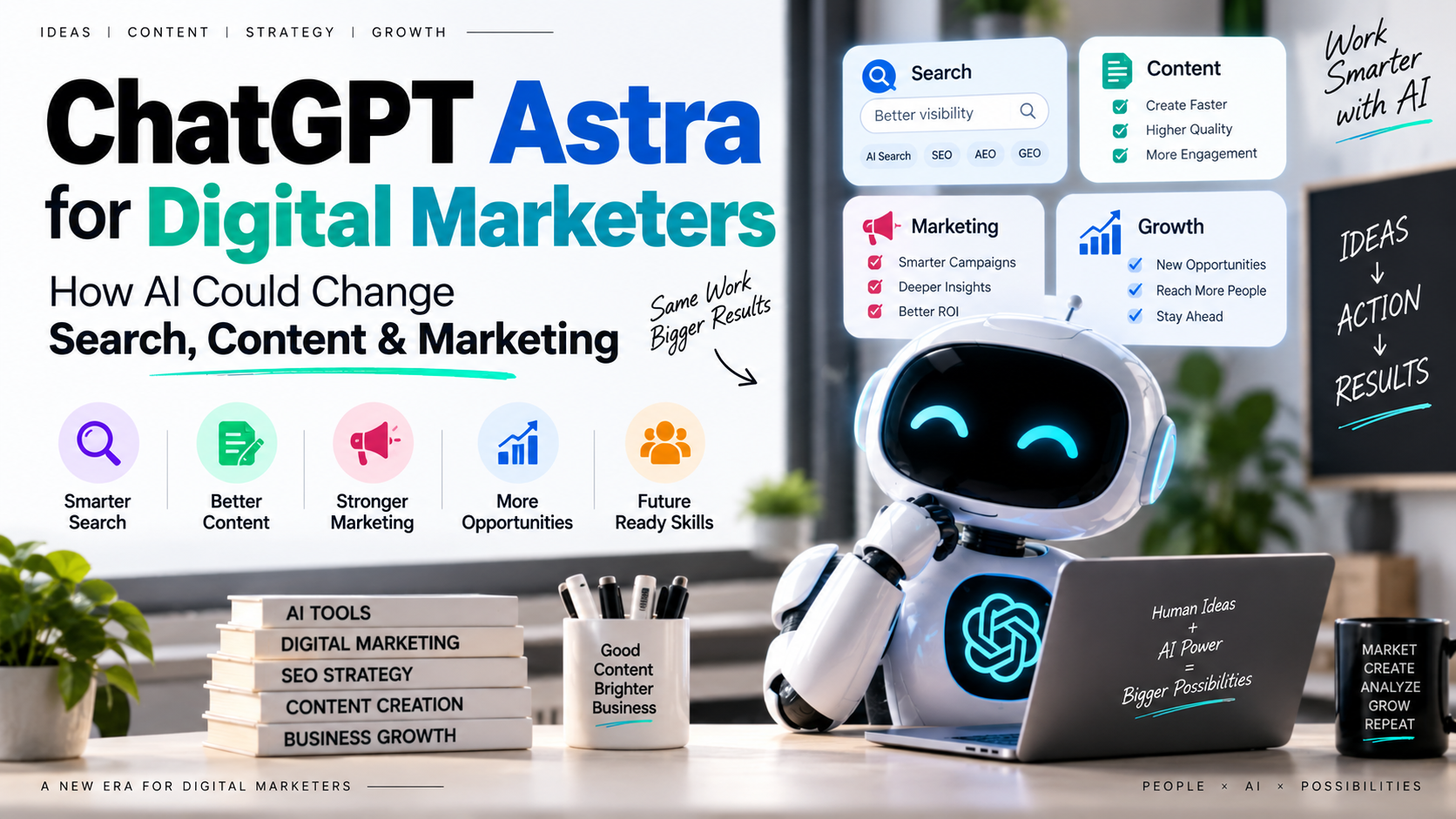
A few weeks back I was auditing a client’s website traffic and noticed something odd. A chunk of visits were coming in with almost no click path. No scrolling, no bounce back to search, just one visit and gone. Turned out an AI assistant had already answered the person’s question before they even landed on the page. They were just checking if the site backed up what they were told ChatGPT Astra for Digital Marketers
That is the world OpenAI just pushed us further into with GPT-6 Astra, the model now powering ChatGPT under the name Astra.
If you run ads, write blogs, manage SEO, or handle content for clients like I do, this one is worth paying attention to. Not because it is another shiny AI headline. Because it genuinely changes how people find businesses, read content, and decide who to trust online.
Table of Contents
ToggleWhat this post covers
I am going to walk you through what Astra actually is, why it matters for marketers specifically, and what you should be doing differently starting this month. No hype, no fear mongering. Just what I would tell a client sitting across the table from me.
Quick answer ChatGPT Astra for Digital Marketers
ChatGPT Astra is OpenAI’s newest and most capable model, built to browse the web, use software, and complete multi step tasks almost like a human assistant would. For marketers, it means AI is no longer just answering questions, it is now discovering, comparing, and even acting on behalf of your customers. SEO, content, and web experience all need to adapt to being read by machines that act, not just machines that answer.
What is ChatGPT Astra?
Astra is the model OpenAI released in September 2026, and it is a real step up from what came before it. Technically it is called GPT-6 Astra, and it now runs inside ChatGPT, the API, and enterprise tools.
The simplest way to describe it is this. Older AI models could talk to you. Astra can actually do things. It can browse a website, fill in a form, compare options across pages, put together a document, and carry a task through from start to finish, mostly on its own.
Here is a small example. If someone tells Astra to find a hair salon near them with good reviews and book an appointment for Saturday, it does not just list a few names. It can visit the sites, check availability, compare pricing, and take the booking action itself. That is a completely different behavior than a search engine handing you ten blue links.
OpenAI has been open about the fact that Astra is powerful enough that they built stronger safety controls around it, since it can act with real consequences on real websites and accounts. That alone tells you this is not a small update.
Why this matters for digital marketers
I will be honest, when GPT-5 came out, most marketers barely changed their strategy. It answered questions well, but it did not really touch how people found brands. Astra is different for one simple reason.
It browses like a person and it acts like a person.
That changes three things at the core of what we do every day.
First, discovery. If Astra is out there comparing options and reading pages the way a human would, then the old game of just ranking on page one is not enough anymore. It needs to actually understand your business from your content, not just detect keywords.
Second, trust verification. Astra does not only read your homepage. It checks reviews, directories, other websites that mention you, and cross references what your site claims against what it finds elsewhere. If your business information is inconsistent across platforms, that is now a bigger problem than it used to be.
Third, action. This is the big one. Astra can fill forms, click buttons, and complete bookings. If your website is confusing to navigate, has broken forms, or hides pricing behind five clicks, an AI agent trying to complete a task on your site is going to struggle just like a human would, except it might just give up and recommend a competitor instead.
The complete guide to adapting your marketing for Astra
I have broken this down into practical shifts. These are the things I am personally changing for client accounts right now.
1. Make your website easy for an AI agent to understand and act on
What it means Your site needs clean structure, clear pricing, working forms, and content that plainly states what you offer, where you operate, and how someone can take action.
Why it matters Astra can browse and click through your website the same way a customer would. If it gets confused or stuck, it will simply move to a competitor’s site that works better.
How to do it Go through your own website like you are a stranger who knows nothing about your business. Can you find your services, your location, your prices, and a way to contact or book within a few clicks? Clean up anything that requires guesswork. Use plain, direct language instead of clever marketing phrases that hide the actual offer.
Example A hair studio client of mine used to bury their pricing inside a PDF menu you had to download. We moved it to a simple, readable table right on the services page. Bookings from search traffic improved almost immediately, and that is before you even factor in AI agents reading the page.
Pro tip Add clear, specific answers to common questions directly on your page. Not buried in an FAQ accordion twelve clicks deep, but visible and easy to extract.
2. Build content that answers questions completely, in one place
What it means Write content that fully answers a question without forcing the reader (or the AI) to hunt across multiple pages.
Why it matters Generative engines like ChatGPT, Gemini, and AI Overviews pull answers from pages that give a complete, clear response. Thin content that only partially answers something gets skipped.
How to do it Start each section of your blog or service page with the direct answer, then explain the reasoning after. This is the opposite of old school SEO writing where you buried the point at the bottom to keep people scrolling.
Example Instead of writing three paragraphs building up to “yes, hair spa treatment does help with dandruff,” just say that clearly in the first two lines, then explain why underneath.
Pro tip Read your content out loud and ask yourself if it actually settles the question, or if it just talks around it.
3. Keep your business information consistent everywhere
What it means Your name, address, phone number, working hours, and pricing should match across your website, Google listing, directories, and social profiles.
Why it matters Astra cross checks information across sources before trusting or recommending a business. Mismatched details create doubt, and doubt means it looks elsewhere.
How to do it Do a simple audit every couple of months. Search your business name and go through every platform it appears on. Fix anything outdated.
Example I once found a client whose Google listing said they closed at 8pm while their website said 9pm. Small thing, but it is exactly the kind of inconsistency that erodes trust with both humans and AI systems.
Pro tip Set a recurring reminder. This is boring work, but it genuinely pays off.
4. Treat reviews and third party mentions as part of your SEO strategy
What it means Reviews, press mentions, directory listings, and other sites talking about you are no longer just nice to have. They are part of how AI verifies your credibility.
Why it matters Astra does not just trust what your website says about itself. It looks for outside confirmation before recommending you.
How to do it Actively ask happy clients for reviews. Get listed in relevant local directories. If you have done good work for a client, ask if they will mention you on their own site or social media.
Example For the hair studios I work with, we started a simple system of asking for a review right after a good service, through a quick WhatsApp message with a direct link. Review volume roughly doubled within two months.
Pro tip Do not just chase review quantity. Encourage clients to mention specifics, like the service they got or the result they liked, since that specificity helps both human readers and AI systems understand what you actually do well.
5. Rethink what conversion means
What it means With AI agents potentially completing actions on behalf of users, your conversion path needs to work without a human necessarily reading every word.
Why it matters If Astra is filling out a booking form, that form needs to be simple enough for an automated process to complete correctly.
How to do it Simplify forms. Remove unnecessary required fields. Make sure your booking or contact flow does not rely on a pop up or a step that a bot might miss.
Example We cut one client’s inquiry form from nine fields down to four. Human conversions went up on their own, and it also made the whole flow far more reliable for anything automated interacting with it.
Pro tip Test your own forms occasionally. If you get confused for even a second, assume an AI agent will too.
Common mistakes marketers are making with this shift
Mistake: Assuming this is just another SEO update. Impact: You keep optimizing purely for keywords while missing the trust and usability signals AI agents actually care about. Solution: Broaden your definition of optimization to include clarity, consistency, and ease of action, not just rankings.
Mistake: Ignoring your Google Business Profile and directory listings because “the website is what matters.” Impact: AI systems cross check multiple sources, so a neglected listing can quietly undercut an otherwise solid website. Solution: Treat every platform where your business appears as part of one connected trust signal.
Mistake: Writing content that sounds impressive but never actually answers the question. Impact: Both readers and AI models skip past vague content in favor of something that gets to the point. Solution: Lead with the answer, then support it. Every single time.
Mistake: Overcomplicating website forms and checkout flows. Impact: Friction that used to just annoy humans can now cause an AI agent to abandon the task entirely. Solution: Simplify ruthlessly. Fewer fields, fewer steps, clearer labels.
Best practices going forward
Keep your content genuinely useful before you think about keywords. Write like you are explaining something to a real person who asked you directly.
Audit your website’s usability every quarter, not just its SEO metrics. Ask whether a task can be completed start to finish without confusion.
Build real trust signals. Reviews, mentions, case studies, and consistent information matter more now, not less.
Do not abandon traditional SEO. Structured data, fast loading pages, and clear headings still matter, they are just no longer the whole story.
Watch how AI tools describe your business when you ask them directly. If the description is wrong or outdated, that is a signal worth acting on.
Tools and Resources
| Tool | Best for | Notes |
|---|---|---|
| Google Search Console | Tracking organic visibility | Still essential, shows how Google crawls and ranks your site |
| ChatGPT / Astra itself | Testing how AI describes your business | Ask it directly what it knows about your brand |
| Google Business Profile | Local trust and consistency | Keep hours, address, and services updated |
| Schema markup generators | Structured data for AI readability | Helps machines understand your page content faster |
| Review management tools | Collecting and monitoring reviews | Automate requests without being pushy |
A real scenario from agency work
One of the hair studio clients I work with came to us frustrated. Their Instagram following was decent, their website looked fine, but new client bookings from search had gone flat for months.
We went through the checklist above. Pricing was hidden in a downloadable menu. Their Google listing had an old phone number. Reviews were sparse and generic. The booking form asked for eleven different fields including things like “how did you hear about us” as a required question.
We simplified the form, fixed the listing details, moved pricing onto the page directly, and built a simple system to collect specific, detailed reviews after each visit.
Within about six weeks, booking inquiries through the website picked up noticeably, and the client told us people were mentioning specific services by name when they called in, which told us the content itself was being read and understood clearly, by people and, most likely, by AI tools recommending them too.
Nothing about this required chasing some new algorithm trick. It was about removing friction and being genuinely clear.
Expert tips for staying ahead
Talk to Astra directly about your own business every few weeks. Ask it what it knows, what it would recommend, and where the gaps are. It is one of the most direct feedback loops available right now, and most marketers are not using it.
Do not chase every AI trend that shows up in your feed. Focus on the fundamentals that make you easy to find, easy to trust, and easy to act on. That foundation holds up no matter which model comes out next.
Watch your own analytics for changes in how people arrive and behave on your site. A shift in bounce patterns or session length can be an early sign that AI referred traffic is behaving differently than traditional search traffic.
If you manage multiple client accounts, standardize a basic AI readiness checklist. Business information consistency, clear pricing, simple forms, and direct content. It sounds basic, but very few businesses actually have all four in place.
Frequently Asked Questions
What is ChatGPT Astra?
ChatGPT Astra, technically called GPT-6 Astra, is OpenAI’s newest AI model. It can browse websites, use software, and complete multi step tasks, going beyond just answering questions.
How is Astra different from earlier ChatGPT models?
Earlier models mainly generated text answers. Astra can actively browse, click, fill forms, and carry out tasks on your behalf, closer to how a human assistant would work.
Will Astra replace Google search for most people?
Not entirely, at least not yet. But it changes how a growing share of people research and decide, especially for tasks that involve comparing options or taking an action like booking something.
Does this mean SEO is dying?
No. SEO fundamentals like structure, speed, and clarity still matter. What is changing is that trust, consistency, and usability now carry more weight alongside traditional ranking signals.
How can I check what Astra or ChatGPT knows about my business?
Simply ask it directly. Type in a question a potential customer might ask and see what it says about your business, including anything outdated or incorrect.
Should small local businesses worry about this?
It is worth paying attention to, especially if a lot of your customers search online before visiting. Local businesses that keep their information consistent and clear tend to come up more reliably.
What is the single biggest change marketers should make right now?
Simplify your website. Clear pricing, easy navigation, and simple forms matter more than ever, both for human visitors and AI agents acting on their behalf.
Do reviews matter more now because of Astra?
Yes, quite a bit. AI systems use reviews and outside mentions to verify credibility, not just what your own website claims about itself.
Is Astra available to everyone yet?
It rolled out gradually starting with select organizations, then to paid ChatGPT plans, with wider availability expanding afterward. Free tier access has been more limited so far.
How often should I audit my content for this shift?
A quarterly review of your website content, business listings, and forms is a reasonable starting point. Treat it the same way you would treat a regular SEO health check.
Key Takeaways
- ChatGPT Astra can browse, click, and complete tasks, not just answer questions
- Marketers need to focus on clarity, trust, and usability, not just keyword rankings
- Keep your business information consistent across your website, listings, and directories
- Write content that answers questions directly and completely
- Simplify forms and conversion paths so both humans and AI agents can complete them easily
- Reviews and outside mentions now play a bigger role in AI trust signals
- Traditional SEO fundamentals still matter, they are just not the whole picture anymore
Wrapping this up
AI moving from answering questions to actually taking action is a genuine shift, not just another update to shrug off. The businesses that adapt now, by being clear, consistent, and easy to work with online, are going to have a real advantage over the ones that wait and see.
You do not need to overhaul everything overnight. Start with the basics. Clean up your information, simplify your site, and make sure your content actually answers what people are asking.
Ready to get your business ready for AI search?
If you want help auditing your website and content for how AI tools like Astra actually read and recommend businesses, reach out to us at NexasAI. We work with local businesses across Vizag and Hyderabad to make sure they show up clearly, wherever their customers are searching.