
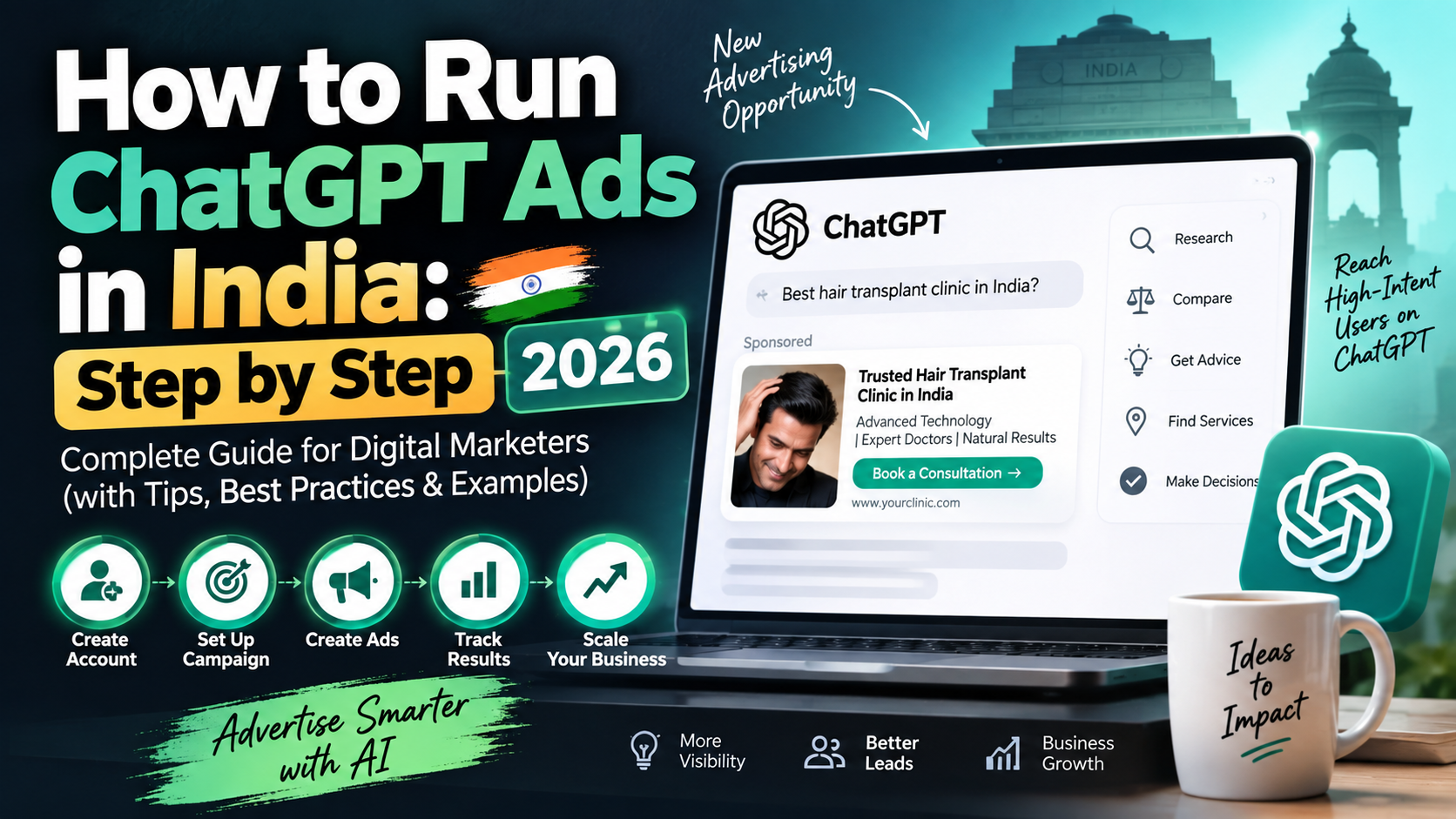
The Moment Every Indian Marketer Has Been Waiting For
For most of 2026, Indian marketers watched from the sidelines while businesses in the US, UK, and a handful of other countries got early access to ChatGPT Ads. We read the case studies, saw the screenshots, and wondered when our turn would come.
It finally came on August 31, 2026, when OpenAI opened self serve access to Ads Manager for India. Then, right on cue, full rollout followed on September 4. If you are reading this, chances are you already know ChatGPT has over 330 million monthly users in India. That is not a small test audience. That is a genuine advertising channel sitting right next to Google Ads and Meta Ads on your media plan.
I run a digital marketing agency, and honestly, I have been testing every new ad platform that shows up since 2019. Some turned out to be hype. This one feels different, mainly because of where the ad actually sits, right inside a conversation where someone is actively trying to solve a problem. That is a completely different mindset compared to someone scrolling Instagram half distracted ChatGPT Ads in India
This guide walks you through everything, from setting up your account to writing ads that do not feel like ads, using what is actually live in India right now.
Table of Contents
ToggleQuick Answer
ChatGPT Ads let businesses in India show sponsored placements below ChatGPT’s responses to Free and Go plan users aged 18 and above. You run campaigns through OpenAI Ads Manager, choosing CPM, CPC, or conversion optimized CPC, with daily budgets starting from 725 rupees. Targeting works through context hints tied to conversation topics rather than exact keywords.
What Are ChatGPT Ads?
ChatGPT Ads are sponsored units that appear below an answer ChatGPT gives, when OpenAI’s system judges that an advertisement might genuinely help the user with what they are exploring. The ad sits clearly separated from the AI’s response, labelled as sponsored, so nobody mistakes a paid placement for ChatGPT’s own recommendation.
Here is a simple way to picture it. Someone types into ChatGPT asking why their website gets visitors but almost no enquiries. ChatGPT answers with general advice about conversion rate and page speed. Below that answer, a sponsored card from a website audit company or a conversion optimisation agency might appear, because that conversation signals a real, current need.
That is fundamentally different from a banner ad interrupting a video, or a product showing up because you searched for it once on Amazon three weeks ago. The person is mid thought, mid problem, right now.
Why Is It Important for Businesses in India?
A few things make this launch genuinely worth your attention, not just another platform to add to an already long list.
India is one of ChatGPT’s biggest markets globally, and that user base skews toward exactly the kind of people who research before buying. Students comparing courses, small business owners troubleshooting operations, young professionals planning purchases, all of them are already having these conversations inside ChatGPT every single day.
The entry cost is low. A daily budget of 725 rupees means even a small salon, a local clinic, or a two person marketing agency can test this without committing a serious chunk of monthly spend.
It also reaches people at a different stage of decision making compared to Google or Meta. Google captures people who already know what they want and are searching for it. Meta reaches people while they are relaxed and scrolling, open to discovery. ChatGPT catches people while they are actively working through a decision, asking follow up questions, weighing options out loud in text form. That is a rare and valuable moment for a business to show up in.
Step by Step Process to Run ChatGPT Ads in India
Step 1: Create Your OpenAI Ads Manager Account
What It Means Before anything else, you need an advertiser account on OpenAI’s platform, separate from your regular ChatGPT login.
Why It Matters Without a verified business account, you cannot launch a single campaign. OpenAI needs to confirm you are a legitimate business, not a random individual trying to game the system.
How To Do It Go to ads.openai.com and sign up using your business email. You will be asked for business details, a billing method, a tax identification number such as your GST number, and a working landing page for whatever you plan to promote. Keep these documents ready before you start so the process does not stall halfway.
Example A Vizag based skincare brand preparing to advertise would need their GSTIN, a company bank card or UPI linked billing method, and a product or service page already live on their website.
Pro Tip Do not use a personal Gmail address for signup if you can help it. A business domain email tends to move through verification faster.
Step 2: Understand Who Will Actually See Your Ad
What It Means Not every ChatGPT user in India sees ads. Knowing your real audience saves you from wrong assumptions about reach.
Why It Matters Ads only show to users on the Free and Go plans who are 18 or older. People paying for Plus, Pro, Business, Enterprise, or Education plans never see ads at all. If your ideal customer is a senior executive who pays for Plus, this channel simply will not reach them through ChatGPT.
How To Do It Think honestly about whether your target customer is likely on a free account. Students, first time professionals, small business owners testing ChatGPT casually, these groups skew toward free usage and are strong candidates for this channel.
Example A coaching institute selling exam prep courses to college students is a much better fit here than a company selling enterprise software to CTOs who almost certainly pay for a premium plan.
Pro Tip Ads also will not show near sensitive topics like health conditions, mental health, or politics, so do not plan a campaign that depends on appearing in those conversations.
Step 3: Pick Your Objective and Set a Budget
What It Means OpenAI currently supports three buying options, cost per thousand impressions, cost per click, and conversion optimised cost per click, often written as oCPC.
Why It Matters Choosing the wrong objective wastes money before you even learn anything useful. CPM suits pure visibility goals. CPC suits driving traffic. oCPC suits businesses chasing actual sales or leads, but it needs conversion tracking set up first or it has nothing to optimise against.
How To Do It If you are brand new to the platform, start with CPC. It gives you a direct, easy to understand cost tied to actual clicks, and it is simpler to judge performance early on. Set your daily budget at the minimum of 725 rupees while testing, then scale once you see which ad groups perform.
Example A furniture ecommerce store testing the platform for the first month might run 725 rupees a day on CPC, purely to understand click costs and landing page behaviour before committing serious spend.
Pro Tip Resist the urge to jump straight into oCPC on day one. Let the data breathe for a couple of weeks under CPC first.
Step 4: Build Ad Groups Around Context Hints, Not Just Keywords
What It Means Instead of bidding on exact search terms like you would on Google, you give OpenAI context hints, phrases and topics describing situations where your product fits.
Why It Matters This is the single biggest mindset shift for anyone coming from Google Ads. A context hint guides the matching system but does not guarantee your ad shows up every time that topic comes up in a chat.
How To Do It List out the problems your customers actually talk about, not just the product name. A CRM company should think beyond the phrase CRM software and add hints around missing follow ups, disorganised leads, and spreadsheet chaos.
Example A hair studio in Vizag running a hair fall treatment offer might use context hints around hair thinning, scalp issues, and monsoon hair fall, rather than just the treatment name.
Pro Tip Write your hints the way your customer would actually phrase a question to ChatGPT, not the way you would write a Google search.
Step 5: Write Ad Creative That Fits a Conversation
What It Means Your ad needs a headline, description, image, and destination link, but the tone should read like a helpful suggestion, not a shouty banner.
Why It Matters People are mid conversation with an AI when your ad appears. Aggressive sales language feels jarring in that context and tends to get ignored or actively disliked.
How To Do It Write copy that answers an implied question. Explain clearly what you offer, who it helps, and why it is relevant right now. Avoid all capital letters and exclamation heavy lines like BEST DEAL IN INDIA CONTACT NOW.
Example Instead of writing Best SEO Company in Hyderabad, Call Now, try something like Struggling to rank on Google despite regular posting. See how local businesses in Hyderabad are fixing this.
Pro Tip Match your landing page tone to your ad tone. If the ad sounds calm and helpful but the landing page screams with pop ups, you lose the trust you just built.
Step 6: Set Up Conversion Tracking Before You Scale
What It Means OpenAI offers a Pixel and a Conversions API so you can track what happens after someone clicks your ad, not just the click itself.
Why It Matters Without this, you are flying blind past the click. You will know people clicked but not whether they bought anything, filled a form, or booked a call.
How To Do It Install the OpenAI Pixel on your website the same way you would install a Meta or Google tracking pixel, then define your conversion events such as purchase, lead form submission, or signup.
Example An online course platform would track a completed enrollment as its main conversion event, not just the click on the ad.
Pro Tip Set up tracking before your campaign goes live, not after. Retroactive data is data you cannot get back.
Step 7: Launch, Watch Closely, and Adjust
What It Means Once your campaign goes live, the real work of watching numbers and making small adjustments begins.
Why It Matters Early campaigns on any new platform behave unpredictably. What performs well in week one might dip in week three as the algorithm learns and competition increases.
How To Do It Check impressions, clicks, clickthrough rate, average cost per click, and conversions daily for the first two weeks. Pause context hints that are not pulling their weight and add budget to the ones that are.
Example If a fitness brand notices one context hint around home workout struggles is bringing far cheaper leads than a generic fitness hint, they should shift budget toward the winning hint quickly.
Pro Tip Give any single change at least three to four days before judging it. Daily fluctuations are normal and do not always mean something is broken.
Common Mistakes Businesses Make on ChatGPT Ads
Mistake: Copying a Google Ads strategy word for word. Impact: Keyword heavy, robotic ad copy that ignores the conversational nature of the platform, leading to weak engagement. Solution: Rebuild your targeting around customer problems and real conversations, not a keyword list pulled from Google Keyword Planner.
Mistake: Skipping conversion tracking setup. Impact: You end up with click data and no idea whether any of it turned into business. Solution: Install the Pixel or Conversions API before your first campaign goes live, not weeks into spending.
Mistake: Targeting a premium plan audience. Impact: Wasted planning time on a persona that will rarely see your ad, since paid plan users are excluded entirely. Solution: Check honestly whether your ideal customer is likely to be on ChatGPT’s free tier before building the campaign.
Mistake: Writing overly promotional, shouty ad copy. Impact: Poor engagement because the tone clashes with the calm, helpful nature of a chat interface. Solution: Write like you are answering a question a friend asked you, not selling from a stage.
Mistake: Expecting Google level scale on day one. Impact: Disappointment and premature budget pullback when early volumes look small compared to search or social. Solution: Treat the first month as a learning phase and judge by lead quality, not raw volume.
Best Practices Worth Following
- Start every campaign with a single, clear offer instead of promoting your entire range of services at once.
- Write context hints in plain, natural language, the same way an actual customer would phrase a worry or question.
- Keep your landing page fast and focused, since ChatGPT users clicking through are usually mid decision and impatient with clutter.
- Review performance weekly at minimum during your first two months, since the platform and its algorithm are both still maturing.
- Run ChatGPT Ads alongside Google Ads and Meta Ads rather than replacing either, since each one catches customers at a different point in their journey.
- Avoid duplicating creative from other platforms exactly. Rework the tone so it fits a conversational environment.
Tools and Platforms Compared
| Platform | Best For | Targeting Style | Typical Starting Budget in India |
|---|---|---|---|
| ChatGPT Ads | Reaching people mid research or mid decision | Context hints based on conversation topics | 725 rupees per day |
| Google Ads | Capturing people who already know what they want | Exact and broad match keywords | Varies widely by industry |
| Meta Ads | Building awareness and discovery | Interests, behaviour, and lookalike audiences | Around 300 to 500 rupees per day commonly used by small businesses |
A Practical Example: How a Small Business Might Approach This
Picture a hair and skin studio with two branches, one in Vizag and one recently opened in Hyderabad, the kind of client I work with regularly.
Situation The studio wants more bookings for a hair spa and scalp treatment package, but their Meta Ads have started to plateau after running the same creative for months.
Challenge Their ideal customer is someone actively worried about hair fall or dullness, often searching for solutions rather than casually scrolling. That behaviour fits a research mindset far more than a discovery one.
Action They set up an OpenAI Ads Manager account, choose CPC to start, and build context hints around hair fall during monsoon, dry scalp treatment, and hair thinning in your twenties. The ad copy asks a simple question about hair fall worry rather than shouting a discount.
Result Early clicks come in at a lower cost than their Meta clicks that month, and because the studio tracks bookings through the Conversions API, they can see which context hint is actually turning into appointments rather than just clicks. They shift more budget toward the winning hint in week three.
This is not a guaranteed outcome for every business. But it shows the kind of testing mindset that works well with a new platform like this.
Expert Tips for Getting Ahead Early
Being early on a platform gives you a real advantage, but only if you treat it seriously rather than as a box to tick.
Study your actual customer conversations before you write a single ad. Look at enquiry forms, WhatsApp chats, and Google reviews to understand the exact words customers use when they describe their problem. That language should shape your context hints far more than any keyword tool.
Do not silo this channel. Feed learnings back into your Google Ads and Meta Ads copy too, since the customer language you uncover here is useful everywhere.
Watch how OpenAI expands features over the coming months. Product feed ads, additional targeting options like city and postal code level targeting, and new measurement tools are all rolling out quickly. What works in September might look different by December.
Finally, be patient with attribution. Someone might see your ad on ChatGPT, research further on Google, and finally buy after seeing you on Instagram. Do not judge this channel purely on last click numbers.
Frequently Asked Questions
Are ChatGPT Ads available in India right now?
Yes. OpenAI opened self serve access to ChatGPT Ads Manager for Indian advertisers starting August 31, 2026, with full rollout following in early September 2026.
What is the minimum budget to run ChatGPT Ads in India?
The minimum daily campaign budget is 725 rupees, though actual profitable spend depends heavily on your industry and offer.
Who sees ChatGPT Ads in India?
Users on the Free and Go plans who are 18 years or older. Paid plan users on Plus, Pro, Business, Enterprise, or Education never see ads.
Can I target specific cities like Hyderabad or Vizag?
OpenAI supports country level targeting and, where available, more specific location targeting including states, regions, and cities, though exact availability can vary as the platform expands.
Do ChatGPT Ads use keywords like Google Ads?
Not exactly. Instead of exact match keywords, advertisers provide context hints describing topics and conversations where their product might be relevant.
Can advertisers see my private ChatGPT conversations?
No. OpenAI states advertisers do not get access to private conversations, chat history, or personal information, only aggregated campaign performance data.
Do ads influence what ChatGPT recommends to users?
No. OpenAI has been clear that advertising does not influence ChatGPT’s actual answers. Ads appear as clearly separated sponsored content.
Which businesses benefit most from ChatGPT Ads in India?
Businesses whose customers research and compare before buying tend to do well here, including software companies, ecommerce brands, education businesses, service providers, and healthcare adjacent businesses within OpenAI’s allowed categories.
Should I choose CPM, CPC, or oCPC for my first campaign?
Most beginners are better off starting with CPC since it is easier to understand and evaluate, then moving to oCPC once conversion tracking has enough data.
Is ChatGPT Ads better than Google Ads or Meta Ads?
Not better, just different. Google captures existing search demand, Meta builds discovery and awareness, and ChatGPT reaches people while they are actively researching and deciding. Most businesses benefit from using more than one.
Key Takeaways
- ChatGPT Ads are now live and self serve for Indian advertisers as of September 2026.
- Ads only reach Free and Go plan users aged 18 and above, never paid plan subscribers.
- Campaigns run through OpenAI Ads Manager with a minimum daily budget of 725 rupees.
- Targeting relies on context hints tied to real conversations, not exact keyword match.
- CPM, CPC, and oCPC are the three available objectives, with CPC being the easiest starting point.
- Conversion tracking through the Pixel or Conversions API should be set up before launch, not after.
- This channel works best alongside Google Ads and Meta Ads, not as a replacement for either.
Final Thoughts
New advertising platforms come with a strange kind of pressure, the fear of missing out mixed with the fear of wasting money on something unproven. ChatGPT Ads in India sit right at that intersection today.
What makes this one worth your time is not hype. It is the sheer number of people already having genuine, detailed conversations inside ChatGPT about problems your business might solve. That is a rare kind of attention, and right now, competition for it in India is still relatively low.
Start small, learn fast, and let the data guide where you put real budget.
Ready to Test ChatGPT Ads for Your Business?
If you are running a business in Hyderabad, Vizag, or anywhere else in India and want help setting up your first ChatGPT Ads campaign the right way, from account setup to writing context hints that actually convert, reach out to a team that lives in this space every day. Getting the structure right in your first month saves you from burning budget while everyone else is still figuring the platform out.
[…] to Make Money with AI in 2026: 10 Skills You Can Actually Learn and Sell How to Run ChatGPT Ads in India: A Step-by-Step Guide for 2026 Meta Ads for Beginners: 10 Things You Must Know Before You Start Advertising in 2026 Claude AI […]
[…] Priorities and ROI How to Make Money with AI in 2026: 10 Skills You Can Actually Learn and Sell How to Run ChatGPT Ads in India: A Step-by-Step Guide for 2026 Meta Ads for Beginners: 10 Things You Must Know Before You Start Advertising in 2026 Claude AI […]