
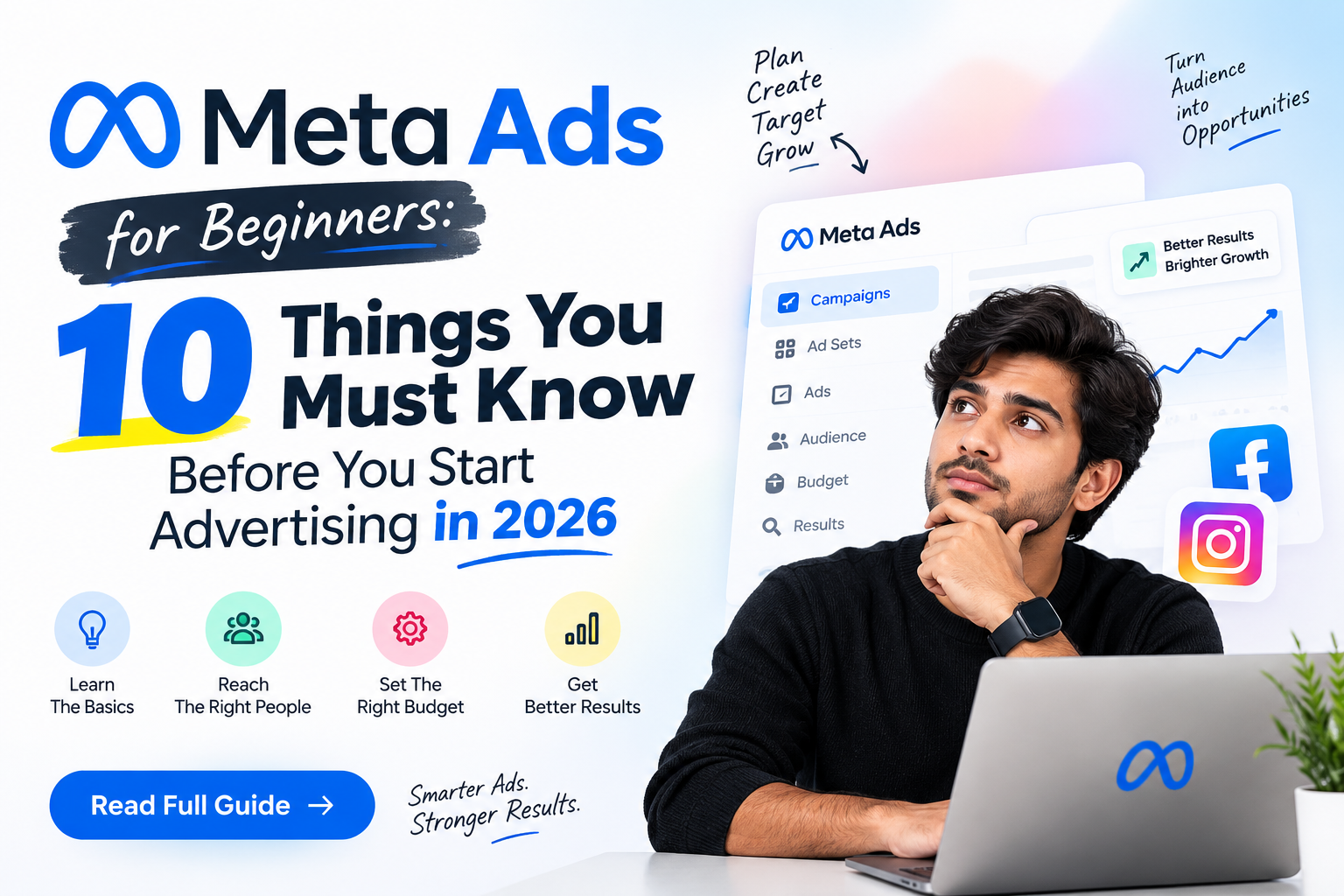
You are about to spend real money on ads. Read this first.
I have lost count of how many business owners come to me after burning ten or fifteen thousand rupees on Meta ads with nothing to show for it. No leads, no calls, no sales. Just a Meta Ads Manager dashboard full of numbers that mean nothing to them.
It is not because Meta ads do not work. They work incredibly well when you know what you are doing. The problem is almost everyone starts by clicking that green Boost button without understanding what happens behind the scenes Meta Ads for Beginners
So before you put in your card details and hit publish on your first campaign, let us slow down. This is everything I wish someone had told me before I ran my first Meta ad years ago, back when I was figuring this out for my own clients at NexasAI.
Table of Contents
ToggleQuick Answer Meta Ads for Beginners
Meta ads run on Facebook, Instagram, Messenger, and Audience Network through one platform called Meta Ads Manager. Before you start in 2026, you need a clear objective, a properly set up Meta Pixel or Conversions API, a defined audience, a realistic budget, and creative that stops the scroll. Skipping any one of these usually means wasted spend.
What Are Meta Ads, Really
Meta ads are paid advertisements that show up across Facebook and Instagram, and sometimes on Messenger or partner apps too. You are not just paying to be seen. You are paying to be shown to a very specific type of person, at a very specific moment, based on things they have shown interest in.
Think of it like this. A newspaper ad gets seen by everyone who buys that newspaper, whether they care or not. A Meta ad gets seen mostly by people who already fit a profile you chose, or one that Meta’s algorithm has learned works for your kind of business.
That difference is everything. And it is also why so many beginners get it wrong. They treat Meta ads like a digital newspaper ad instead of a targeted conversation with the right person.
Why This Matters More In 2026 Than Ever Before
Ad costs have gone up. Attention spans have gone down. And Meta’s algorithm has gotten smarter, which is good news and bad news at the same time.
Good news because if you feed it the right signals, it will find you customers you did not even know to look for. Bad news because if your setup is sloppy, the algorithm will happily spend your entire budget chasing the wrong people, fast.
I have seen small salons and local shops around Hyderabad and Vizag get incredible results from a daily budget as small as three hundred rupees, and I have seen bigger businesses waste lakhs because nobody bothered to set things up properly. The difference was never the budget. It was the fundamentals.
Let us go through what actually matters.
1. Pick One Clear Objective, Not Five
What It Means When you create a campaign, Meta asks what your goal is. Awareness, traffic, engagement, leads, sales, app promotion. There are more options than most beginners know what to do with.
Why It Matters Meta’s algorithm optimizes for whatever objective you choose. If you pick engagement when you actually want sales, you will get a lot of likes and comments and very few paying customers. The algorithm did exactly what you asked. You just asked for the wrong thing.
How To Do It Ask yourself one honest question. What do I want someone to do after seeing this ad? Call me? Message me? Buy something on my website? Fill a form? Pick the objective that matches that action directly, not the one that sounds impressive.
Example A hair studio client of mine wanted more walk ins for a new hair spa service. We did not run an awareness campaign. We ran a leads campaign asking people to fill a quick form for a free consultation, and calls started coming in within two days.
Pro Tip If you are not sure, start with leads or messages. For most local businesses, getting someone to raise their hand is more valuable than getting them to just look.
2. Install The Meta Pixel Before You Spend A Single Rupee
What It Means The Meta Pixel is a small piece of code you place on your website. It tells Meta what people are doing after they click your ad. Did they visit? Did they add to cart? Did they actually buy?
Why It Matters Without the pixel, you are flying blind. Meta cannot learn who converts on your site, so it cannot find you more people like them. You end up paying for clicks that go nowhere and you never really know why.
How To Do It Go to Events Manager inside Meta Business Suite, create a pixel, and add the code to your website through your website builder or a developer. If you use WordPress or Shopify, there are simple plugins for this.
Example One of my ecommerce clients had been running ads for two months without a pixel. The moment we installed it and let it collect data for a week, our cost per purchase dropped by almost forty percent because Meta finally understood who was actually buying.
Pro Tip Give the pixel at least a week of quiet data collection before judging any campaign’s performance. It needs time to learn.
3. Understand That Your Audience Is Not “Everyone”
What It Means New advertisers almost always think bigger audience means more sales. It does not. A vague audience gets you a lot of impressions and very little actual interest.
Why It Matters If you sell premium skincare and your audience includes everyone in India between eighteen and sixty five, your ad is being shown to people who will never buy from you. That is money gone.
How To Do It Start narrow. Think about age, location, interests, and behaviors that genuinely match your buyer. Then let the campaign run for a few days and check who is actually responding, not who you assumed would.
Example For a Vizag based hair studio, we did not target all women in the city. We targeted women aged twenty two to forty five, within an eight kilometer radius, who had shown interest in beauty and grooming pages. Cost per lead came down sharply compared to a broad, city wide audience.
Pro Tip Do not be afraid to test two or three different audiences side by side in the beginning. Let the data tell you who your real customer is, not your assumptions.
4. Your Creative Matters More Than Your Targeting
What It Means Creative means your image, video, and ad copy together. This is the actual ad the person sees.
Why It Matters You could have the most perfectly targeted audience in the world, but if your creative is boring or looks like a spam ad, people will scroll right past it. In a feed full of movement and noise, you have about two seconds to earn attention.
How To Do It Use real photos or videos, not stock images that look fake. Show your actual product, your actual space, your actual team if possible. Write copy the way you would talk to a friend, not the way a brochure talks.
Example We once swapped a polished, studio style photo for a slightly rough, phone shot video of a stylist actually working on a client’s hair. The rough version outperformed the polished one because it felt real and trustworthy.
Pro Tip Test video against static images every single time. Video usually wins for engagement, but there are exceptions, so never assume.
5. Set A Budget You Can Actually Learn From
What It Means Your daily or lifetime budget decides how much data Meta collects and how fast it can optimize your campaign.
Why It Matters If your budget is too small, the algorithm never gets enough signal to figure out who converts. If it is too large without testing first, you can burn through money before you know what works.
How To Do It Start with a modest daily budget you are comfortable testing with for at least five to seven days. Resist the urge to change it every few hours based on panic.
Example I usually recommend beginners in the local services space start around five hundred to a thousand rupees a day for the first week of testing, then scale up once we see which ad and audience combination is actually converting.
Pro Tip Scaling too fast can actually hurt performance. If something is working, increase budget gradually, not by doubling it overnight.
6. Give Every Campaign Time Before Judging It
What It Means Meta’s system goes through something called the learning phase, where it is still figuring out the best way to deliver your ad.
Why It Matters Many beginners kill a campaign after one day because it did not get instant results. But the algorithm needs roughly fifty conversion events to exit learning phase and start performing well.
How To Do It Let a campaign run for at least three to five days before making major changes. Small tweaks are fine, but avoid pausing and restarting constantly, since that resets the learning process.
Example A client wanted to pause a campaign after twelve hours because it had zero leads. We convinced them to wait. By day three, leads started flowing steadily once the algorithm found its footing.
Pro Tip Patience is genuinely a strategy in Meta ads. It is boring advice, but it saves more campaigns than any clever trick I know.
7. Track The Right Numbers, Not The Vanity Ones
What It Means Likes, comments, and reach feel good to look at, but they rarely tell you if your business is actually growing.
Why It Matters You can have a wildly popular ad with thousands of likes and zero sales. If your goal is revenue, that popularity means nothing on its own.
How To Do It Focus on cost per result, whether that is cost per lead, cost per purchase, or cost per message. Compare that number against what a customer is actually worth to your business.
Example For one client, cost per lead looked high on paper at around two hundred rupees, but each lead converted into a service worth several thousand rupees. That high looking number was actually a great deal.
Pro Tip Always know your customer’s lifetime value before deciding whether a cost per result is good or bad. A number alone tells you nothing without context.
8. Retargeting Is Where The Real Money Often Is
What It Means Retargeting means showing ads specifically to people who already interacted with your business, whether they visited your website, watched your video, or messaged you before.
Why It Matters These people already know you exist. They are far more likely to convert than someone seeing your brand for the very first time.
How To Do It Create custom audiences based on website visitors, video viewers, or Instagram engagers, then run a separate campaign speaking directly to them, often with a slightly different offer or message.
Example We ran a simple retargeting campaign for a hair studio client, showing a limited time offer only to people who had visited the booking page but not completed it. That campaign alone brought in bookings at a fraction of the cost of cold audience ads.
Pro Tip Do not show retargeting audiences the exact same ad as your cold audience. Speak to them like they already know you, because they do.
9. Your Landing Experience Decides If The Click Was Worth It
What It Means Where someone lands after clicking your ad matters just as much as the ad itself. This could be your website, a WhatsApp chat, or a lead form.
Why It Matters I have seen great ads with strong click through rates fail completely because the website was slow, confusing, or did not match what the ad promised.
How To Do It Keep the message consistent from ad to landing page. If your ad promises a discount, make sure that discount is visible immediately. Keep forms short. Keep pages fast.
Example A client’s website took nearly nine seconds to load on mobile. We simplified it, and even without touching the ad itself, conversion rate improved noticeably.
Pro Tip Test your own ad’s journey on your phone, on mobile data, not office wifi. That is closer to how most of your customers will experience it.
10. Stay Updated, Because Meta Changes Things Constantly
What It Means Meta updates its algorithm, ad formats, and policies regularly. What worked perfectly last year might behave differently now.
Why It Matters Advertisers who treat their first successful setup as a permanent formula often get surprised when performance suddenly drops for no obvious reason.
How To Do It Follow Meta’s official business updates, join a few trustworthy marketing communities, and revisit your strategy every few months instead of assuming it will always work the same way.
Example Ios privacy changes a few years back reshaped how tracking works for everyone overnight. Advertisers who adapted quickly with tools like Conversions API stayed ahead. Those who ignored it struggled to understand why their numbers suddenly looked worse.
Pro Tip Treat your ad account like a living thing that needs regular attention, not a machine you set up once and forget.
Common Mistakes Beginners Make
Mistake: Boosting posts instead of using Ads Manager Impact: Limited targeting options and weaker reporting. Solution: Always build campaigns through Ads Manager, even if it feels more complex at first.
Mistake: Changing campaigns too frequently Impact: Resets the learning phase and confuses the algorithm. Solution: Make fewer, more thoughtful changes and give them time to show results.
Mistake: Ignoring the Meta Pixel setup Impact: Poor optimization and wasted budget on the wrong audience. Solution: Set it up correctly from day one, before your first campaign even launches.
Mistake: Using the same ad for everyone Impact: Lower relevance and higher costs. Solution: Create separate ads for cold audiences and retargeting audiences.
Mistake: Judging performance too early Impact: Killing campaigns that would have worked given more time. Solution: Wait at least three to five days before making major decisions.
Best Practices Worth Remembering
Start small, test often, and scale only what actually works. Write your ad copy like you are talking to one real person, not a crowd. Use genuine photos and videos over polished stock content whenever possible. Always separate cold audience campaigns from retargeting campaigns. Check your numbers weekly, not every hour.
Tools And Resources
| Tool | What It Is Used For |
|---|---|
| Meta Ads Manager | Creating, managing, and analyzing all campaigns |
| Meta Business Suite | Managing pages, pixel, and business assets in one place |
| Meta Pixel or Conversions API | Tracking website actions and conversions |
| Canva | Designing simple, scroll stopping ad creatives |
| Meta Ads Library | Seeing what ads your competitors are currently running |
Real Life Example
Situation: A local hair studio in Vizag had tried running ads on their own for a month with almost no results and a shrinking marketing budget.
Challenge: Their targeting was too broad, there was no pixel installed, and every ad used the same generic salon stock photo.
Action: We rebuilt the campaign from scratch. Installed the pixel, narrowed the audience to women within a realistic distance from the salon, switched to real photos of the space and stylists, and set up a proper leads objective with a simple form.
Result: Within two weeks, the studio was getting consistent enquiries at a cost per lead that was less than half of what they were spending before, with noticeably better quality leads walking through the door.
Expert Tips For Going Further
Once you are comfortable with the basics, look into Advantage Plus campaigns, which let Meta’s AI handle more of the targeting and placement decisions using broader signals. It sounds counterintuitive after everything about narrow targeting, but at scale, giving the algorithm more room to work with strong creative often performs better than micromanaging every detail.
Also, build a habit of testing three to five ad variations at once in the beginning. Let the data pick the winner instead of relying on your personal favorite.
Frequently Asked Questions
How much money do I need to start Meta ads?
You can technically start with as little as a few hundred rupees a day, though most beginners see clearer patterns with a budget of around five hundred to a thousand rupees daily for the first week or two of testing.
Do I need a website to run Meta ads?
No. You can run lead generation ads that collect information directly on Facebook or Instagram without ever sending someone to a website.
What is the difference between boosting a post and running a proper campaign?
Boosting is a simplified, limited version of advertising with fewer targeting and optimization options. Running campaigns through Ads Manager gives you full control over objectives, audiences, and budgets.
How long does it take to see results from Meta ads?
Most campaigns need three to seven days to exit the learning phase and start showing consistent, reliable performance.
Can I run Meta ads without a Facebook page?
No, you need a Facebook business page connected to your ad account, even if your ad is primarily shown on Instagram.
What is the Meta Pixel and do I really need it?
It is a tracking code for your website that tells Meta which visitors convert. It is not optional if you want the algorithm to actually learn and improve over time.
Why did my ad get rejected?
Usually due to policy issues like exaggerated claims, restricted content, or personal attribute targeting. Check the specific reason in Ads Manager and adjust accordingly before resubmitting.
Should I target Facebook, Instagram, or both?
Let Meta’s automatic placements decide initially. The system usually finds the best mix on its own, and you can review platform level performance later to make adjustments.
How do I know if my ad is actually working?
Look at cost per result compared to what that result is worth to your business, not just likes, comments, or reach.
Is it better to run one big campaign or several small ones?
For beginners, one well structured campaign with a couple of ad sets is usually easier to manage and learn from than several scattered small campaigns.
Key Takeaways
Meta ads reward clarity, patience, and honest creative far more than clever tricks.
- Choose one clear objective before building your campaign
- Install the Meta Pixel before you spend anything
- Keep your audience specific, not everyone
- Real, authentic creative outperforms polished stock content
- Give campaigns time before judging results
- Track cost per result, not vanity metrics
- Retargeting often brings your best returns
- Your landing page matters as much as your ad
- Stay updated as Meta’s platform keeps evolving
Conclusion
Meta ads are not complicated once you understand the pieces that actually matter. Most beginners fail not because the platform is hard, but because they skip steps, judge too early, or chase vanity numbers instead of real results.
Get your pixel right, know your audience, create honestly, and give your campaigns room to breathe. That alone puts you ahead of most people who start advertising this year.
Your Next Step
If you are running a local business and want your first Meta ad campaign set up the right way from day one, without the trial and error that usually costs a few thousand rupees to learn, reach out and we can walk through your specific situation together.