

The Hook
Picture this. Your team spends months getting a page to rank on Google. It sits at position two, traffic flows in, everyone’s happy. Then someone asks ChatGPT the exact same question your page answers, and your brand doesn’t show up anywhere in the response.
That moment is happening to marketers all over the world right now, and most of them don’t even know it’s happening because they’re not tracking it.
If you’ve ever wondered why your Google rankings look fine but your traffic from AI tools still feels invisible, this is the gap. Prompt tracking is how you close it.
Table of Contents
ToggleIntroduction
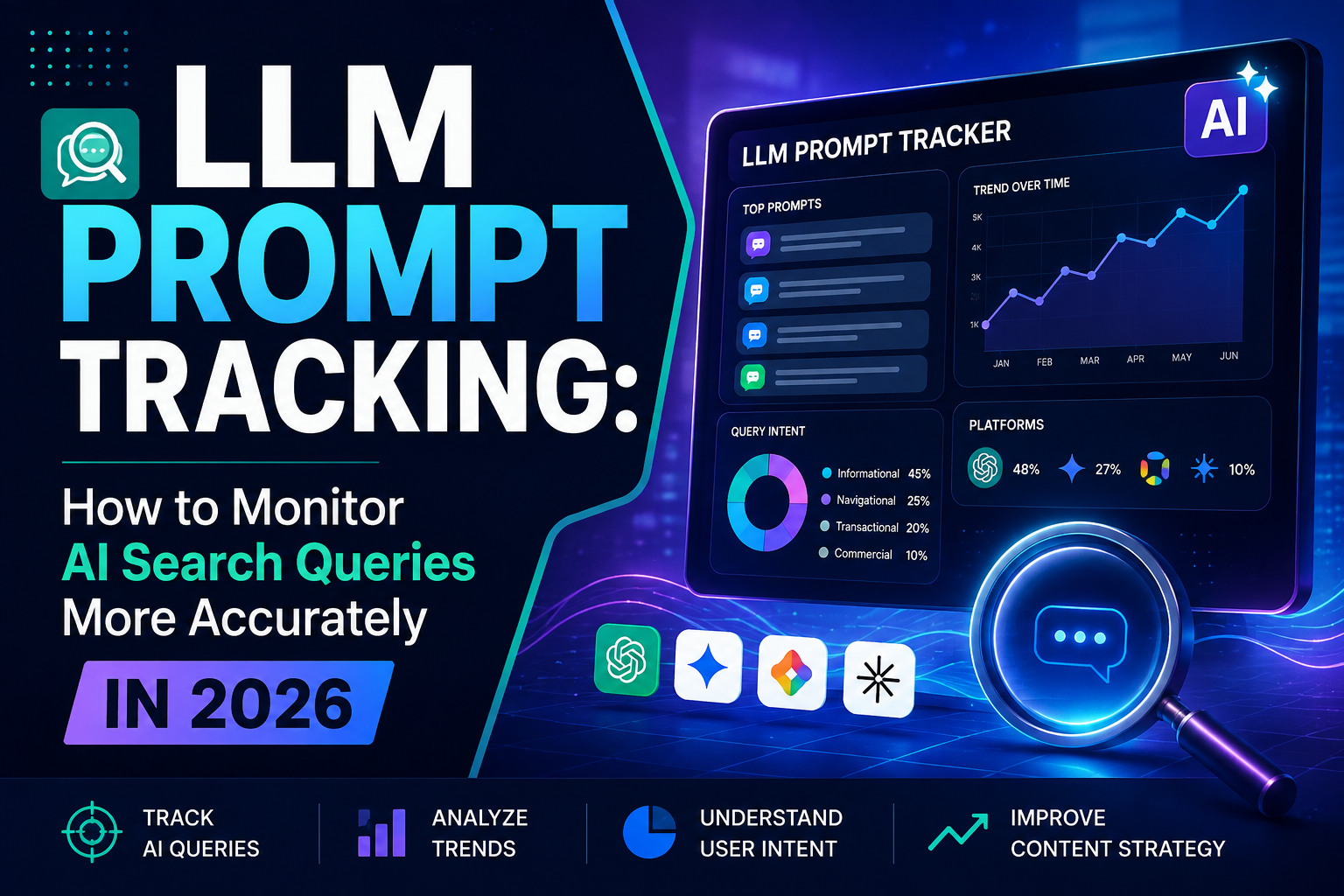
LLM prompt tracking is the practice of monitoring how your brand, product, or content actually shows up when people ask questions inside tools like ChatGPT, Gemini, Perplexity, Claude, and Google’s AI Overviews.
It matters because search behavior has genuinely changed. People aren’t just typing three word keywords anymore. They’re asking full questions, the way you’d ask a colleague, and AI tools are answering with a synthesized response instead of ten blue links.
By the end of this guide, you’ll understand what prompt tracking actually involves, how it’s different from the rank tracking you’re probably already doing, which mistakes waste the most budget, and how to set up a system that gives you real signal instead of noise.
Quick Answer
LLM prompt tracking means monitoring the exact prompts people use in AI tools and checking whether, how, and how favorably your brand appears in the response. Unlike keyword rank tracking, it measures mention rate, citation frequency, and answer sentiment across platforms like ChatGPT and AI Overviews, since AI answers vary by phrasing, location, and even time of day.
What Is LLM Prompt Tracking?
Here’s the simplest way to think about it. A keyword is what someone types into Google. A prompt is what someone asks an AI model. They sound similar but they behave very differently.
Someone searching Google might type “best CRM software India.” Someone asking ChatGPT is more likely to write “I run a small services business in Hyderabad, which CRM should I use and why.” That second query has intent, context, and phrasing baked in that a keyword tool was never built to capture.
LLM prompt tracking is the discipline of collecting a realistic set of these questions, running them regularly across AI platforms, and recording what comes back. Does your brand get mentioned? Does the model cite your website as a source? Is the framing positive, neutral, or does a competitor get the recommendation instead?
A quick example. Say you run a digital agency. You might track a prompt like “which agency should I hire for Google Ads management in Vizag.” If your name never comes up across ten runs of that same question, that’s not a ranking problem you can fix with a meta title. That’s a visibility problem in a completely different system.
Why Is It Important?
A few years back, nobody cared about this because almost nobody was searching this way. That’s changed fast. Millions of people now use AI chat tools as their first stop for research, comparison shopping, and even local recommendations. Google itself has folded AI generated answers directly into search results, which means a chunk of your “organic” traffic opportunity is already being intercepted by an AI summary before a user even scrolls to your listing. If you’re not tracking prompts, a few things happen quietly in the background.
You lose visibility without any warning sign, because your Google Search Console numbers can look completely normal while your AI visibility craters. You keep optimizing content for the old rules while your buyers are already asking a machine instead of typing a query. And you let competitors take the recommendation slot in AI answers by default, simply because nobody on your side noticed the shift was happening.
The upside is just as real. Brands that show up consistently and accurately in AI answers get trusted faster, because the recommendation feels like it’s coming from an impartial source rather than an ad. That trust compounds.
Complete Guide: How to Track LLM Prompts Accurately
Step 1: Build a Realistic Prompt List
What It Means This is your starting set of questions, the actual phrasing real customers would use when talking to an AI tool about your category.
Why It Matters Track the wrong prompts and you’ll get data that looks fine but tells you nothing useful. Most teams make the mistake of just converting their old keyword list into prompts, which misses how conversational and specific real AI queries tend to be.
How To Do It Pull your existing customer questions from sales calls, support tickets, and reviews. Look at what people actually ask, not what you assume they ask. Group these into buyer stages, some prompts are early research, some are comparison, some are ready to buy. Build out ten to thirty core prompts to start, you don’t need thousands on day one.
Example For a hair studio client, that might look like “which hair studio in Vizag is best for keratin treatment” alongside “is keratin treatment safe for coloured hair,” one comparison prompt and one informational prompt, both worth tracking separately.
Pro Tip Write prompts the way your customer would text a friend, not the way you’d write ad copy. AI models respond to natural phrasing far better than stiff, formal queries.
Step 2: Choose Your Tracking Method
What It Means You need a repeatable way to actually run these prompts and record the answers, either manually or through a tool built for this.
Why It Matters AI answers are not static. The same prompt can return a different answer an hour later, depending on the model, your location, and recent web updates. A single check tells you almost nothing on its own.
How To Do It For smaller operations, manual tracking works to start, run your prompt list weekly across ChatGPT, Gemini, and Perplexity, and log the results in a simple sheet. As you scale, dedicated LLM tracking platforms automate this and run your prompts daily across multiple models, which gives far more reliable trend data than any manual process can.
Example A small agency might check twenty prompts by hand every Monday morning. A larger brand might run the same prompts on autopilot every single day and get an alert the moment a competitor starts appearing where they didn’t before.
Pro Tip Don’t rely on just one AI platform. ChatGPT, Gemini, and Google AI Overviews often pull from different sources and phrase things differently, so single platform tracking leaves real blind spots.
Step 3: Measure the Right Metrics
What It Means Move past “did I show up, yes or no” and start measuring how you show up.
Why It Matters Two brands can both get mentioned in an AI answer, but one gets recommended first with a glowing description and the other gets a passing, neutral reference buried at the bottom. Those are very different outcomes even though both count as a “mention.”
How To Do It Track mention rate, how often you appear across repeated runs of the same prompt. Track citation source, which pages the AI is actually pulling from when it talks about you. Track sentiment and position, are you framed as the top pick or an afterthought.
Example If AI tools keep citing an old, outdated blog post on your site instead of your current pricing page, that tells you exactly which page needs a refresh to correct the story being told about you.
Pro Tip Screenshot or archive the actual AI response text when you spot something notable, since these answers change and you’ll want a record to show clients or your own team what shifted.
Step 4: Turn Findings Into Content Fixes
What It Means Tracking on its own is just reporting. The real value comes from acting on what you find.
Why It Matters If AI models keep citing your competitor’s comparison page and never yours, that’s a content gap you can close directly, not a mystery you have to accept.
How To Do It Build the specific content the AI seems to be missing, comparison pages, clear FAQ sections, straightforward answers near the top of your pages rather than buried three paragraphs down. Structure content so a machine can lift a clean, accurate answer out of it easily.
Example If your prompt tracking shows AI tools can’t answer “how much does Google Ads management cost in India” using your site, write that page directly, plainly, with a real number range, and watch that specific prompt over the following weeks.
Pro Tip Answer engines reward clarity over cleverness. A blunt, well structured answer usually outperforms a beautifully written paragraph that buries the point.
Common Mistakes
Tracking only a handful of prompts once and assuming that’s the full picture is a common one. The impact is that you miss how much these answers fluctuate, and the fix is running the same prompts repeatedly over time instead of treating one check as gospel.
Copying keyword lists straight into prompt trackers without rewriting them conversationally is another. It quietly produces data that doesn’t reflect how people actually talk to AI tools, and the fix is rebuilding prompts from real customer language.
Ignoring citation sources is a big one too. Teams look at whether they were mentioned but never check which page got cited, missing the chance to fix the exact page shaping the AI’s answer, and the fix is always tracing every mention back to its source page.
Treating one AI platform as the whole picture causes real blind spots, since a brand can be strong on ChatGPT and nearly invisible on Google AI Overviews, so tracking across at least three major platforms is worth the extra effort.
Best Practices
Track a mix of branded and unbranded prompts, not just questions with your company name already in them. Review your prompt list every quarter, because the way people phrase questions to AI tools keeps shifting as they get more comfortable with these platforms. Pair prompt tracking with actual content updates, since data without action is just a spreadsheet nobody opens after week one. Keep a simple log of what changed and when, so you can connect a content update to a later shift in AI visibility instead of guessing at cause and effect.
Tools and Resources
There’s a growing set of platforms built specifically for this. Broadly, they fall into a few camps.
| Tool Type | Best For | Typical Starting Cost |
|---|---|---|
| Manual tracking sheet | Small teams just getting started | Free |
| Mid tier LLM monitoring platforms | Agencies tracking a handful of clients | Moderate monthly fee |
| Enterprise AI visibility suites | Larger brands tracking dozens of prompts daily across many models | Higher monthly fee, often usage based |
If budget is tight, a manual sheet tracked weekly across two or three AI tools will still tell you far more than doing nothing at all. As tracking needs grow, most teams move to a dedicated platform once manual checking starts eating too many hours each week.
Real Life Example
Situation A local services business had strong Google rankings for its core service pages but almost no visibility when the same questions were asked inside ChatGPT.
Challenge Their content was written the old way, keyword focused headlines with the actual answer buried deep in the page, which made it hard for an AI model to extract a clean response.
Action The team rebuilt the top of each key page with a direct, plain answer in the first two lines, added a clear FAQ section addressing the exact prompts they were tracking, and kept running the same prompt set weekly to watch for movement.
Result Within a few months, the business started appearing consistently in AI answers for several of its tracked prompts, and the citation source shifted from a competitor’s page to their own.
Expert Tips
Treat AI visibility as directional, not exact. These answers are genuinely variable, so a single missed mention isn’t a crisis, but a consistent pattern across many runs is worth acting on.
Watch your competitors’ prompts too, not just your own brand name. Seeing who gets recommended when your name doesn’t show up tells you exactly who you’re actually up against in this new search layer.
Keep your site’s factual information current and easy to extract, pricing, service areas, hours, since AI models lean heavily on whatever is clearest and most recently updated when building an answer.
Frequently Asked Questions
What is LLM prompt tracking?
It’s the process of monitoring specific questions across AI tools like ChatGPT and Gemini to see how, and how often, your brand appears in the generated answers.
How is prompt tracking different from keyword rank tracking?
Keyword tracking measures your position on a search results page. Prompt tracking measures whether and how you’re mentioned inside a generated AI answer, which has no fixed “position” in the traditional sense.
Which AI platforms should I track?
At minimum, ChatGPT, Google AI Overviews, and Perplexity, since they pull from different sources and represent different parts of how people research online today.
How often should I run my prompt list?
Weekly is a reasonable starting cadence for smaller operations. Larger brands with dedicated tools often run daily checks to catch shifts early.
Do I need a paid tool to start tracking prompts?
No. A simple spreadsheet and a weekly manual check across a few AI tools is a completely valid starting point.
Why does my brand show up sometimes but not other times for the same prompt?
AI answers are probabilistic, meaning the same question can generate different responses depending on timing, phrasing, and the model’s own sampling. This is normal and part of why repeated tracking matters more than a single check.
Can I influence which sources an AI model cites?
Not directly, but you can make your content easier to extract and cite by keeping answers clear, current, and near the top of the page, which increases the odds of being pulled as a source.
Is GEO the same as SEO?
They overlap but aren’t identical. SEO focuses on ranking pages in search results. GEO, or generative engine optimization, focuses on being accurately represented inside AI generated answers, which requires different content structuring.
What metrics matter most in prompt tracking?
Mention rate, citation source, and sentiment or positioning within the answer tend to matter more than a simple yes or no on whether you appeared.
Should small businesses bother with this yet?
Yes, especially local businesses, since AI tools are increasingly used for exactly the kind of “which one near me” questions that used to live entirely on Google Maps and search.
Key Takeaways
- LLM prompt tracking monitors how your brand appears in AI generated answers, not just where you rank on Google
- Prompts should reflect real conversational language, not repurposed keyword lists
- Track mention rate, citation source, and sentiment, not just a simple yes or no
- Cover at least three AI platforms to avoid blind spots
- Turn tracking data into actual content fixes instead of letting it sit in a report
- Treat single results as directional and watch for patterns over repeated runs
Conclusion
Search didn’t disappear, it just grew a new layer on top of it. The businesses that show up clearly and accurately inside that layer are going to win trust faster than the ones still treating AI visibility as someone else’s problem.
Prompt tracking isn’t complicated to start. It just requires actually looking, consistently, at what AI tools are telling people about you.
CTA
If you want a clear picture of how your brand actually shows up across ChatGPT, Gemini, and AI Overviews right now, start with a simple prompt list this week and see what comes back. You might be surprised by what’s already being said about you, or by who’s getting recommended in your place.
[…] August 2026 Spam Update: What Changed, Who’s Affected & How to Recover LLM Prompt Tracking: How to Monitor AI Search Queries More Accurately in 2026 How to Track WhatsApp Leads in GA4 Using Google Tag Manager (Step-by-Step Guide) Target ROAS […]
[…] You About Google August 2026 Spam Update: What Changed, Who’s Affected & How to Recover LLM Prompt Tracking: How to Monitor AI Search Queries More Accurately in 2026 […]