
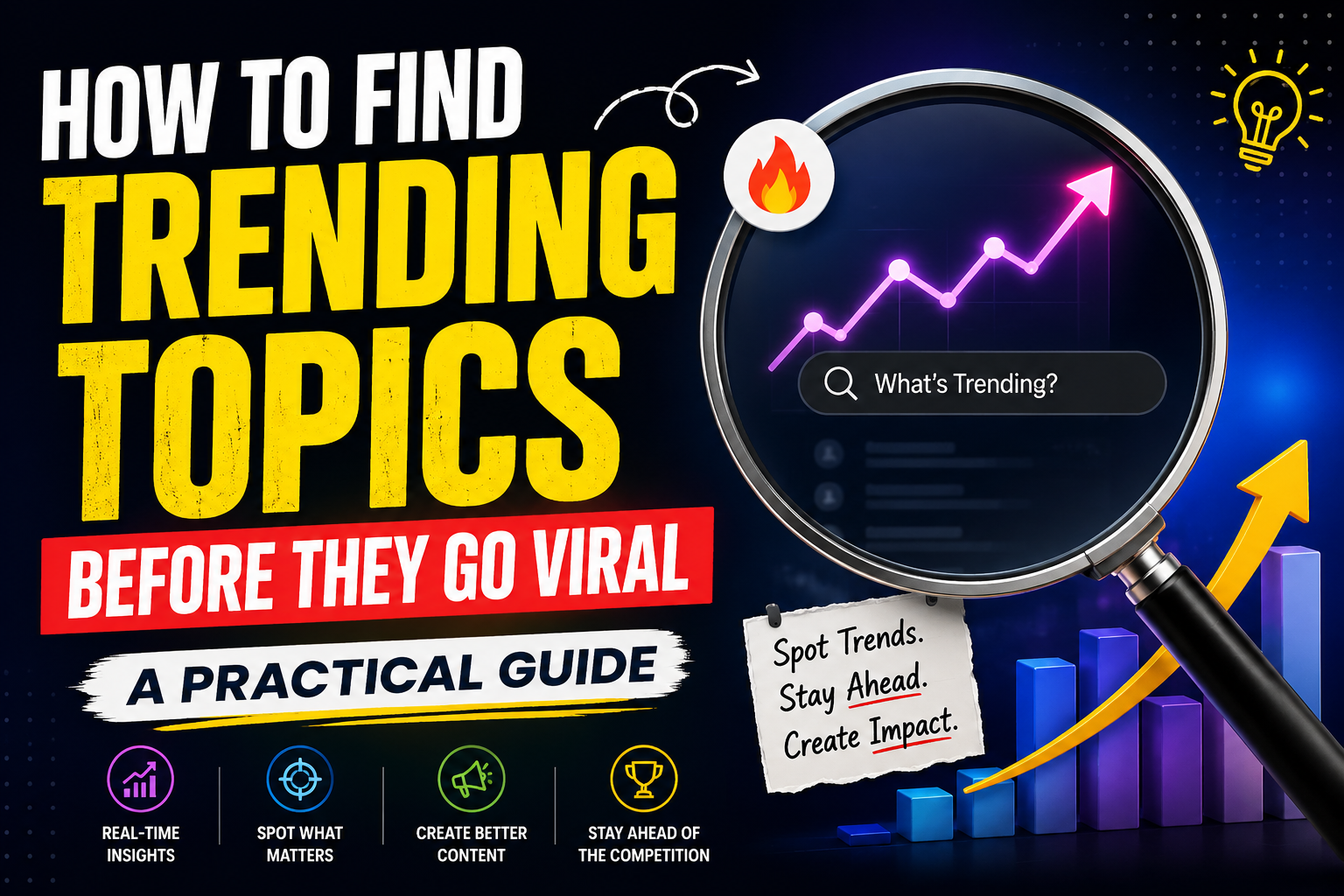
Hook
You know that sinking feeling when you post about a trend, and the comments are basically dead because everyone already moved on three days ago?
Yeah. Been there more times than I’d like to admit.
Here’s the truth nobody tells you when you’re starting out with content or running ads for a client. By the time a topic shows up on your Explore page or your Twitter trending list, it’s already too late. The smart marketers, the ones getting the real reach and the real leads, spotted it a week earlier How to Find Trending Topics
This guide is about closing that gap.
Table of Contents
ToggleIntroduction
Trending topics are basically conversations that are picking up speed faster than usual, whether that’s a hashtag, a news story, a meme format, or a shift in what people are searching for.
Why does catching them early matter so much? Because early content rides the wave. Late content just gets buried under it. If you run a business page, manage ads, or write content for clients (like I do), being early is often the difference between a post that gets shared and one that just sits there with 12 likes from your own team.
In this guide, you’ll learn where trends actually start, the tools that catch them before they blow up, how to tell a real trend from noise, and how to turn that early signal into content that actually performs, whether that’s a blog, a reel, or a Google ad.
Quick Answer How to Find Trending Topics
To spot trending topics before they go viral, track early signal sources like Google Trends’ rising queries, Reddit’s fast-growing subreddits, X’s niche hashtags, and TikTok’s Discover page daily. Look for topics with low competition but rising search volume or engagement. Act within 24 to 72 hours, since most trends peak and fade within a week or two.
What Is a Trending Topic (Really)?
A trending topic is any subject, keyword, hashtag, or format that’s seeing a sudden and noticeable jump in attention compared to its usual baseline. That’s the textbook definition anyway.
In practice, it’s messier than that. Some trends build slowly over a few weeks (like a growing interest in AI tools for small businesses). Others explode overnight because of a single viral video or a celebrity moment.
Real example. A couple of months back, one of the hair studio clients I work with saw “glass hair” searches spike out of nowhere in Hyderabad. We caught it early through Google Trends, put together a quick reel and a blog post around it within two days, and that single piece of content brought in more organic traffic than the previous month’s entire blog output combined. That’s the power of catching something while it’s still rising, not after it’s already peaked.
Why Is It Important?
Getting ahead of a trend isn’t just about looking trendy. It has real business impact.
First, there’s the reach advantage. Algorithms on Instagram, YouTube, and even Google tend to push content tied to rising topics because the platform wants to ride the same wave you do. Early movers usually get more organic distribution simply because there’s less competing content fighting for the same eyeballs.
Second, it builds authority. When you’re consistently one of the first voices talking about something relevant to your industry, people start seeing you as someone who’s actually paying attention, not just copying what everyone else posted last week.
Third, and this is the one clients care about most, it drives conversions. A well timed blog post or ad tied to a genuine spike in interest often converts better because people are actively searching for answers right then. You’re not creating demand from nothing. You’re meeting demand that already exists.
The Complete Step-by-Step Process
Step 1: Set Up Your Early Warning Systems
What It Means This is about building a small daily habit of checking the places where trends are born, not where they end up after everyone’s already talking about them.
Why It Matters Most people only discover a trend once it hits mainstream feeds. By then, thousands of creators and brands have already published content on it. Your post gets lost in the flood.
How To Do It Bookmark and check these daily, or every other day at minimum.
Google Trends, specifically the “Trending Now” and rising queries sections for your country
Reddit’s r/all and niche subreddits related to your industry
X (Twitter) trending tab, filtered to your location
TikTok’s Discover page and sound trends
Exploding Topics, a tool built specifically for catching early rising searches
Answer The Public, for questions people are just starting to ask
Example I keep three tabs open every morning before checking client dashboards. Google Trends, Reddit, and Exploding Topics. Takes about ten minutes and it’s saved me from missing at least a dozen good content opportunities this year alone.
Pro Tip Set Google Alerts for two or three keywords tied to your niche. It’s old school, but it still works better than most people expect.
Step 2: Learn to Read the Signal, Not Just the Spike
What It Means Not every spike is a trend worth chasing. Some are one day wonders. Others have real staying power.
Why It Matters Jumping on every random spike wastes time and can actually hurt your brand if the topic turns out to be controversial or irrelevant to your audience.
How To Do It Look for these markers before committing resources.
Search volume rising steadily over 3 to 7 days, not just a single day jump
Multiple unrelated sources talking about it (news, social, forums) around the same time
Low to medium competition in your specific niche or location
Some logical connection to your industry or audience, even if it’s a stretch
Example When “AI generated ads” started trending in marketing circles, I noticed it building across LinkedIn, Reddit, and Google Trends over about five days before it hit mainstream marketing pages. That gave enough lead time to write a proper piece instead of a rushed one.
Pro Tip If a topic is trending only on one platform and nowhere else, treat it cautiously. Cross platform trends usually have more staying power.
Step 3: Move Fast, But Not Sloppy
What It Means Once you’ve confirmed something is genuinely rising, speed matters. But rushed, low quality content can actually damage credibility more than missing the trend entirely.
Why It Matters There’s a sweet spot, usually within the first 24 to 72 hours of a trend’s rise, where content performs best. Wait too long and you’re competing with hundreds of similar posts.
How To Do It Keep a content template ready (blog structure, reel script, ad copy frame) so you’re not starting from zero
Draft the core message first, polish later
Publish on your fastest channel first (usually social), then follow with a more detailed blog or long form piece
Repurpose the same core idea across formats instead of creating from scratch each time
Example For the hair studio “glass hair” trend, we posted a quick Instagram reel within four hours of confirming the spike, then followed up with a full blog post the next day once we had time to add proper detail and local SEO keywords.
Pro Tip Have a rough content calendar with two or three empty slots each week specifically reserved for trend based content. That way you’re not scrambling to rearrange your whole schedule.
Step 4: Localize and Personalize the Trend
What It Means A national or global trend rarely fits perfectly into a local business context. You need to bend it toward your audience.
Why It Matters Generic trend content competes against thousands of similar posts. Localized content competes against almost none.
How To Do It Add local context, city names, regional language touches, or nearby events
Tie the trend back to a specific problem your audience faces
Use local search terms alongside the trending keyword
Example Instead of just writing about a general hair care trend, we angled it specifically for Vizag and Hyderabad audiences, mentioning local weather and water quality issues that affect hair health. That local angle is what actually pulled in the search traffic, not the trend keyword by itself.
Pro Tip Even a small local reference (a nearby landmark, a regional festival, a common local complaint) can make generic trend content feel personally relevant.
Step 5: Track Performance and Build a Trend Library
What It Means Every trend you act on teaches you something about your audience’s behavior. Don’t waste that data.
Why It Matters Over time, you’ll start recognizing patterns specific to your niche, which topics tend to work for your audience and which ones fizzle out despite looking promising.
How To Do It Keep a simple spreadsheet logging trend name, date spotted, date published, and performance results
Note which sources first alerted you to each trend
Review monthly to spot recurring patterns
Example After a year of tracking, I noticed most trends relevant to our hair studio clients originate on Reddit beauty subreddits about a week before hitting Instagram Reels in India. That single insight changed where I check first every morning.
Pro Tip Revisit old trend content every few months. Some trends cycle back, and having a ready made piece to update and republish saves a ton of time.
Common Mistakes People Make
Mistake: Chasing every single trend that appears
Impact: Spreads your content team thin and dilutes your brand voice, since you end up talking about things with zero connection to your actual business.
Solution: Filter trends through a simple relevance test before committing. If you can’t draw a genuine line to your audience within thirty seconds, skip it.
Mistake: Waiting for confirmation from big accounts before posting
Impact: By the time a major influencer or brand posts about something, the early advantage is gone.
Solution: Trust your own research tools. If Google Trends and two other sources show rising interest, that’s usually enough confirmation to act.
Mistake: Copying trend content word for word from competitors
Impact: Search engines and audiences both notice repetitive, unoriginal content, which hurts both SEO ranking and brand trust.
Solution: Use the trend as a starting point, then add your own data, local angle, or personal experience to make it genuinely different.
Mistake: Ignoring platform specific trend behavior
Impact: A trend that’s hot on TikTok might barely register on LinkedIn, so publishing the same content everywhere often flops on at least one platform.
Solution: Adjust tone, format, and even the angle of the trend based on where you’re publishing.
Best Practices
- Check your trend sources at the same time every day so it becomes a habit, not an afterthought
- Keep a ready to go content template for quick turnaround
- Always add a local or personal angle before publishing
- Track results so you learn what actually works for your specific audience
- Don’t force a trend that doesn’t genuinely fit your brand, audience will notice
Tools and Resources
| Tool | Best For | Cost | Speed of Signal |
|---|---|---|---|
| Google Trends | Search volume and rising queries | Free | Fast |
| Exploding Topics | Early stage trend discovery | Free and paid tiers | Very fast |
| Niche community discussions before mainstream | Free | Very fast | |
| Answer The Public | Emerging questions and search intent | Free and paid tiers | Medium |
| BuzzSumo | Content performance and trending topics by industry | Paid | Medium |
| TikTok Discover | Format and sound trends | Free | Fast |
Real life example
Situation
A local hair studio client wanted more organic reach without increasing ad spend, since the budget was already tight that quarter.
Challenge
Their previous content strategy relied on posting about trends only after seeing them everywhere else, which meant they were always a week or two behind competitors.
Action
We set up a simple daily trend check across Google Trends and Reddit, specifically filtered for beauty and hair care topics relevant to South Indian audiences. When we spotted the “glass hair” search spike building over three days, we created a quick reel and a detailed blog post with local SEO keywords within 48 hours.
Result
That single piece of trend based content outperformed the studio’s average monthly organic reach by over three times, and it brought in several new client inquiries directly traced back to that blog post through Google Analytics.
Expert Tips
Build relationships with a few niche forums or communities relevant to your industry, not just for research but for genuine conversation. Trends often surface in casual discussion long before any tool picks them up.
Don’t only track topics. Track formats too. Sometimes it’s not the subject that’s trending, it’s the way people are presenting it, like a specific meme style, video transition, or storytelling format.
Keep a swipe file of trend based content that performed well for you, even from unrelated niches. The underlying structure of why something worked often transfers across industries.
Frequently Asked Questions
What's the best free tool to find trending topics early?
Google Trends is usually the best starting point since it’s free and shows rising queries by region. Pairing it with Reddit gives you an even earlier signal since discussions often start there before showing up in search data.
How early can you realistically catch a trend before it goes viral?
With consistent daily monitoring, most trends can be spotted 3 to 10 days before they hit mainstream visibility, though viral moments tied to sudden news events are much harder to predict in advance.
Do trending topics work the same way for small local businesses as big brands?
Not exactly. Small local businesses benefit more from localizing a broader trend rather than trying to compete on the trend itself, since local search intent combined with trending interest often converts better than generic national content.
How do I know if a trend is fake or manipulated engagement?
Check if the spike is happening across multiple unrelated platforms and sources. If it’s isolated to one account or one platform with unusually high engagement compared to normal patterns, it might be artificially boosted rather than organic.
Should every business jump on every trending topic?
No. Only pursue trends that have a genuine, even if slightly creative, connection to your industry or audience. Forcing unrelated trends usually reads as inauthentic and can hurt brand trust.
What's the ideal time window to publish trend based content?
Generally within 24 to 72 hours of confirming a genuine rising trend, since most trends peak within one to two weeks and early content gets the most organic algorithmic support.
Can trending topics help with SEO long term, or is it only short term traffic?
Both, actually. Short term you get a traffic spike, but if the content is well written and genuinely useful, it can continue ranking for related long tail searches long after the original trend fades.
How do I find trending topics specific to my city or region?
Filter Google Trends by your specific location, follow local news outlets and regional social media pages, and check location based hashtags on Instagram and X for early regional signals.
What's the biggest mistake businesses make with trend based content?
Publishing too late, after the trend has already peaked, or forcing a trend connection so weak that audiences see straight through it as a cheap marketing attempt.
Is it worth paying for trend tracking tools, or are free tools enough?
For most small businesses and solo marketers, free tools like Google Trends and Reddit are genuinely enough. Paid tools like BuzzSumo or Exploding Topics’ premium tier become worthwhile once you’re managing multiple accounts or niches and need faster, more automated alerts.
Key Takeaways
- Trends are born on platforms like Reddit and niche communities before they hit mainstream feeds
- Check your trend sources daily, ten minutes is often enough
- Confirm a trend across multiple sources before committing resources to it
- Speed matters, but rushed low quality content can hurt more than help
- Always localize or personalize a trend before publishing
- Track your results so you build a personal playbook of what works for your specific audience
Conclusion
Catching trends before they go viral isn’t about luck or having some secret insider tool. It’s about building a simple daily habit, learning to filter real signals from noise, and moving quickly once you’ve confirmed something is genuinely rising.
The businesses and creators who consistently win with trend based content aren’t smarter than everyone else. They’re just paying attention a little earlier, and acting a little faster, than the crowd.
Your Next Step
Start small. Pick two or three sources from this guide, check them tomorrow morning, and see what you find. Even one well timed piece of content built around a genuine early trend can outperform months of generic posting, and that’s worth the ten minutes it takes to look.
[…] AI Overviews Are Expanding Fast. Here’s What That Actually Means For Your SEO In 2026 How to Find Trending Topics Before They Go Viral (A Practical Guide) Meta Ads Creative Strategy: Why More Ads Won’t Beat Better Creative Diversity 8 Content […]
[…] AI Overviews Are Expanding Fast. Here’s What That Actually Means For Your SEO In 2026 How to Find Trending Topics Before They Go Viral (A Practical Guide) Meta Ads Creative Strategy: Why More Ads Won’t Beat Better Creative Diversity […]
[…] AI Overviews Are Expanding Fast. Here’s What That Actually Means For Your SEO In 2026 How to Find Trending Topics Before They Go Viral (A Practical Guide) Marketing […]