

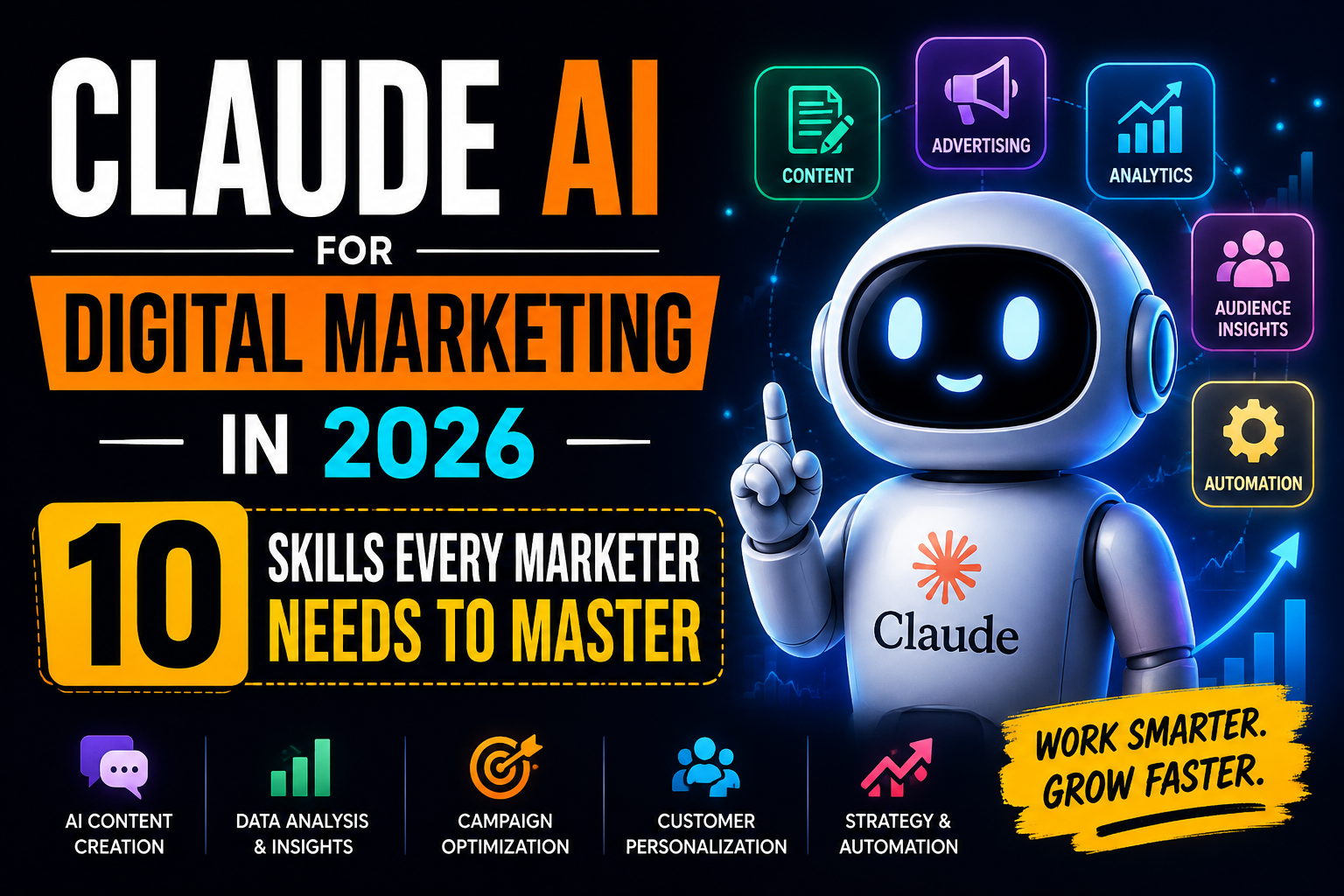
The wake up call nobody sent you
Here is something I noticed while auditing campaigns for clients this year. The marketers still writing every ad copy line by hand, still building reports manually at 11pm, they are not losing to bigger agencies anymore. They are losing to smaller teams that figured out how to work with AI tools like Claude instead of around them.
I run a digital marketing agency, and I will be honest, two years ago I was skeptical too. AI generated content felt stiff. It read like a robot trying to sound friendly. But Claude changed that equation for a lot of us who actually do this work daily, not just talk about it on LinkedIn.
This post is not a hype piece. It is a practical rundown of the ten Claude AI skills that are actually moving the needle for marketers in 2026, based on what I have seen work and what has flopped.
Table of Contents
ToggleQuick Answer Claude AI for Digital Marketing
Claude AI helps marketers in 2026 by speeding up content creation, campaign analysis, SEO research, ad copywriting, and client reporting while keeping the human judgment that AI alone cannot replace. The marketers winning right now are the ones using Claude as a research and drafting partner, then adding their own strategy and voice on top.
What Is Claude AI, In Plain Terms
Claude is an AI assistant built by Anthropic. Think of it less like a chatbot and more like a very well read colleague who never gets tired, never forgets what you told it earlier in the conversation, and can read through a hundred page document in seconds.
For marketers, that translates into something specific. You are not just asking it to write. You are handing it your client’s brand voice, past campaign data, competitor research, and asking it to think alongside you.
A real example. Last quarter I was building a Meta Ads audit for a client and instead of manually cross referencing every metric against benchmarks, I fed the raw numbers into Claude and asked it to flag anomalies. It caught a targeting overlap issue between two ad sets that had been quietly wasting spend for weeks. That is not magic, that is just pattern recognition done fast.
Why This Matters More In 2026 Than It Did Before
Search itself has changed. People are not only typing queries into Google anymore, they are asking AI Overviews, ChatGPT, and Gemini directly. If your content strategy still treats search the old way, you are already behind.
Clients also expect faster turnarounds now. A proposal that used to take three days now needs to land in one, because their competitors are already doing that with AI assistance. Marketers who master these skills are not replacing their expertise, they are multiplying it.
The 10 Skills Every Marketer Needs to Master
1. Prompting Like You Mean It
What It Means Prompting is basically how you talk to Claude to get useful output instead of generic mush. It is a skill, not luck.
Why It Matters Vague prompts get vague answers. A prompt with context, tone, and a clear goal gets you something you can actually publish with minor edits.
How To Do It Give Claude the audience, the goal, examples of tone you like, and any constraints upfront. Do not assume it knows your brand unless you tell it.
Example Instead of “write an Instagram caption for a hair salon,” try “write a casual, slightly playful Instagram caption for a hair studio in Vizag targeting women aged 20 to 35 who want a keratin treatment, keep it under 40 words, no emojis.”
Pro Tip Save your best prompts somewhere. Build a personal prompt library specific to your niche. It saves hours over a month.
2. Turning Client Briefs Into Content Calendars
What It Means Feeding Claude a rough client brief and having it structure a month of content ideas, themes, and formats.
Why It Matters Content calendars used to eat a full afternoon. Now that groundwork can happen in twenty minutes, leaving more time for the actual creative work.
How To Do It Share the client’s goals, past performing content, seasonal events relevant to their business, and ask Claude to draft a calendar with content pillars, not just random post ideas.
Example For a hair studio client, I asked Claude to build a 30 day calendar mixing educational posts about hair care, behind the scenes reels, and festival specific promotions. It grouped everything into pillars automatically, which made the whole thing easier to present to the client.
Pro Tip Always review the calendar against actual local events and holidays yourself. AI sometimes misses regional context you know better than it does.
3. Writing Ad Copy That Does Not Sound Like Ad Copy
What It Means Using Claude to draft Google Ads and Meta Ads copy that reads like a person talking, not a sales pitch shouting.
Why It Matters People have gotten very good at ignoring anything that smells like an ad. Copy that sounds human gets read, and read copy gets clicked.
How To Do It Ask for multiple variations with different emotional angles, pain point led, curiosity led, offer led, then pick the strongest lines and combine them yourself.
Example For a local service business, instead of “Best Hair Studio in Hyderabad, Book Now,” Claude helped draft “Tired of salon visits that never match the photo you showed them? Come see why our regulars stopped shopping around.”
Pro Tip Always run the output through your own read aloud test. If it sounds strange coming out of your mouth, it needs editing.
4. Speeding Up SEO Research Without Losing Accuracy
What It Means Using Claude to brainstorm keyword clusters, content gaps, and search intent mapping before you commit to a content plan.
Why It Matters SEO in 2026 is not just about ranking on Google anymore. It is about showing up in AI Overviews and being cited by tools like Perplexity, which means your content needs stronger topical depth than before.
How To Do It Give Claude your target keyword, ask it to map out related subtopics, questions people actually ask, and gaps competitors have not covered well.
Example Working on a services page for website design in Hyderabad, Claude helped surface long tail questions real users search for, things I would not have thought to include on my own, which rounded out the page’s topical coverage.
Pro Tip Always verify search volume and competition data through an actual SEO tool afterward. Claude is great at ideation, not a replacement for real search data.
5. Building Client Reports People Actually Read
What It Means Turning raw analytics numbers into a report that tells a story, instead of a spreadsheet dump nobody opens.
Why It Matters Clients do not care about impressions and CTR in isolation. They care what it means for their business. Reports that translate data into plain language keep clients longer.
How To Do It Paste your GA4 or Meta Ads data into Claude and ask it to summarize performance in plain language, highlight wins, and flag concerns with suggested next steps.
Example For a client review, instead of listing forty metrics, the report opened with “your website traffic grew 22 percent this month, mostly from people searching for hair treatments near them, which means your local SEO work is paying off.”
Pro Tip Keep the executive summary to three sentences max. Clients skim before they read.
6. Repurposing One Piece Of Content Into Five
What It Means Taking a single blog post or video script and reshaping it into different formats for different platforms.
Why It Matters Creating from scratch every time burns you out fast. Repurposing smartly means one good idea works harder across channels.
How To Do It Share the original content with Claude and ask for platform specific rewrites, a LinkedIn version, an Instagram carousel outline, a short form video script, each respecting that platform’s tone.
Example A blog post about hair care myths became an Instagram carousel with five myth versus fact slides, and a short reel script busting the top myth in fifteen seconds.
Pro Tip Do not just copy paste the same sentence structure across platforms. Ask Claude specifically to adjust tone for each one, LinkedIn is not Instagram.
7. Auditing Campaigns Like A Second Pair Of Eyes
What It Means Using Claude to review ad account structures, targeting overlaps, and budget allocation before you present recommendations.
Why It Matters It is easy to miss something when you are deep in a client’s account daily. A fresh analytical pass catches things fatigue hides.
How To Do It Export campaign data and describe the account structure, then ask Claude to identify inefficiencies, overlapping audiences, or underperforming ad sets worth pausing.
Example During a Meta Ads audit, this process flagged that two ad sets were targeting nearly identical audiences and competing against each other in the auction, which was quietly inflating costs.
Pro Tip Always cross check flagged issues against the actual ads manager before making changes. Numbers can look off for reasons AI cannot see, like a recent budget change.
8. Writing In A Local Voice, Not A Generic One
What It Means Training your prompts to produce content that actually sounds like it is from your region, not generic global marketing speak.
Why It Matters Local businesses connect better with local language and cultural references. Generic AI output tends to default to a flat, western tone unless you push back on it.
How To Do It Explicitly tell Claude the regional context, local slang if relevant, and give it examples of the tone you want. For Telugu speaking audiences, mixing in natural Tenglish phrasing where appropriate makes ad scripts land better.
Example A voiceover script for a Vizag hair studio worked far better once it included natural Tenglish phrasing instead of pure English, because that is how the actual audience speaks day to day.
Pro Tip Read the output out loud in the accent your audience uses. If it feels stiff, rework the phrasing yourself, do not just accept the first draft.
9. Building Interactive Tools That Set You Apart
What It Means Using Claude to build small interactive assets, calculators, quizzes, checklists, that clients and prospects can actually use.
Why It Matters Static PDFs get ignored. An interactive Meta Ads audit checklist or a pricing calculator gets shared and remembered, and it positions you as more capable than agencies handing over plain documents.
How To Do It Describe the tool you want, the inputs a user provides, and what output or recommendation it should give back, then have Claude build it as a simple interactive page.
Example An interactive audit checklist built this way became something clients kept coming back to reference, instead of a document that got buried in their downloads folder within a day.
Pro Tip Keep the tool simple. One clear function done well beats a cluttered tool trying to do everything.
10. Knowing When To Ignore The AI Completely
What It Means Recognizing the moments where your judgment, relationship knowledge, or gut feeling should override whatever Claude suggests.
Why It Matters This is the skill that separates marketers who use AI well from marketers who become dependent on it. Clients hire you for judgment, not for how well you can copy paste.
How To Do It Treat every AI output as a first draft or a second opinion, never the final word, especially on strategy calls involving budget, brand risk, or sensitive client relationships.
Example I have had Claude suggest a campaign angle that was technically sound but wrong for a client’s brand reputation in their local market. Knowing the client relationship well enough to catch that is not something any AI tool replaces.
Pro Tip If something feels off even though the AI reasoning sounds solid, trust the feeling and dig deeper before acting on it.
Common Mistakes Marketers Make With Claude
Mistake: Copy pasting AI output straight to clients Impact: Content feels generic, and sharp clients notice patterns across agencies using the same tools the same way. Solution: Always edit for brand voice and add a specific detail only you would know about that client.
Mistake: Treating Claude as a search engine for facts Impact: You risk publishing outdated or slightly wrong information, especially around pricing or fast changing platform features. Solution: Verify any specific numbers, dates, or claims independently before publishing.
Mistake: Never giving context about the brand Impact: Output ends up sounding like it could belong to any business, anywhere. Solution: Build a short brand brief you paste in at the start of every session, tone, audience, past wins, things to avoid.
Mistake: Using the same prompt structure for every task Impact: Content across different clients starts to sound suspiciously similar. Solution: Vary your prompting style and always request multiple angles before choosing one.
Best Practices Worth Repeating
Keep a swipe file of your best AI assisted content and the exact prompts that produced it. Review AI output the same way you would review a junior copywriter’s first draft, with a critical eye, not blind trust. Combine AI research with actual client conversations, the two together beat either alone. Set aside time weekly to test one new way of using Claude in your workflow, the tool improves and so should your approach.
Tools And Resources Comparison
| Tool | Best For | Limitation |
|---|---|---|
| Claude AI | Drafting, analysis, brainstorming, reports | Needs human review for accuracy and brand fit |
| Google Analytics 4 | Traffic and behavior data | Requires interpretation, does not tell the story alone |
| Meta Ads Manager | Campaign execution and targeting | Overwhelming raw data without a summarization layer |
| SEO tools like Ahrefs or Semrush | Keyword volume and competition data | Does not generate content strategy on its own |
Real Life Example
Situation A client running a hair studio in Vizag was seeing decent ad clicks but poor conversion into actual bookings.
Challenge The ad copy was performing on engagement metrics but not translating into the phone calls and bookings that actually mattered to the business.
Action Using Claude, several ad copy variations were drafted around a specific pain point, salon visits that never match the photo shown beforehand, rather than generic promotional lines. The copy was refined further based on how a real customer in that market would actually phrase that frustration.
Result The revised campaign saw a noticeable lift in booking inquiries within the following weeks, simply because the message finally spoke to something the audience actually felt.
Expert Tips For Going Further
Build a reusable brand voice document for each client and paste it into every Claude session for that account. This alone improves consistency more than any single prompt trick. Use Claude to role play as a skeptical customer and poke holes in your ad copy before it goes live, this catches weak points early. When stuck on a creative block, ask Claude for ten wildly different angles on the same idea, most will be unusable, but one or two often spark the actual direction you needed.
Frequently Asked Questions
Is Claude AI better than ChatGPT for marketing work?
Both have strengths. Claude tends to handle longer documents and nuanced brand voice instructions well, which suits detailed campaign work and client reports.
Can Claude replace a copywriter?
Not really, not for work that depends on brand judgment, client relationships, and local cultural nuance. It works best as a fast drafting partner, not a replacement for the person making final calls.
How do I make Claude sound less robotic?
Give it specific examples of tone you want, ask it to avoid stiff phrases, and always edit the output yourself before publishing anything.
Is AI generated content bad for SEO in 2026?
Content quality matters more than who or what drafted it. Thin, generic AI content performs poorly, but well edited, genuinely helpful content does fine regardless of how the first draft was created.
What is the difference between SEO and AEO?
SEO focuses on ranking in traditional search results. AEO, Answer Engine Optimization, focuses on getting your content cited directly inside AI generated answers from tools like AI Overviews, ChatGPT, and Perplexity.
Can small agencies really compete using AI tools like Claude?
Yes, and in many cases this is exactly how smaller teams are closing the gap with bigger agencies, by moving faster on research and drafting without needing a large team to do it.
How much editing does AI content typically need?
It varies, but expect to spend real time reviewing for brand voice, factual accuracy, and local relevance. Treat the first output as a draft, not a finished piece.
Does Claude know about the latest Google algorithm updates?
Not automatically. Always verify recent SEO changes through current sources rather than relying on what an AI assistant already knows.
What is the best way to start using Claude for marketing if I have never tried it?
Start small. Pick one repetitive task, like writing first drafts of social captions, and build from there once you see what works for your workflow.
Can Claude help with local language content like Tenglish?
Yes, if you give it clear examples and explicitly ask for that mix. It picks up regional phrasing well when guided, though the output still benefits from a native speaker’s final pass.
Key Takeaways
- Claude works best as a drafting and research partner, not a replacement for marketing judgment
- Prompting well, with context and examples, makes the biggest difference in output quality
- Local voice and brand specific detail separate content that connects from content that gets ignored
- AI assisted reports and audits save real hours but still need human verification
- The marketers pulling ahead in 2026 are combining speed from AI with judgment that only comes from actual experience
Conclusion
None of this is about handing your job over to a machine. It is about not wasting hours on the parts of marketing that do not need a human touch, so you have more energy left for the parts that do, understanding your client’s business, reading a room, knowing what will actually land with a real audience.
The marketers who figure this balance out first are the ones who will look back in a year and wonder how they ever worked without it.
Ready To Work Smarter, Not Just Faster?
If you are still doing every part of your marketing process manually, start with just one of these ten skills this week. Pick the one that eats the most of your time right now, and see what changes when you bring Claude into that part of your workflow.
[…] Ads for Beginners: 10 Things You Must Know Before You Start Advertising in 2026 Claude AI for Digital Marketing in 2026: 10 Skills Every Marketer Needs to Master Why Is Your Website Losing Organic Traffic Even Though Rankings Haven’t Dropped Google […]
[…] for 2026 Meta Ads for Beginners: 10 Things You Must Know Before You Start Advertising in 2026 Claude AI for Digital Marketing in 2026: 10 Skills Every Marketer Needs to Master Why Is Your Website Losing Organic Traffic Even Though Rankings Haven’t Dropped Google […]