
The Problem Every Agency Owner Knows Too Well
It’s 11 PM and you’re still tweaking ad copy for a client who wanted “just one small change” three hours ago. Your content calendar for next month is half empty. A client just asked why their GA4 numbers dropped and you haven’t even looked yet.
If you run a marketing agency, this isn’t a hypothetical. This is Tuesday Best AI Marketing Tools for Agencies in 2026
The agencies surviving this grind aren’t the ones with the biggest teams anymore. They’re the ones who figured out which AI tools actually save time versus which ones just sound impressive on a sales call. There’s a real gap between the two, and most “top 10 AI tools” lists online don’t tell you which side a tool falls on.
This one will.
Table of Contents
ToggleWhat This Article Covers
Best AI Marketing Tools for Agencies We’re going through the AI marketing tools that agencies are genuinely using day to day, not the ones trending on a LinkedIn carousel for two weeks and then forgotten. You’ll see tools for content writing, ad management, analytics, social media, client reporting, and even voice and video work, because that’s where agency work actually happens.
By the end, you’ll know what to plug into your workflow this month, not someday.
Quick Answer
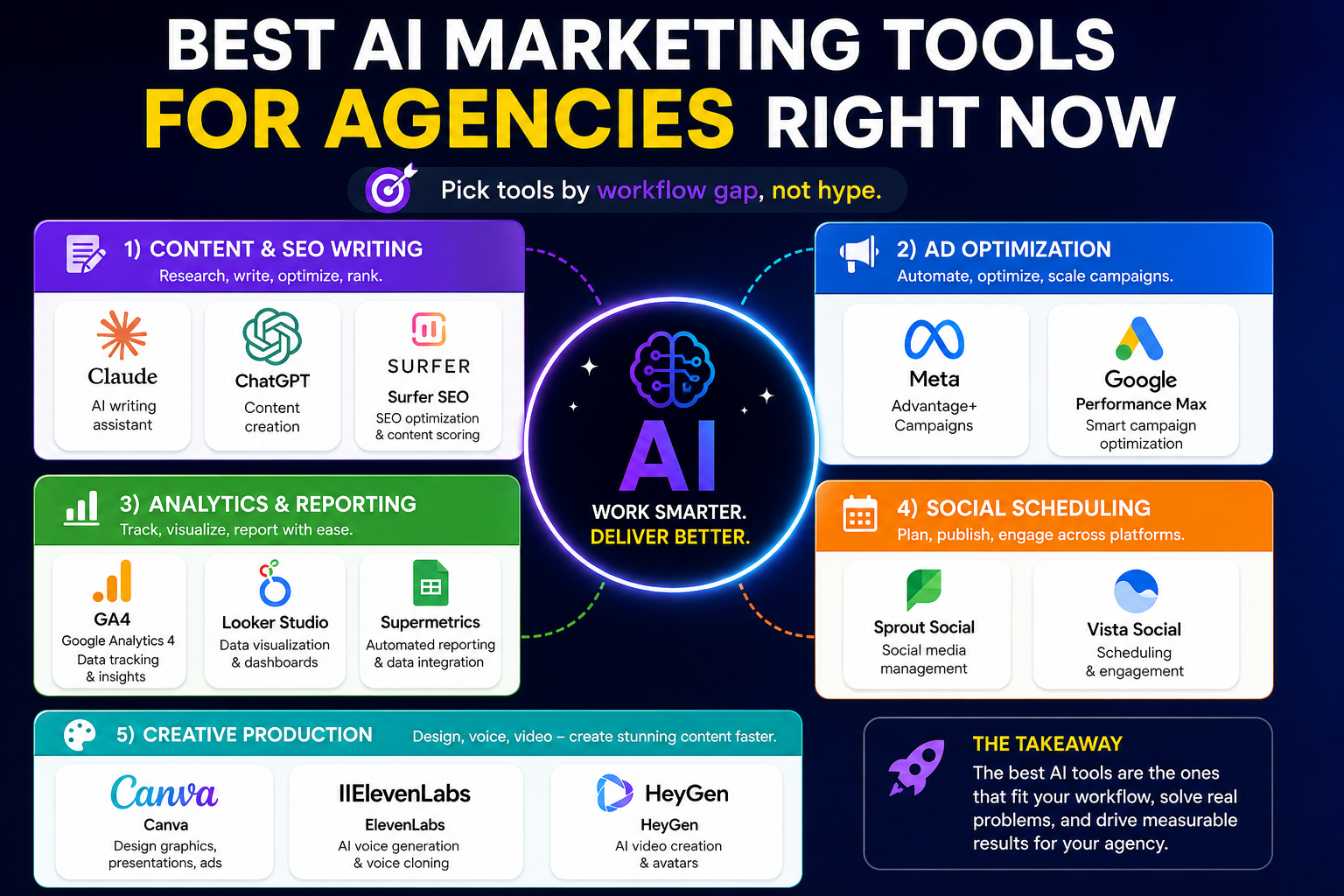
The best AI marketing tools for agencies right now cover five areas: content and SEO writing (Claude, ChatGPT, Surfer SEO), ad optimization (Meta’s Advantage+ campaigns, Google’s Performance Max), analytics and reporting (GA4, Looker Studio, Supermetrics), social scheduling (Sprout Social, Vista Social), and creative production (Canva, ElevenLabs, HeyGen). Pick tools by workflow gap, not hype.
What Are AI Marketing Tools, Really?
AI marketing tools are software built to handle tasks that used to need a human sitting there typing, clicking, or thinking through every step. Writing a blog draft, predicting which ad creative will perform, pulling a client report together, generating a voiceover in Telugu for a Reel script. All of that now has an AI layer somewhere in the process.
Here’s a simple example. A few months back, one of our hair studio clients needed five Instagram Reel scripts by the next morning. Writing those from scratch, including the Tenglish hooks and captions, used to take a couple of hours. With the right AI workflow, that dropped to about 30 minutes of actual writing and editing time. The tool didn’t replace the thinking. It removed the blank page problem.
That’s the honest definition. AI tools don’t run your agency for you. They remove the parts that drain your time without adding much value.
Why This Actually Matters for Agencies
Best AI Marketing Tools for Agencies Clients in 2026 expect agency speed without agency sized budgets. A real estate client in Hyderabad wants daily posts, weekly blogs, and monthly ad optimization, but their budget hasn’t grown since last year. That math only works if your team isn’t spending hours on tasks AI can do in minutes.
There’s also the competition angle. Other agencies in your city are already using these tools. If you’re still manually building every report or writing every caption from a blank doc, you’re working harder for the same output someone else is producing faster.
And honestly, the agencies that burn out fastest are the ones where every team member is doing repetitive grunt work instead of strategy. AI tools, used right, free people up to actually think about the client’s business instead of formatting another spreadsheet.
The Complete Guide to AI Marketing Tools for Agencies
Content and SEO Writing Tools
What it means
These are AI tools that help draft blog posts, ad copy, website content, and SEO optimized text faster than writing from scratch.
Why it matters
Content is the backbone of most agency retainers. Blogs, landing pages, meta descriptions, social captions. If your team spends six hours writing one 2,500 word blog, you’re losing money on every content heavy client.
How to do it
Use AI writing assistants for the first draft and structure, then have someone on your team rewrite it for tone, local references, and anything the AI got generic. Never publish raw AI output. Google’s own guidance has been clear that helpful, people first content wins, and unedited AI text rarely passes that bar.
Example
For SEO blogs targeting Hyderabad and Vizag keywords, an AI draft gives the skeleton: headings, keyword placement, FAQ structure. Then a human pass adds local pricing in rupees, neighborhood names, and the kind of detail only someone who actually knows the market would include.
Pro tip
Feed the AI tool a real client brief, not a vague prompt. “Write about hair transplants” gives generic output. “Write for a 35 year old man in Kukatpally worried about hair loss after stress, who’s never heard of non surgical options” gives something usable.
Ad Campaign Optimization Tools
What it means
AI driven systems inside platforms like Meta and Google that automatically adjust targeting, bidding, and creative rotation based on real time performance data.
Why it matters
Manual ad optimization used to mean checking campaigns every few hours and manually shifting budget. Now the platforms themselves often do this better than a person can, because they’re reading thousands of signals at once.
How to do it
Turn on Meta’s Advantage+ campaigns or Google’s Performance Max for clients with enough budget and conversion data to make automation worthwhile (usually clients running at least a few thousand rupees a day in spend). Feed it strong creative variety, since the AI optimizes what you give it, not what you wish you’d given it.
Example
A clinic client running Meta ads saw cost per lead drop noticeably after switching from manual campaign structure to Advantage+, mainly because the system tested creative combinations faster than any human could manually A/B test.
Pro tip
Automation doesn’t mean hands off. Check in weekly, and if performance plateaus, it’s usually the creative that needs refreshing, not the targeting.
Analytics and Reporting Tools
What it means
Tools that pull data from GA4, ad platforms, and CRMs, then help interpret what’s actually happening, not just dump numbers on a page.
Why it matters
Clients don’t want raw numbers. They want to know if their money is working. A report full of charts with no insight is just decoration.
How to do it
Use GA4 as your base data source, then pull it into Looker Studio or Supermetrics for cleaner client facing dashboards. Some agencies now ask AI tools to draft the written summary section of reports, explaining trends in plain language before a human reviews it.
Example
Instead of sending a client a screenshot of traffic numbers, a short written summary like “organic traffic grew 18 percent this month, mostly from blog visitors searching for hair patch pricing in Hyderabad” tells them something they can actually act on.
Pro tip
Automate the data pulling, not the judgment. The numbers are easy to gather. The “so what does this mean for your business” part still needs a human who understands the client.
Social Media Scheduling and Content Tools
What it means
Platforms that help plan, schedule, and sometimes generate social media content across Instagram, Facebook, and other channels.
Why it matters
Managing five or six client accounts manually, posting one by one, checking each platform separately, eats an entire day a week that could go toward strategy or new client work.
How to do it
Use a scheduler like Sprout Social or Vista Social to batch a month of content at once. Pair it with Canva’s AI design features for quick visual variations, and tools like ElevenLabs for AI voiceovers when a Reel script needs a Telugu or Tenglish voice track without booking a voice artist every time.
Example
A content calendar for a hair studio client used to take a full day to plan, write, and schedule. With templated AI assisted captions and batch scheduling, that same calendar now takes a few focused hours.
Pro tip
Don’t let every caption sound the same just because AI generated the first draft. Read them out loud before scheduling. If it sounds like a robot wrote it, it probably did, and your client’s audience will notice.
Client Communication and Project Tools
What it means
AI features inside CRMs and project management tools that draft emails, summarize meeting notes, or organize client requests.
Why it matters
Agency owners lose hours to admin work that has nothing to do with actual marketing. Drafting the same kind of client update email every week, summarizing a 45 minute call into action items, chasing approvals.
How to do it
Use AI note takers during client calls so nothing gets missed, and let AI draft routine status update emails that a human then personalizes before sending.
Example
After a strategy call with a real estate client, an AI summary turned 40 minutes of conversation into five clear action points in under a minute, instead of someone listening again to a recording later that night.
Pro tip
Always read the AI summary before sending anything to a client. AI tools occasionally misread tone or miss sarcasm, and that’s an easy way to send something embarrassing.
Common Mistakes Agencies Make With AI Tools
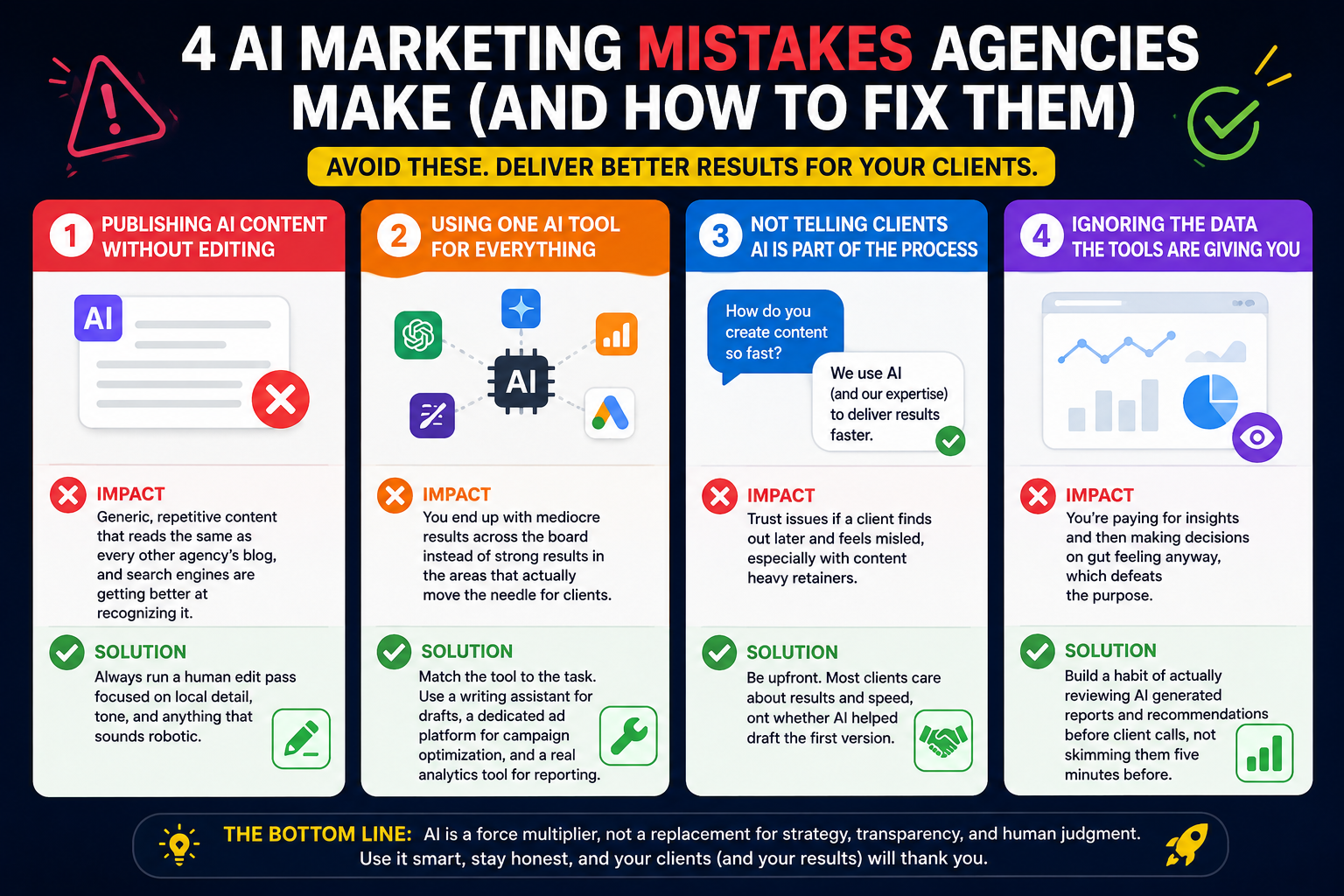
Mistake: Publishing AI content without editing. Impact: Generic, repetitive content that reads the same as every other agency’s blog, and search engines are getting better at recognizing it. Solution: Always run a human edit pass focused on local detail, tone, and anything that sounds robotic.
Mistake: Using one AI tool for everything. Impact: You end up with mediocre results across the board instead of strong results in the areas that actually move the needle for clients. Solution: Match the tool to the task. Use a writing assistant for drafts, a dedicated ad platform for campaign optimization, and a real analytics tool for reporting.
Mistake: Not telling clients AI is part of the process. Impact: Trust issues if a client finds out later and feels misled, especially with content heavy retainers. Solution: Be upfront. Most clients care about results and speed, not whether AI helped draft the first version.
Mistake: Ignoring the data the tools are giving you. Impact: You’re paying for insights and then making decisions on gut feeling anyway, which defeats the purpose. Solution: Build a habit of actually reviewing AI generated reports and recommendations before client calls, not skimming them five minutes before.
Best Practices for Using AI Tools in an Agency
Best AI Marketing Tools for Agencies Keep a human in the loop for anything client facing. AI drafts, humans finalize.
Build templates and prompts specific to your niche. A generic prompt gives generic output, but a prompt built around your actual client types (hair studios, clinics, real estate) gives you something close to final draft quality.
Track which tools actually save time versus which ones just feel productive. Some tools look impressive in a demo but add steps once you’re using them daily.
Train your whole team on the tools you commit to, not just the owner. Half adopted tools waste money.
Revisit your toolset every few months. This space moves fast, and what worked a year ago might have a better, cheaper alternative now.
Tools and Resources Comparison
Tool Category | Tool | Best For | Rough Starting Cost |
Writing and SEO | Claude or ChatGPT | Blog drafts, ad copy, outlines | Free tier available, paid plans typically under $25/month |
SEO research | Surfer SEO | Keyword and content optimization | Mid range monthly subscription |
Ad optimization | Meta Advantage+ | Automated ad targeting and bidding | Built into ad spend, no separate fee |
Ad optimization | Google Performance Max | Automated campaign management | Built into ad spend, no separate fee |
Analytics | GA4 plus Looker Studio | Client reporting dashboards | Free |
Social scheduling | Sprout Social or Vista Social | Multi account scheduling | Entry plans typically under $50/month |
Design | Canva | Quick visual content and templates | Free tier, paid plans affordable |
Voice and video | ElevenLabs, HeyGen | AI voiceovers and avatar videos | Pay per use or monthly credits |
Pricing changes often, so treat this as a starting point for research, not a final quote.
Real Life Example
Situation: A non surgical hair replacement client wanted weekly blog content, daily Instagram posts, and monthly performance reports, but their retainer didn’t justify hiring a dedicated content writer.
Challenge: The team was spending close to 15 hours a week just on content creation and reporting, leaving almost no time for actual strategy or campaign improvements.
Action: The workflow shifted to AI assisted blog drafting with heavy local editing, batch scheduled social content using templated prompts, and automated GA4 reporting pulled into a simple dashboard.
Result: Weekly time spent on content dropped to around 6 hours, and the freed-up time went into refining ad targeting, which led to a noticeable improvement in cost per lead within two months.
Expert Tips for Getting More Out of AI Tools
Best AI Marketing Tools for Agencies Write your prompts the way you’d brief a new junior team member. Vague instructions get vague output, whether it’s a human or an AI doing the work.
Save your best prompts somewhere your whole team can access, not just in your own head or one person’s notes app.
Use AI for the first draft of anything repetitive, but protect the strategic thinking for yourself and your senior team. That’s where the real client value lives.
Don’t chase every new AI tool that launches. Pick three or four that solve real bottlenecks and get genuinely good at using them before adding more to the stack.
Frequently Asked Questions
What are the best free AI marketing tools for small agencies?
ChatGPT’s free tier, Canva’s free plan, and GA4 are solid starting points that cost nothing and cover content drafting, design, and analytics.
Can AI tools fully replace a marketing team?
Best AI Marketing Tools for Agencies No. AI tools handle repetitive tasks well, but strategy, client relationships, and local market understanding still need real people behind them.
Which AI tool is best for writing SEO blog content?
Best AI Marketing Tools for Agencies Claude and ChatGPT both work well for first drafts, especially when paired with a tool like Surfer SEO for keyword structure and on page optimization guidance.
Is it okay to tell clients that AI helped create their content?
Yes, and most clients appreciate the transparency, as long as the final output is reviewed and refined by a real person on your team.
How much time can AI tools realistically save an agency?
Many agencies report cutting content and reporting time by 40 to 60 percent once workflows are properly set up, though the exact number depends on how well the tools are used.
Do AI ad tools like Performance Max actually outperform manual campaigns?
For accounts with enough conversion data, often yes, since the AI can process performance signals faster than manual optimization allows.
What's the biggest risk of relying too heavily on AI marketing tools?
Generic, repetitive output that fails to reflect the client’s actual brand voice or local market, which can hurt trust and SEO performance over time.
Are AI voiceover tools good enough for client facing video content?
Quality has improved a lot, and tools like ElevenLabs work well for many use cases, though Telugu and regional language nuance sometimes still needs a human touch or careful script adjustment.
How do I choose between competing AI tools in the same category?
Test the free trial on a real client task, not a generic demo prompt, and judge it on how much editing the output actually needs before it’s usable.
Should a one person agency invest in AI tools the same way a bigger agency does?
Yes, often more so, since a smaller team benefits even more from automating repetitive work and competing with larger agencies on output speed.
Key Takeaways
- AI tools save the most time on repetitive tasks like content drafts, scheduling, and reporting
- Strategy and client relationships still need real human judgment
- Match the tool to the specific task instead of relying on one tool for everything
- Always edit AI output for local relevance and brand voice before it reaches a client
- Review pricing regularly since the AI tools market shifts fast Best AI Marketing Tools for Agencies
Final Thoughts
The agencies pulling ahead right now aren’t necessarily the ones with the fanciest tool stack. They’re the ones who picked a handful of AI tools that solve real, specific bottlenecks and then actually trained their team to use them well.
Start small. Pick one workflow eating the most time this month, whether that’s content writing, reporting, or ad management, and bring in one AI tool to fix that specific gap. Get good at it before adding the next one. Best AI Marketing Tools for Agencies
Ready to Build an AI Powered Workflow for Your Agency?
Best AI Marketing Tools for Agencies If you’re still piecing this together manually, that’s hours you could be spending on client strategy instead. Start with one tool, one workflow, and build from there. The agencies that figure this out early are the ones winning client retainers later this year.